How EU Advanced Materials Will Power Europe’s Bold Industrial Future
EU advanced materials
How EU Advanced Materials Will Power Europe’s Bold Industrial Future
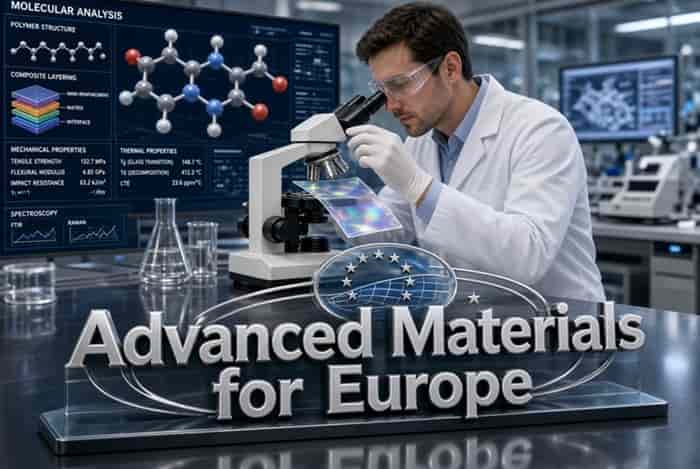
Europe has a long history of inventing world-changing science in its laboratories, only to watch other global superpowers scale and profit from those breakthroughs. On November 18, 2026, the European Commission moved decisively to break that pattern by unveiling its comprehensive Advanced Materials for Europe agenda. EU advanced materials
Presented by Commissioner for Startups, Research and Innovation Ekaterina Zaharieva alongside Commission President Ursula von der Leyen, the proposal for a Council Recommendation (COM(2026) 833) aims to establish the European Union as the undisputed global leader in inventing, producing, and deploying safer, more sustainable advanced materials by 2035.
Rather than treating materials science as a niche academic discipline, Brussels is placing EU advanced materials at the very center of its economic security, clean energy transition, and industrial competitiveness.
What Are Advanced Materials and Why Do They Matter Now?
Engineered at the atomic and molecular level, advanced materials are intentionally designed to deliver superior performance—making everyday and industrial products lighter, stronger, smarter, and vastly more energy-efficient.
Real-world applications highlighted in the Commission’s latest technical briefings include:
-
Clean Energy and Mobility: High-performance magnets manufactured without critical rare earths for wind turbines and electric vehicle motors.
-
Smart Construction: Nanoparticle coatings for smart glass windows that dynamically adjust their tint to slash building heating and cooling demands.
-
Aerospace and Defence: Ultra-lightweight, high-strength graphene composites that reduce fuel consumption and strengthen structural durability.
-
Healthcare and Computing: Biocompatible compounds for 3D-printed medical implants and next-generation semiconductor substrates powering quantum computing and artificial intelligence.
As Commissioner Zaharieva emphasized during the launch in Brussels, Europe’s clean energy transition currently relies too heavily on critical rare earths imported from third countries. Developing domestic, circular alternatives through EU advanced materials is therefore a direct matter of strategic autonomy. EU advanced materials
Europe’s Existing Industrial Footprint
Europe is not starting from scratch. According to new figures released by the European Commission alongside the proposal, the bloc already boasts a massive industrial base:
-
More than 15,000 companies actively operate within the European advanced materials value chain.
-
Approximately 1.5 million jobs across EU Member States are directly supported by the sector.
-
€2.3 billion in funding has already been mobilized under Horizon Europe (2021–2027), complemented by the Innovative Advanced Materials for Europe partnership and the European Advanced Materials Academy.
“Advanced materials will be at the heart of Europe’s next industrial age,” said Commission President Ursula von der Leyen. “With this initiative, we are helping Europe turn scientific excellence into industrial leadership, so that innovative materials created in Europe are also produced, scaled up and used in Europe.”
Three Benchmark Targets for 2035
To ensure the strategy delivers measurable economic impact rather than remaining an aspirational white paper, the Commission proposed three concrete benchmark targets for EU Member States to achieve by 2035:
-
A 20% increase in investment dedicated to advanced materials research and innovation across public and private channels.
-
A 20% expansion in EU-based startups and scaleups commercializing advanced materials technologies.
-
At least 20% of innovation projects reaching higher industrial deployment levels specifically focused on safer and more sustainable materials. EU advanced materials
Five Strategic Pillars for Action by 2030
Bridging the notorious “valley of death” between laboratory prototypes and mass manufacturing requires coordinated action across borders. The Commission is inviting Member States to align their national industrial policies around five core pillars by 2030:
-
Strategic R&I Targeting: Directing research and innovation capital toward high-impact sectors, including energy, mobility, electronics, construction, health, aerospace, and defence.
-
AI-Accelerated Discovery: Utilizing digitalization, computational modeling, and artificial intelligence to dramatically speed up molecular design, virtual hazard assessment, and material testing.
-
Faster Time-to-Market: Upgrading testing and qualification facilities while opening up cross-border access to shared research and technology infrastructures.
-
Demand-Side Scale-Up: Stimulating early market adoption through strategic industrial projects, clearer regulatory pathways, and targeted public procurement.
-
Closing the Skills Gap: Investing heavily in multidisciplinary training, reskilling, and upskilling—aligned with the Choose Europe initiative—to attract and retain top researchers and engineers.
Crucially, the agenda also pushes for wider adoption of the Safe and Sustainable by Design (SSbD) framework. By embedding environmental safety and recyclability into the earliest stages of material engineering, European manufacturers can avoid costly regulatory bottlenecks down the road. EU advanced materials
Governance, Timeline, and What Happens Next
The proposal now moves to the Council of the EU for formal adoption by Member States. Once enacted, progress will be tracked via standardized key performance indicators overseen by the Technology Council for Advanced Materials—a high-level governance body uniting national ministries, industry leaders, and academic experts.
Brussels has built strict accountability checkpoints into the roadmap: a first stocktaking exercise will take place by the end of 2028, followed by a comprehensive implementation report at the end of 2030. If executed effectively, the EU advanced materials agenda could redefine Europe’s manufacturing backbone for decades to come. EU advanced materials
Breakthrough Recyclable Vehicle Composites Could Transform Transport
More…