PA66 Carbon Fiber Compound Powers AiM SW4 Racing Steering Wheel
PA66 Carbon Fiber Compound Supports AiM SW4 Racing Steering Wheel
Motorsport is becoming increasingly dependent on compact electronics, precise control interfaces and lightweight structural components. In this environment, the steering wheel is no longer just a mechanical part. It is a command centre.
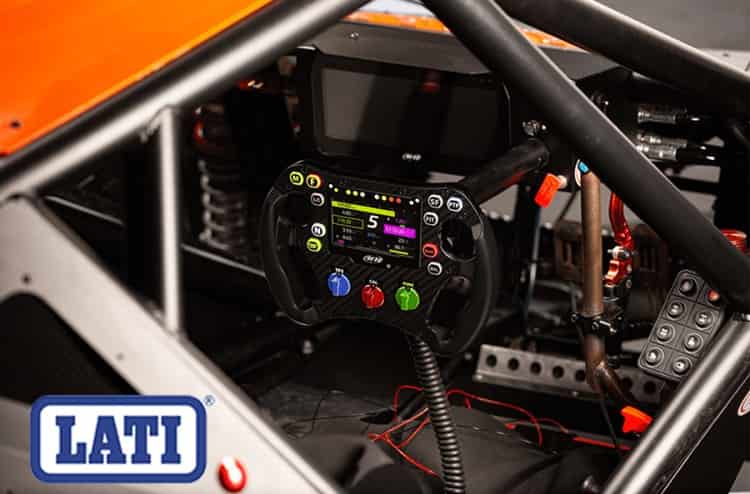
AiM Tech’s SW4 racing steering wheel reflects this evolution. The platform integrates a TFT display, rotary selectors, control buttons and a data acquisition system designed for racing applications.
To support the mechanical and dimensional requirements of the SW4, AiM Tech worked with LATI on selected polymer components. The material chosen was LATAMID 66 H2 K/50, a polyamide 66 compound reinforced with 50% high-tenacity carbon fibre.
The compound was used for the steering wheel front panel and some accessory components, with moulding carried out by G.S.T. Plast.
Why material choice matters in racing steering wheels
A modern racing steering wheel has to combine several functions in a limited space.
It must support electronics, displays, buttons, rotary switches and mounting interfaces. At the same time, it has to remain light, rigid and stable under demanding conditions.
Dimensional precision is especially important. If the front panel deforms or loses tolerance, the assembly of electronic devices can become more difficult. Buttons, openings, fixing points and interfaces must remain accurate to ensure reliability and repeatable performance.
This is why engineering polymers are increasingly used in motorsport components where metal is not always the most efficient solution.
PA66 carbon fiber for stiffness and low weight
LATAMID 66 H2 K/50 is based on PA66, also known as polyamide 66 or nylon 66, reinforced with a high level of carbon fibre.
The high carbon-fibre content gives the compound strong structural rigidity while helping to keep component weight low. This combination is valuable in motorsport, where every gram matters but mechanical stability cannot be compromised.
For the SW4 steering wheel, the material was selected to support stiffness, dimensional stability and minimal deformation under load.
These properties are particularly relevant for the front panel, which contains multiple openings, mounting points and precision interfaces.
The SW4 front panel is the critical component
The front panel required particular design attention because it is the structural and visual interface between the driver and the electronics.
It must house the display, selectors and control buttons while maintaining accurate geometry. Any distortion could affect assembly, usability or long-term reliability.
Using a carbon-fibre-reinforced PA66 compound allows the component to be injection moulded with the precision required for this kind of application.
Compared with conventional materials, reinforced engineering polymers can offer a balance of design freedom, repeatability, lower weight and integrated functionality.
Resistance to racing conditions
Motorsport components operate in an environment where mechanical and chemical resistance are important.
Steering wheel parts can be exposed to oils, greases, cleaning agents and fluids commonly found in racing environments. They also need to maintain performance despite vibration, handling and repeated use. PA66 carbon fiber
The LATI compound was selected not only for stiffness and lightness, but also for its ability to support the durability requirements of a racing application.
For high-value motorsport equipment, material performance must remain consistent from production to use on track.
Aesthetic finishing also influenced the material selection
The component is also subjected to cubic finishing, a decorative process that can reproduce the visual appearance of carbon fibre composites.
This is important because motorsport products are judged not only by performance, but also by perceived quality.
The selected material had to support this finishing process while maintaining the mechanical properties and surface precision required by the project.
In this case, the polymer compound contributes to both the technical function and the final visual identity of the steering wheel.
Engineering plastics move closer to structural applications
The AiM Tech and LATI collaboration shows how advanced thermoplastic compounds are moving into applications once associated mainly with metals or traditional composite laminates.
Carbon-fibre-reinforced PA66 can offer high stiffness, good dimensional control and efficient processing through injection moulding.
This makes it suitable for complex geometries, integrated features and medium-to-high precision parts.
In motorsport, where performance, weight and rapid production are all important, these advantages can make reinforced thermoplastics an attractive option.
Why this matters beyond motorsport
Although the SW4 steering wheel is a racing application, the same material logic applies to other sectors.
Automotive, electronics, industrial equipment and high-performance consumer products are all looking for materials that combine lightness, stiffness, precision and design flexibility.
Carbon-reinforced polyamide compounds can help replace heavier materials in selected applications, especially where complex shapes and repeatable production are needed.
The motorsport sector often acts as a proving ground for these solutions because it pushes materials to demanding limits.
Outlook
The collaboration between AiM Tech and LATI highlights the growing role of high-performance engineering polymers in racing components.
The SW4 steering wheel needed a material capable of supporting electronics, precise assembly, stiffness, low weight and premium finishing.
By selecting a PA66 carbon fiber compound, AiM Tech and LATI demonstrated how reinforced thermoplastics can meet both structural and aesthetic requirements in a compact motorsport component.
As racing technology becomes more electronic and integrated, material selection will remain central to performance, reliability and design freedom.
More…