Microplastics – Microplastics are among the most widely discussed environmental topics today. The media often highlights the harmful effects of polymer nanoparticles on living organisms 18-02-2025 - Archive
Microplastics
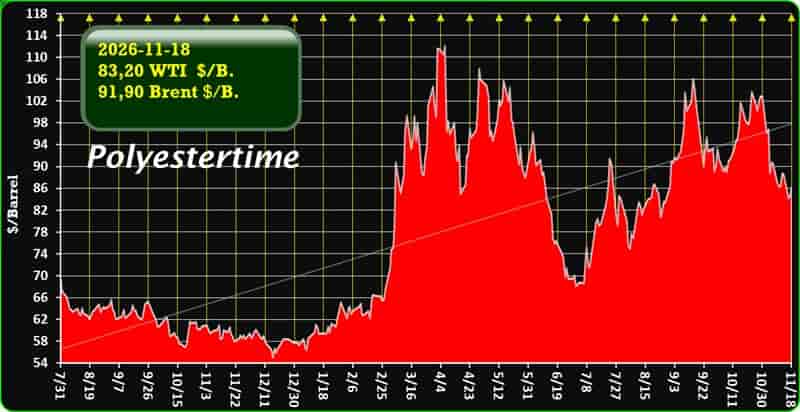
Crude Oil Prices Trend

Germany Faces Recycling Shortage Crisis
By 2030, Germany may face a shortage of nearly one million tons of recycled plastic needed to meet EU regulations. Despite advances in plastic waste recovery, demand is expected to exceed supply by 30%, impacting packaging companies and, eventually, the automotive sector.
A study by Conversio Market & Strategy for BKV, a German plastics industry think tank, projects a deficit of one million tons in Germany and 3.5 million tons across Europe. Currently, 80% of recycled plastic originates from packaging waste, a trend expected to persist. However, by 2030, over half of this material will be diverted to other industries, including construction and automotive, exacerbating shortages for packaging producers.
To address this issue, industry associations urge the government to enhance plastic waste collection, particularly in commercial and public spaces. They also call for the urgent approval of safe recycling methods for food packaging, currently limited to PET, and stricter import controls to ensure material quality. Microplastics
Trump Tariffs Push EU-US Relations Into Uncharted Waters
- The European Union has vowed to take countermeasures in response to the Trump administration’s imposition of tariffs on steel and aluminum imports, signaling a significant shift in transatlantic trade relations.
- Trump’s “America First” economic policies, including tariffs and tech regulations, are creating friction with the EU, which fears potential destabilization and challenges to its economic interests.
- The rise of right-wing populist leaders in Europe, who share some affinities with Trump’s agenda, adds another layer of complexity to the EU’s relationship with the United States. Microplastics
The day after U.S. President Donald Trump announced his intention to slap 25-percent tariffs on imported steel and aluminum, the European Union’s chief executive hit back.
“The EU will act to safeguard its economic interests. We will protect our workers, businesses, and consumers,” European Commission President Ursula von der Leyen said in a statement.
“Unjustified tariffs on the EU will not go unanswered — they will trigger firm and proportionate countermeasures.”
Transatlantic relations are lurching into new territory as the Trump administration embraces a more muscular, transactional, and mercantilist American foreign policy, aimed at protecting U.S. jobs and industry and rewriting long-standing rules of international trade. Microplastics
Alarming media reports about the harm of microplastics to the human body and the environment are greatly exaggerated, Alexei Khokhlov has told RT
Microplastics are among the most widely discussed environmental topics today. The media often highlights the harmful effects of polymer nanoparticles on living organisms. However, as head of the Department of Polymer and Crystal Physics at Moscow State University, and a member of the Russian Academy of Sciences, Alexei Khokhlov told RT, there is no scientific basis for these claims. Khokhlov argues that microplastic particles are no more hazardous to humans than tiny wood or concrete particles which exist in the environment in much greater quantities.
RT: In recent years, many scientific studies and media reports have been published about microplastics. What exactly are they made of?
Khokhlov: Microplastics are defined as fragments of polymer materials smaller than 5 mm. These particles can break down into even smaller micron-sized pieces, and there are also polymer nanoparticles. Microplastics
We live in an era dominated by new materials. Just 100 years ago, the polymer industry was virtually nonexistent. The widespread use of plastics began in the 1950s, and today, approximately 400 million tons of various plastics are produced annually worldwide.
The main types of polymers include polyethylene, polypropylene, polyethylene terephthalate, polystyrene, and polyvinyl chloride. These materials are used to make plastic wrap, packaging, and so on. Essentially, we are surrounded by polymer materials; life today would be unimaginable without them.

Fabric produces light, sound even if stretched to 200% of its length, can help wearables
Reports revealed that the display achieves a brightness of 319 candelas per square meter.
Scientists have created a new type of electronic fabric that maintains consistent performance even when repeatedly stretched, bent, and twisted. It’s also capable of producing bright light and clear sound while stretching to double its original size. Microplastics
Developed by researchers from the Korea University of Technology and Education and the University of California San Diego, the composite material combines three significant components (Ecoflex, Triton X, and inorganic EL phosphor).
The innovative sound display, which seamlessly translates auditory information into optical signals, was developed utilizing transparent ionogel electrodes and a high dielectric layer composed of Ecoflex, Triton X, and inorganic EL phosphor.
Sound display addresses challenges of limited stretchability, low brightness
The study, published in the journal Advanced Functional Materials, reveals the stretchable electroluminescent (EL) sound display that addresses the challenges of limited stretchability and low brightness in existing EL displays. Microplastics

The LYCRA Company launches new COOLMAX CORE fibre at Bharat Tex 2025
- The LYCRA Company is introducing its new COOLMAX CORE fibre in India at Bharat Tex (Feb 14–17, New Delhi).
- This pre-dyed filament fibre, available in 25+ shades, enhances efficiency by eliminating fabric dyeing, reducing environmental impact.
- Designed for shirting, knitwear, and formalwear, it offers permanent moisture management for cooling comfort in demanding climates.
The LYCRA Company, a global leader in developing innovative and sustainable fiber and technology solutions for the apparel industry, will introduce its exclusive new COOLMAX CORE fiber for the Indian market at Bharat Tex in New Delhi from 14 to 17 February. The COOLMAX brand is recognized worldwide for its permanent moisture management properties that help the wearer stay cool, dry, and comfortable. Microplastics
The new COOLMAX CORE fiber is a special dyed version in filament form, available in more than 25 shades to enable a wide range of product development opportunities across the apparel industry’s value chain. This fiber improves textile processing production efficiency by eliminating the fabric dyeing process, which also helps reduce the risk of effluents impacting the environment.

20 years on: Recent advances with graphene
Some 20 years have gone ever since the discovery of graphene as a single atom layer. Numerous papers have been published to demonstrate its high electron mobility, excellent thermal and mechanical as well as optical properties. Microplastics
Graphene is an ultra- thin material (one atom thick) and is highly conducive at conducting electricity. The material is strong , very flexible and has been used from coating power plants, to making flexible computing screens to filtering out contaminants from water.
In this article, Digital Journal takes a brief look at five recent innovations with graphene that showcase continued developments. These are centred on different manufacturing and characterization techniques, especially in electronics and power modules.
Graphene enhanced concrete
A collaborative consortium, working within with Abu Dhabi government’s initiatives towards reducing carbon footprint and enhancing economies of construction materials, has undertaken work on boosting the properties of concrete in an environmentally friendly way. Microplastics