Rare Earths – SK Chemicals unveils plans for new Recycle Innovation Center at its Ulsan plant Korea-based SK chemicals has announced plans to build a new recycling centre at its Ulsan plant. The project marks the establishment of the company’s first depolymerisation technology-based recycling centre in the country 26 -02-2025 - Archive
Rare Earths
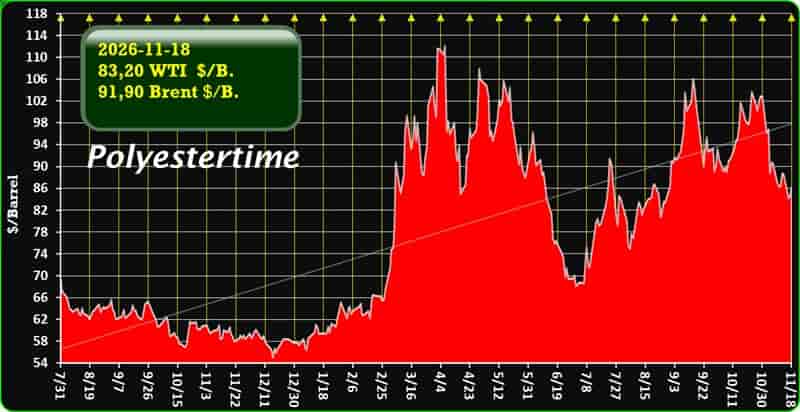
Crude Oil Prices Trend

Oben Group Expands with Brückner’s Advanced BOPP Film Line
Oben Group strengthens its global presence by launching a new production facility in Monterrey, Mexico, equipped with Brückner’s cutting-edge BOPP film production line.
As a leading film manufacturer with over 17 plants across the Americas and Europe, Oben Group has invested in Brückner’s latest BOPP technology. The high-performance line, featuring a 12-meter film width and 700 m/min speed, will be a key component of the new facility. Rare Earths
With a long-standing partnership spanning over 30 years, Oben Group and Brückner continue to drive innovation in film production. Markus Gschwandtner, Managing Director of Brückner Maschinenbau, highlighted the significance of this investment: “We are proud that our collaboration has led to the world’s first 12m BOPP line, showcasing our deep-rooted relationship.”
Oben Group’s President, Jamil Zaidan, reaffirmed the company’s commitment to excellence: “This milestone underscores our relentless pursuit of efficiency and productivity. Brückner’s technology has been crucial in our growth, and we remain dedicated to shaping the future of the packaging industry.”
With this latest expansion, Oben Group further solidifies its position as a global leader in flexible packaging solutions. Rare Earths

SK Chemicals unveils plans for new Recycle Innovation Center at its Ulsan plant
Korea-based SK chemicals has announced plans to build a new recycling centre at its Ulsan plant. The project marks the establishment of the company’s first depolymerisation technology-based recycling centre in the country.
Using sophisticated chemical decomposition technology, the new Recycling Innovation Center (RIC) will produce recyclable plastic raw materials (r-BHET) from waste plastics. Set to open in 2026, the pilot facility will produce 50 tons of r-BHET each year from various types of low-quality waste plastics such as fibres, films, and automotive parts that were previously difficult to recycle using conventional methods. Rare Earths
Textiles are known to be especially challenging due to the mix of materials commonly encountered in clothing – from polyester yarn to other fibres such as cotton, and various accessories like buttons.
At the Ulsan plant, SK chemicals’ RIC will integrate research and production, covering everything from circular recycled raw materials (r-BHET) to circular recycled materials, supported by a polymerisation pilot that produces a circular recycled PET and a commercial production facility capable of mass-producing circular recycled copolyester.
In creating the RIC, SK chemicals aims to provide flexible solutions to meet the diverse recycling requirements of such sectors as the automotive, electronics, and fashion industry. Rare Earths

Rare Earths in Italy: The Reopening of the Silius Mine
Italy is set to revive its mining industry with the reopening of the historic Silius mine in Sardinia, located 50 km from Cagliari. Rich in fluorite, the site will resume operations after decades, thanks to Brescia geologist Umberto Gioia. The initiative, reported by Corriere della Sera, marks a significant step for Italy’s mineral sector.
The project, in development for over ten years, led to the creation of Mineraria Gerrei, a company formed by Sma Srl and Edilmac Srl, with financial backing from cloud services leader Aruba. A €50 million investment will generate around 100 jobs at the site. Rare Earths
Economic and Strategic Importance
Containing over 3 million tonnes of fluorite, the mine will be essential for the ecological transition, as fluorite is used in lithium-ion batteries. Mining is expected to begin by late 2025, with an annual output of at least 70,000 tonnes of fluorite and 6,800 tonnes of galena.
The project gains momentum from Italy’s Critical Raw Materials Decree 84/2024, aimed at reducing reliance on South America, Africa, and China for strategic minerals. While Italy lacks significant rare earth deposits, enhancing domestic resources aligns with its long-term industrial strategy. Rare Earths
Gioia emphasized the importance of securing critical raw materials for Europe’s industry and fostering transparent communication to prevent conflicts and misinformation.

‘When it comes to sustainability in packaging, not everything is black and white’
Across more than 30 years in the packaging industry working for companies like Nestlé, Mondi and Pepsico, Dr. Thomas Gröner, Director & Founder of TG PACK SOLUTIONS, has seen the topic of packaging sustainability from every perspective. In this interview, he shares his views on sustainability, talks about the problem of food waste, and argues that some political guidelines are questionable. Rare Earths
Thomas, you have extensive knowledge and experience in the area of sustainable packaging. Today you work as an independent consultant. How has that changed the way you contribute to modern and sustainable packaging?
For the past four years, I have been successfully running my own business TG PACK SOLUTIONS. I advise companies and start-ups along the packaging value chain in the areas of sustainability, innovation and business development. This includes, for example, packaging manufacturers and packed consumer goods companies in Europe and North America. Rare Earths
Holistic: because I advise from the perspective of material manufacturers, packaging producers and the FMCG industry as well as from the perspective of waste management companies and consumers. Open: because I am completely free in my choice of materials, partners and suppliers. Fact-based: as a third party from outside I create my concepts independently and based on facts for the benefit of the customer.

Win Win Water Unveils Plant-Based Bottles
Liverpool-based Win Win Water has introduced a 100% plant-based bottle, tackling plastic waste with sustainable Luminy PLA sourced from TotalEnergies Corbion. The brand’s naturally alkaline water, rich in electrolytes and minerals, is sourced from The National Forest UK and the Austrian Mountains.
The launch event, held on February 18 at Liverpool’s Baltic Market, showcased the eco-friendly innovation. Luminy PLA, derived from responsibly farmed sugarcane, is free from toxins and decomposes within 90 days in commercial composting facilities. Rare Earths
Despite being compostable, the bottles are designed for multiple uses, offering both durability and sustainability.
“Win Win Water was founded to redefine the bottled water industry by prioritizing purity, eco-consciousness, and social responsibility,” said Joshua Daley, Sales & Marketing Director.
Derek Atkinson, Sales Vice-President at TotalEnergies Corbion, emphasized the growing shift toward PLA bottles: “More water brands are adopting compostable and recyclable Luminy PLA bioplastics, helping to eliminate plastic waste.”
Win Win Water’s launch highlights a growing movement toward greener packaging, offering consumers an environmentally responsible hydration option. Rare Earths

Future Cars: The Rise of Electric Braking
Electrification is revolutionizing mobility, not just in propulsion but in key functions like braking and steering. As automakers move towards lighter, more efficient vehicles, complex hydraulic systems are being replaced by electric alternatives. A major milestone in this shift is the large-scale production of “brake by wire” in 2025. This innovation eliminates traditional hydraulic brakes, using lightweight electric wiring instead—reducing weight, complexity, and environmental impact.
Already tested extensively, brake-by-wire has proven its reliability over billions of kilometers and more than a decade in Formula 1, where Mercedes pioneered it in 2014 with Brembo’s advanced system. Now, safety takes center stage. Rare Earths
Bosch, a leading automotive supplier, recently conducted a 3,300-kilometer test across Europe, demonstrating the system’s real-world performance. The company confirmed that after summer, the technology will debut in production vehicles, with 5.5 million units expected by the decade’s end.
This system improves stopping distances, simplifies construction, and enhances vehicle dynamics. Unlike conventional brakes, it allows independent wheel braking, optimizing grip and correcting understeer. The brake pedal becomes more compact and repositionable, improving interior space. While initially adopted by premium models due to high development costs, economies of scale will eventually make it widespread. Just as with electric powertrains and digital dashboards, brake-by-wire is set to redefine the driving experience. Rare Earths