Chemical industry – The European chemical industry is on the brink of collapse, warns Sir Jim Ratcliffe, Chairman and CEO of INEOS Once a key driver of Europe’s economy, generating nearly a trillion euros in revenue—comparable to the automotive sector—it now faces extinction due to damaging government policies 28-02-2025 - Archive
Chemical industry
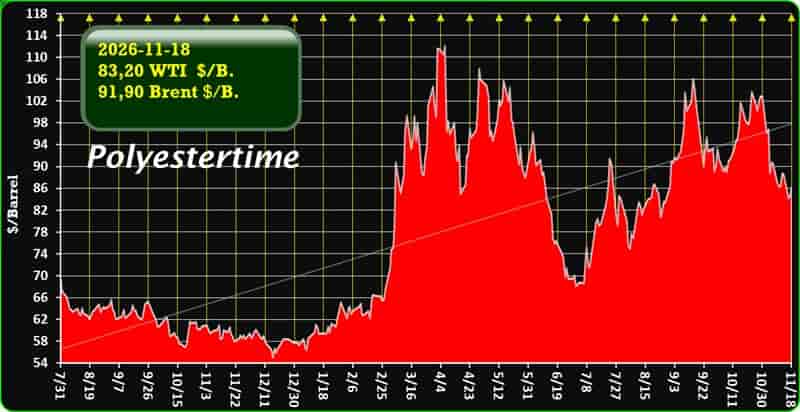
Crude Oil Prices Trend

The European chemical industry is on the brink of collapse, warns Sir Jim Ratcliffe, Chairman and CEO of INEOS
Once a key driver of Europe’s economy, generating nearly a trillion euros in revenue—comparable to the automotive sector—it now faces extinction due to damaging government policies.
Soaring energy costs and steep carbon taxes have placed European manufacturers at a severe disadvantage.
At INEOS’ Cologne facility, a major petrochemical hub employing 10,000 people, gas costs exceed US equivalents by €100m, electricity bills are €40m higher, and carbon taxes are approaching €100m. Instead of expanding, the industry is struggling to survive. Chemical industry
Government inaction is driving petrochemical companies out of Europe. Major competitors are planning their exit, and if this trend continues, Europe will be forced to import raw materials from the US and China, enriching those economies while weakening its own.
Attempting to decarbonise through deindustrialisation is counterproductive—jobs disappear, economic security erodes, and CO2 emissions persist, merely shifting location.
To prevent collapse, Ratcliffe urges the removal of carbon taxes, the provision of affordable energy, and incentives for industrial growth and clean technology. Temporary tariff barriers are also needed to protect the sector during this transition. Chemical industry
Unlike Europe, the US prioritises industry, securing its future with pro-business policies. As a result, it is surging ahead, while Europe risks being left behind.

Versalis’ Losses Deepen in 2024
Despite a slight increase in sales volumes, margins remain under pressure due to challenging macroeconomic conditions
ENI has released its financial results for Q4 and the full year 2024, including data on its chemical subsidiary, Versalis. Undergoing a major restructuring plan (read article), Versalis reported a pro forma adjusted operating loss of €231 million in Q4, a modest improvement from the €237 million loss in the same period of 2023. The company attributes this decline to a struggling European chemical sector, impacted by economic slowdown and rising production costs, which have eroded its competitiveness against American and Asian rivals amid oversupply. Chemical industry
For the full year, the operating loss widened to €814 million, surpassing the €614 million loss in 2023, driven by “exceptionally adverse market conditions.” Despite these financial struggles, Versalis’ chemical sales reached 740,000 tons in Q4 (-4%) and 3.17 million tons for the year, reflecting a 2% increase over 2023.
Margins remained weak across all segments, as raw material prices failed to offset rising energy and input costs. The European market’s persistent difficulties, sluggish economic activity, and competitive pressures from more cost-efficient producers continued to weigh on performance. As Versalis navigates these headwinds, its restructuring efforts aim to restore profitability in a challenging industry landscape. Chemical industry

Coca-Cola and the Circular Economy: A Blueprint for Sustainable Development in Nigeria
Nigeria faces significant plastic waste challenges due to rapid urbanization and population growth.
Addressing this requires innovative solutions beyond traditional methods. The Nigeria Climate Innovation Center (NCIC) proposes the circular economy as a transformative model in its report titled “Beyond Green Taxes: Embracing the Circular Economy for Sustainable Plastic Waste Management in Nigeria.”
Focusing on recycling, resource efficiency, and community engagement, this initiative moves away from less effective green taxation measures.
Coca-Cola’s proactive involvement in this framework positions it as a leader in promoting sustainability and economic opportunity. Chemical industry
The circular economy contrasts with the linear “take, make, dispose” model, promoting a regenerative system where products are designed for longevity, reuse, and recycling, thus minimizing waste and resource extraction.
According to Mr. Adamu Garba, COO of NCIC, effective circular economy initiatives focus on three pillars: designing for recyclability, establishing robust collection and recycling infrastructure, and driving markets for recycled materials.

Chemical recycling projects receive backing
Several companies recently announced progress toward chemical recycling capacity, including a developing method to recycle PET that could require much less energy.
In east Texas, Braven Environmental will build a new pyrolysis plant, according to a press release from Gov.
Greg Abbott, in conjunction with the Texas Jobs, Energy, Technology and Innovation program. JETI was announced in February 2024 to provide a competitive economic incentive to help attract jobs and investments to the state. Chemical industry
The Texas plant will be the second after Braven’s first in Zebulon, North Carolina. A 2023 press release said the forthcoming project would produce approximately 50 million gallons of pyrolysis oil per year and process more than 250,000 tons of hard-to-recycle plastics.
In October 2024, Braven entered into a second long-term pyrolysis oil offtake agreement with Chevron Phillips Chemical, a joint venture between oil refiners Chevron and Phillips 66. Braven previously signed a similar agreement with CPChem for its North Carolina plant in 2021. Houston-headquartered CPChem is a global producer of PE and styrenics. Chemical industry

New Adhesive Makes Plastic Bottles Easier to Recycle
A newly developed adhesive that detaches cleanly from plastic bottles and packaging could enhance the quality of recycled plastic, according to a recent study. Traditional adhesives used for labels often leave behind residue that hinders recycling. Scientists from the University of Reading’s Department of Chemistry have created a polymer adhesive that dissolves in alkaline solutions, ensuring labels remain secure during use but detach effortlessly during recycling.
Lead researcher Matthew Hyder explained: “Current commercial adhesives are difficult to remove due to their chemical makeup. Our polymer adhesive is designed to break down when exposed to alkaline solutions. This innovation helps eliminate label residues, improving recycled plastic quality and usability.”
Versatile Applications
The study, published in Macromolecules, details how researchers developed a polyurethane adhesive containing sulfonyl ethyl urethane units. These components act as a chemical switch, weakening adhesion when treated with alkaline solutions. In tests, the adhesive lost up to 65% of its sticking power across various surfaces. Chemical industry
Despite its degradability, the adhesive performs comparably to commercial alternatives under normal conditions. It has proven effective at different temperatures on glass and aluminum, making it suitable for applications ranging from food packaging to shipping labels and electronic devices.
Funded by Domino Printing Sciences PLC and the University of Reading, this breakthrough could revolutionize recycling by simplifying material separation, ultimately reducing landfill waste and improving sustainability across industries.
BioProtect benefits from biobased, plastic-free binders
OrganoClick’s OC-BioBinders are made from renewable raw materials and waste from residual food industry streams.
Ahlstrom has been nominated as a finalist in the IDEA 2025 Awards in the Nonwoven Product category for its BioProtect laundry care solution. This biodegradable and certified biobased product is based on cellulosic fibres in combination with OrganoClick’s OC-BioBinder and represents years of dedicated development. Chemical industry
BioProtect is designed to prevent colour runs during the laundering of clothes and is certified biobased, biodegradable to ISO14855-1 and home compostable. Manufactured using wetlaid technology, it ensures premium quality with excellent dye-catching performance, strong wet strength and high absorption capacity.
“Our high-performance solution delivers outstanding dye-catching capabilities, offering protection against colour runs with results that match industry benchmarks,” says Pierre Mary, vice president of nonwovens at Ahlstrom.
“BioProtect significantly reduces environmental impact,” adds Anna Brikh, product manager for consumer nonwovens. “It has also been awarded the highest OK biobased rating of four stars by the accredited certification institute TÜV Austria.”
OrganoClick’s biobased, plastic-free binders are designed for the nonwoven industry and made from renewable raw materials and waste from residual food industry streams.