Biopolymer film – Textile manufacturer INVISTA has announced its decision to retain its downstream nylon fibers business, including the Seaford facility, despite exploring strategic alternatives, including a potential sale, announced last year The company informed employees on Wednesday that after a thorough evaluation process and significant interest from potential buyers, INVISTA concluded that maintaining ownership would generate the most long-term value for the organization 08-04-2025 - Archive
Biopolymer film
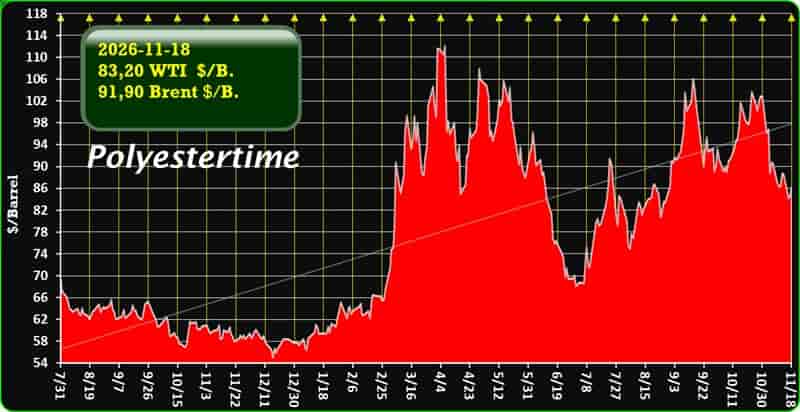
Crude Oil Prices Trend

Beaulieu Divests Technical Textiles Unit to RCP
Beaulieu International Group (BIG), based in Waregem, Belgium, has agreed to sell its European technical textiles division, Beaulieu Technical Textiles (BTT), to investors advised by German private equity firm RCP.
RCP specializes in complex investments, focusing on business carve-outs and performance turnarounds across Europe. With a proven track record in revitalizing companies like Axicom, PowerTech Converter, and SIK Peitz, RCP sees strong potential in BTT despite recent difficulties. Biopolymer film
“BTT holds significant promise,” said Michael Nier, RCP partner and head of operations. “We’ll bring strategic guidance, capital, and hands-on support to help the company return to profitability and pursue sustainable growth. We value the expertise and commitment of the BTT team and look forward to building the future together.”
BIG’s decision follows a strategic review aimed at optimizing its portfolio to better focus resources and improve returns.
BTT, located in Komen, Belgium, employs 194 people. The current management team will remain in place, and all employees will transition under existing salary and working conditions. Biopolymer film

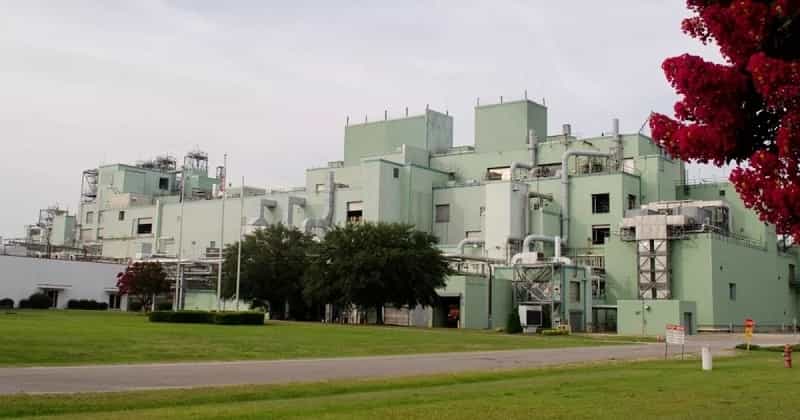
Textile manufacturer INVISTA has announced its decision to retain its downstream nylon fibers business, including the Seaford facility, despite exploring strategic alternatives, including a potential sale, announced last year
The company informed employees on Wednesday that after a thorough evaluation process and significant interest from potential buyers, INVISTA concluded that maintaining ownership would generate the most long-term value for the organization. This decision signifies INVISTA’s commitment to its nylon fibers operations and its belief in the business’s future potential under its continued management. Biopolymer film
Overview:
- INVISTA is a privately held company and a subsidiary of Koch Industries since 2004.
- Headquartered in Wichita, Kansas, USA, it operates in over 20 countries and employs approximately 10,000 people worldwide.
- The company has a long history rooted in innovation, tracing back to DuPont’s textile fibers division, which became DuPont Textiles and Interiors in 2003 and was then sold to Koch Industries in 2004, adopting the INVISTA name.
- INVISTA’s business spans the creation of essential chemical building blocks and high-performance materials used in a vast array of everyday products.
Products and Brands:
- INVISTA is a leading producer of chemical intermediates such as adiponitrile (ADN), hexamethylene diamine (HMD), and adipic acid (Adi-Pure®), crucial for nylon 6,6 production.
- They also manufacture nylon polymers and polypropylene resins used in automotive parts, electronics, packaging, medical equipment, and more.
- While INVISTA sold its Apparels & Advanced Textiles business in 2019 (including well-known brands like LYCRA®, COOLMAX®, and THERMOLITE®), Koch Industries retains a minority stake in The LYCRA Company.
- Other notable brands and products associated with INVISTA include CORDURA® Advanced Fabrics and STAINMASTER®.
A circular economy starts with waste collection and sorting
Recycling offers the opportunity to give end-of-life plastic a second life
In an ideal world, it all begins with pre-sorting, with every household sorting their recyclable waste into different bins according to material, ready to be collected and taken to facilities for further sorting and recycling.
However, this process varies from country to country and even from region to region, depending on local regulations, available infrastructure and services, and consumer behavior. For plastic waste, the next step involves mechanical sorting, separation by material type and purification at dedicated facilities, followed by mechanical or chemical recycling. Biopolymer film
Mechanical recycling uses physical processes (e.g., sorting, shredding, washing, melting) to transform waste materials into feedstock for new products.
When mechanical recycling – which is preferable from a carbon emissions perspective – cannot be used, chemical recycling offers an alternative. This uses chemical processes (e.g., pyrolysis, depolymerization) to transform end-of-life plastic into virgin-quality new plastics, allowing hard-to-recycle materials to still be kept in the loop.

Sunbird: The Fusion Rocket That Could Halve Travel Time to Mars
Pulsar Fusion, a UK-based company, is developing Sunbird, a groundbreaking nuclear fusion rocket capable of slashing travel time to Mars by half. Unlike traditional chemical rockets, Sunbird uses fusion—clean, powerful, and highly efficient.
Expected to reach astonishing speeds of 800,000 km/h—outpacing NASA’s Parker Solar Probe—Sunbird could revolutionize space exploration and make manned missions to Mars far more feasible. Biopolymer film
Fusion differs fundamentally from nuclear fission. While fission splits heavy radioactive atoms like uranium, generating hazardous waste, fusion combines light elements such as hydrogen, mimicking the process that powers stars. It produces no greenhouse gases or long-lasting radioactive byproducts, making it a sustainable energy source.
Sunbird’s engine features a linear reactor design, unlike the traditional circular format used to contain plasma with magnets. This configuration channels the escaping high-energy particles to generate forward thrust. The rocket will run on helium-3, a rare isotope with two protons and one neutron, known for its potential in fusion reactions.
Although fusion is not yet viable for energy generation on Earth, it offers enormous potential for space propulsion—delivering high thrust while reducing fuel mass. Pulsar Fusion aims to conduct an in-space fusion test by 2027. Biopolymer film
Other players, including Helicity Space and General Atomics, are also investing in fusion-powered propulsion, marking the beginning of a new era in clean, ultra-fast space travel.

In the reeling energy sector, an unexpected OPEC production hike plus tariff fears send oil prices plunging 7%
President Trump’s sweeping tariffs combined with OPEC’s unexpectedly large production hike are combining to trigger a “double whammy” on the oil and gas sector, resulting in crude prices tumbling and fears rising of lower energy demand in an economic slowdown.
The tariffs, which did exclude oil and fuel imports, are still expected to increase equipment and supply costs for energy production, construction and transportation, while potentially creating weaker global energy demand. The decision from key OPEC nations and allies, especially Saudi Arabia and Russia, to triple their expected production increase in May adds extra supplies on top of existing recession fears. Biopolymer film
The coincidentally joint announcements from the White House and OPEC caused oil prices to plunge by nearly 7% on April 3 with the U.S. benchmark for oil —front-month NYMEX WTI—hovering just above $66 per barrel, well down from the nearly $78 per barrel when Donald Trump took office in January.
“The world got more complicated, and the outlook is cloudier,” said energy forecaster Dan Pickering, founder and chief and investment officer for Pickering Energy Partners.
“It’s a double whammy because you have OPEC boosting supply, which I think was dangerous to start with, but now you have this issue of tariffs being higher or worse than expected,” Pickering said.
New Biopolymer Lowers Film Production Costs
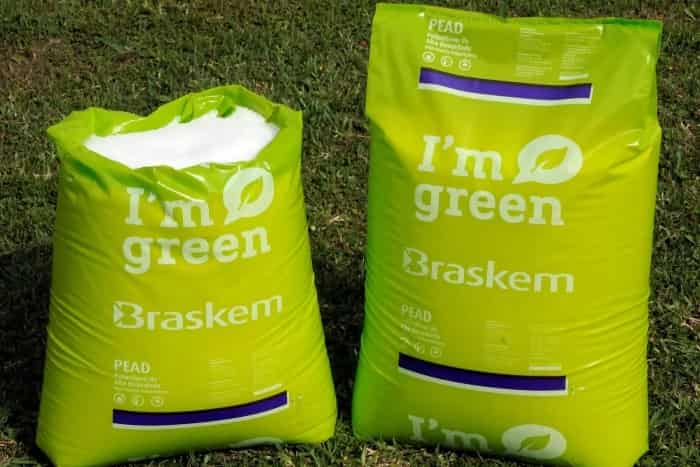
Alone or in PLA blends, NatureWorks’ Ingeo Extend platform touts efficiency, performance, biodegradability, and compliance benefits for BOPLA films. Biopolymer film
At a Glance
The new PLA offering touts efficiency, performance, biodegradability, and compliance benefits for BOPLA films.
Small-format food packaging use can help meet landfill diversion targets to improve EPR/PPWR compliance.
Sustainable biopolymer manufacturer NatureWorks expanded its line of Ingeo polylactic acid (PLA) biopolymers with a new platform for films. Called Ingeo Extend, it promises faster biodegradability; lower production costs; increased efficiency for commercial-scale production of biaxially-oriented PLA (BOPLA) films; and compliance benefits with emerging laws and regulations in the United States and European Union.
The first offering, Ingeo Extend 4950D, provides application benefits both to producers and brand owners:
It enables a transverse-direction stretch ratio of up to 7x for improved performance. It can be used with other Ingeo PLA grades for more cost-effective production on equipment used for manufacturing BOPP. Biopolymer film