Renewable raw materials – Functional nylon 6 from renewable raw materials – scalable and versatile A Chinese research team has developed a biobased lactam monomer that can be used to efficiently produce functional nylon 6 copolymers. The new synthesis route is simple, cost-efficient and suitable for industrial implementation – with great potential for customised polyamides 09-04-2025 - Archive
renewable raw materials
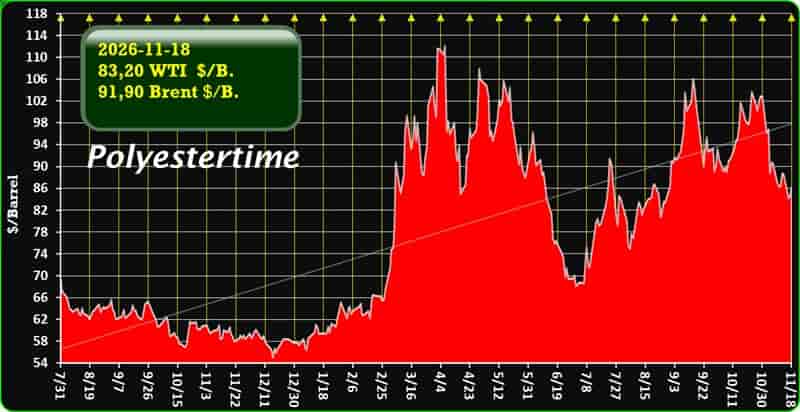
Crude Oil Prices Trend

CATL plans to take a controlling stake in NIO Energy, will the battery swap market dominate?
CATL is in negotiations with NIO to acquire a controlling stake in NIO Energy, with an investment not exceeding 2.5 billion RMB. This move aims to jointly create the world’s largest battery swapping network. CATL hopes to transform into an energy service provider through the battery swapping business, building a complete battery ecosystem. They plan to launch the “Chocolate Battery Swapping” service and construct 1,000 battery swapping stations, with the ultimate goal of jointly building 30,000 stations.
Acquiring NIO Energy will accelerate the implementation of their battery swapping strategy renewable raw materials
Reuters broke the heavy news: Chinese battery giant CATL is in talks with electric vehicle manufacturer Nio to acquire a controlling stake in Nio Power.
Previously, CATL announced an investment of no more than 2.5 billion yuan in Nio Power and reached a strategic cooperation with Nio to jointly build the world’s largest battery swapping network. Domestic media reported that CATL would also increase its investment in Wuhan Weineng, a battery asset management company under Nio, further penetrating the battery swapping industry chain.
The series of actions by CATL shows us that after a penetration rate of over 50%, CATL has ambitions to transform from battery manufacturing to energy services, intending to build a complete ecological closed loop covering production, sales, operation, and recycling through the construction of a battery swapping network and battery asset management.
We will explore CATL’s layout from two dimensions: its strategic layout and the business logic of the battery swapping model. renewable raw materials

Closed loops may help boost US food-grade PCR supply
Industry groups and packaging companies support increasing the use of PCR in food-grade packaging, but progress remains incremental in many cases.
Nova Chemicals’ Syndigo recycled polyethylene resins. Two of four lines at a new Nova recycling facility in Indiana that produce Syndigo are designed for food-grade PCR. Permission granted by NOVA Chemicals
Postconsumer recycled content that can be used in new food and beverage packaging still faces obstacles to widespread use. Companies like Nova Chemicals and Atlantic Packaging are trying to leverage B2B closed loops to increase supply. renewable raw materials
Some states have also passed laws mandating minimum levels of recycled content in certain types of packaging.
There’s also some evidence that the shift to more PCR use could win brands favor with customers. In a recent Nova Chemicals consumer insight survey, three-quarters of respondents agreed that companies ought to increase their use of packaging made from recycled materials.
But there are barriers to achieving this ubiquity, and industry participants lament imbalances in the recycled plastics economy.
“One of the issues that I see is a real disconnect between supply and demand,” said Crystal Bayliss, who leads the PCR workstream at the U.S. renewable raw materials

Functional nylon 6 from renewable raw materials – scalable and versatile
A Chinese research team has developed a biobased lactam monomer that can be used to efficiently produce functional nylon 6 copolymers. The new synthesis route is simple, cost-efficient and suitable for industrial implementation – with great potential for customised polyamides.
In a recent publication in Polymer Chemistry, Yahui Mao and colleagues report a novel copolymerisation method for producing functional nylon 6 from the biobased δ-valerolactam derivative M1 (3-(dimethylamino)piperidone) and the standard monomer ε-caprolactam. The new monomer building block is derived from the amino acid ornithine and offers an efficient way to incorporate functional side chains into the polymer backbone. renewable raw materials
The synthesis of M1 and its copolymerisation with ε-caprolactam proved to be simple, reliable and easily scalable. The resulting polyamides exhibited thermal stability and crystallinity comparable to conventional nylon 6 – while at the same time being expandable through targeted functionalisation. The dimethylamino function in the polymer structure can be selectively reacted with electrophiles to create customised materials with improved adhesion, elasticity or solubility.

Scientists use air moisture to turn mixed plastic waste into building blocks
Chemists at Northwestern University are using moisture from the air to depolymerize plastic waste for further plastic production; this is set to save recyclers the task of sorting mixed waste streams while avoiding expensive, energy-intensive, potentially toxic processes. renewable raw materials
Conventional plastic recycling processes require expensive catalysts like platinum and palladium, which can sometimes be toxic; the reactions themselves call for high temperatures and intense energy and solvents, which can create toxic byproducts in turn.
Furthermore, separating the recycled materials from the solvents after a reaction is performed is believed to be an energy-intensive, time-consuming task to perform.
In what is described as a ‘non-toxic, environmentally friendly, solvent-free process’, Northwestern University scientists have utilized a molybdenum catalyst and activated carbon; both are considered ‘inexpensive, abundant and non-toxic materials’. Apparently, the catalyst is ‘durable and recyclable’, so it can be reused without impacting its effectiveness.
The catalyst and activated carbon are applied to polyethylene terephthalate (PET) and heated up until the plastic depolymerizes. Then the molecules are exposed to air, at which point it reacts and becomes terephthalic acid (TPA). renewable raw materials

Trump wants oil prices to drop below $50, is the market ready?
Currently, oil prices have fallen below the level required for the U.S. shale oil industry to maintain healthy investments. If low oil prices persist, U.S. oil production “will immediately begin to decline, and the extent could be quite significant.” Industry executives warn that it is impossible to achieve U.S. energy dominance and a $50 per barrel oil price simultaneously
Trump’s tariff tsunami shocks global markets, with crude oil prices plummeting 14% in just two days. Investors are concerned that a full-blown trade war will severely impact economic growth and oil demand. JP Morgan warns that the supply-demand imbalance and the Trump administration’s $50 oil price target could become a reality in the next two years, posing a survival threat to U.S. shale oil companies. renewable raw materials
Shale Oil Industry Hit Hard: Billions in Market Value Evaporated in Two Days
According to CCTV News, on April 2 local time, the U.S. announced higher “reciprocal tariffs” on the country with the largest trade deficit with the U.S., which will officially take effect on April 9. The news sent shockwaves through global financial markets.
As a result, international oil prices plummeted nearly 14% over two trading days, briefly reaching $61.99 per barrel, the lowest level since April 2021. This price is already below the level required for U.S. shale oil producers to maintain healthy investments.

A Latvian start-up has developed a 100% recyclable to-go cup made from recycled PET (rPET)
Their innovation uses ultrasonic welding from Weber Ultrasonics to join the cup base to the cylinder without adhesives. This mono-material structure allows the foamed rPET to be recycled endlessly, enhancing sustainability. renewable raw materials
The project, initiated by Sergey Nikitenko of FORPET Baltic SIA, aims to utilize rPET in food-safe, high-quality packaging. Collaborating with technology providers like NGR and Leistritz, they process recycled PET into versatile materials. Their first product, these beverage cups, is produced on a Latvian line yielding over 1.5 million units monthly.
Ultrasonic welding is crucial for circularity, ensuring leak-proof cups with integrated quality control, aligning with Industry 4.0 standards. Plans are in progress to expand production, potentially including a new facility.