Textile waste – Mitsubishi Chemical Corporation (MCC) has announced its decision to withdraw from the PET bottle business This sector of MCC provides various packaging solutions, primarily for condiments and alcoholic beverages. However, the business has faced significant pressure on profitability due to a sharp increase in raw material and logistics costs 10-04-2025 - Archive
Textile waste
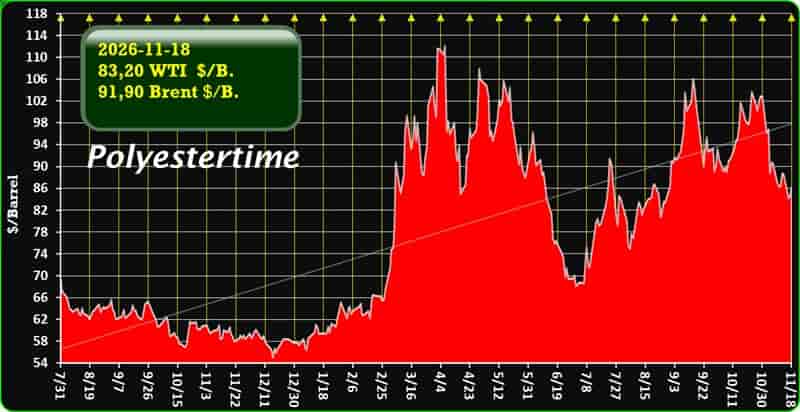
Crude Oil Prices Trend

Trump’s 90-Day Tariff Pause: What Prompted the Sudden Shift
President Trump’s unexpected 90-day suspension of tariffs was driven less by sentiment and more by market signals. Though Trump said the decision came from “the heart,” the real catalyst was Treasury Secretary Scott Bessent, who warned of rising distress in the U.S. Treasury market. He presented Trump with data showing panic selling and soaring yields, which threatened to raise borrowing costs for households and businesses.
U.S. Treasury Bills, typically safe-haven assets, were under pressure due to market fears triggered by Trump’s aggressive tariff stance. The sharp sell-off in Treasuries and a nervous reaction on Wall Street prompted urgent reassessment. Bessent and economic advisers emphasized the need to stabilize markets, especially with the S&P 500 plunging before rebounding 9.5% after the announcement. Textile waste
Though tariffs on steel, aluminum, autos, and Chinese goods remain, Trump hinted that China remains the primary target, increasing their tariff rate to 125%. Meanwhile, tariffs on Canada and Mexico still apply unless USMCA rules are followed.
Bessent described the move as strategic—intended to bring nations to the negotiating table. While some U.S. allies praised the pause, countries like Japan and Canada signaled readiness to support global market stability. Goldman Sachs lowered the U.S. recession risk to 45%, attributing it to the partial tariff rollback.
Trump remains open to resolving the trade conflict with China but insists other agreements must come first. Textile waste
“China wants a deal,” he said, “but doesn’t know how to get there.”

President Trump’s decision to suspend reciprocal tariffs for three months was likely influenced by the significant decline in U.S. government bonds, rather than solely the stock market’s volatility
The bond market’s downturn, marked by soaring yields and a flight from U.S. treasuries, signaled a loss of confidence in U.S. debt as a safe haven.
Economists like Larry Summers warned of potential “spirals” triggered by this market shift, urging a policy reversal. The bond market’s instability, coupled with concerns about Chinese holdings of U.S. debt, created a high-risk scenario.
Trump’s reversal and a successful 10-year bond auction eased immediate pressures, though yields remained elevated. Textile waste
The European debt market, particularly Italian BTPs, also faced strain, prompting central banks to consider intervention. The ECB, amid potential rate cuts, discussed the situation with China and acknowledged the materialization of “negative scenarios.”
The ECB is also accelerating its digital euro project to ensure European “monetary sovereignty,” countering the U.S.’s crypto-centric approach. This move aims to lessen reliance on U.S. payment platforms, perceived as potential targets for future retaliation. The global monetary system faces a potential “divorce,” with the ECB’s digital euro contrasting sharply with the U.S.’s embrace of crypto and stablecoins. Textile waste

S&P Global Commodity Insights has begun surveys to assess the emerging market for chemical recycling via pyrolysis in Europe and the United States
Mixed plastic waste, primarily made up of polyolefins, has become an environmental issue due to challenges in mechanical recycling. However, it is expected to gain market value once chemical recycling plants using pyrolysis are operational in North America and Europe.
S&P Global Commodity Insights is launching a Platts survey to track the prices of these materials in the European and U.S. markets. Olivier Maronneaud, Global Research Lead for Plastic Circularity at S&P Global, notes that pyrolysis plants, which are the focus of most chemical recycling initiatives, primarily process polyolefin waste.
Of the 230 projects tracked, 70% involve pyrolysis. While these plants are currently small, many companies are working toward processing capacities of 50,000 to 100,000 tonnes annually or more. Textile waste
Platts price assessments for mixed plastic waste will offer key market insights, aiding progress toward plastic circularity. S&P Global estimates that four to five new pyrolysis plants will be built in Europe in the coming years, while the U.S. could see pyrolysis recycling capacity surpass 600,000 tonnes annually by 2027.
The new Platts surveys will assess the price of processed mixed plastic waste, suitable for advanced recycling. Prices will be quoted in US dollars and euros, reflecting market conditions in Europe and the U.S. Textile waste

How Recycling Can Solve the Growing Waste Crisis
JEPLAN provides innovative recycling solutions to tackle global textile and PET bottle waste to promote a circular economy.
Japan is globally recognized as a leader in recycling and its commitment to Sustainable Development Goals (SDGs), including achieving carbon neutrality by 2050. However, there are criticisms—fair or not—regarding the lack of a solid framework and limited collaboration between the government, manufacturers, and recyclers. As a company that bridges this gap and promotes advanced recycling technologies, what is your analysis of Japan’s recycling sector, and what do you see as the key obstacles to its improvement? Textile waste
Japan’s recycling system evolved significantly during the 1990s and 2000s with the primary goal of reducing waste. Given Japan’s limited landmass, minimizing the amount of trash sent to landfills has always been a critical priority. Incineration has been the main method used to achieve this, as it significantly reduces the mass of waste.
In the 2000s, new recycling laws were introduced targeting specific sectors, such as automotive packaging, construction materials, and food waste, further driving efforts to reduce landfill use. These laws have effectively helped companies reduce the volume of garbage that ends up in landfills. tile waste

Global plastic consumption, reaching approximately 520 million metric tons, necessitates effective waste management beyond landfilling and incineration
Governments and industries worldwide are shifting towards advanced recycling technologies, driven by regulations like the EU’s Circular Economy Action Plan and the US’s EPR programs. Asia, particularly India and Indonesia after China’s import ban, is focusing on domestic recycling, though infrastructure and enforcement are crucial. Textile waste
Despite plastics’ versatility and growing demand (projected to 590 million metric tons by 2028), recycling rates lag due to collection, sorting, and contamination challenges. Europe has a lower mismanagement rate (3%) due to established systems, while Asia-Pacific faces higher rates due to inefficiencies.
Packaging (40%) and building/construction (30-35%) are major plastic consumers and waste generators. The plastic waste management market is growing (4.1% CAGR), influenced by regulations and technology. Recycling performance varies geographically, with Germany at 52%, France at 29%, India at 60% (downcycling), and China at 34%.
Mechanical recycling remains common for polyolefins and PET. Multi-layer films pose challenges. Dissolution-based recycling, a newer physical separation method, selectively dissolves polymers, preserving their properties better than chemical methods. This is valuable for electronics, textiles, and packaging requiring high-performance recycled materials. Solvent selection is crucial, considering polymer type, contamination, and environmental factors, offering a way to recycle traditionally non-recyclable mixed and contaminated waste streams.
Sustainability, a critical aspect in plastics components
Dirk Tietz, Head of Automotive at igus subsidiaries, explains that the company develops a wide variety of plastic compounds with which it produces bearings and energy chains using the injection moulding process. ‘Depending on the area of use (interior or exterior) and the applications, e.g. vehicle seats or coolant pumps, different materials or others from our iglidur brand are recommended. Here, igus covers a wide range of application conditions. From low moisture absorption and high temperature materials to chemical resistance and low coefficient of friction. It is usually a challenge to identify the most significant polymers. The main goal is always to identify the cheapest solution that works,’ says Tietz. Textile waste
Article published in AutoRevista 2.399
‘The current discourse and evaluation procedures regarding the limitation of perfluorinated and polyfluorinated alkylated substances (PFAS), together with PTFE, have prompted an increasing number of companies in the European Union to explore alternative solutions to conventional metal composite (DU) bearings,’ says Tietz. He adds: ‘At igus, we have developed a range of bearing materials that comply with PFAS restrictions and are free of PTFE, in line with the current regulatory landscape. The field of plastic bearing technology is undergoing further development, focusing on the electrical conductivity of plastics. The aim is to replace metallic bearings that are installed in assemblies that undergo cathodic electroplating (e-coating) and therefore have to be electrically conductive. For example, igus offers the material iglidur F300. The topic of hysteresis behaviour for the application of plastic plain bearings in solenoid valves also plays an important role in the development of materials”.

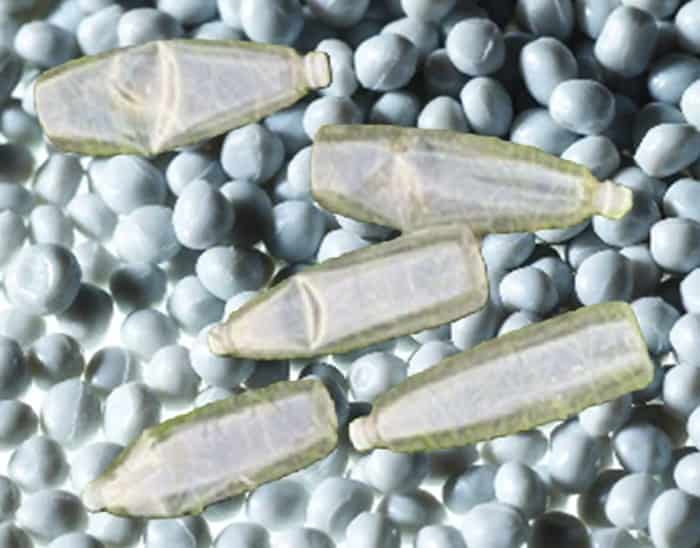
Mitsubishi Chemical Corporation (MCC) has announced its decision to withdraw from the PET bottle business
This sector of MCC provides various packaging solutions, primarily for condiments and alcoholic beverages. However, the business has faced significant pressure on profitability due to a sharp increase in raw material and logistics costs.
Despite efforts to improve the business through fixed cost reductions, MCC has concluded, after a thorough examination of the market environment, that future prospects for profitability and growth are limited. Consequently, the company has decided to exit this business segment. Textile waste
The withdrawal will involve the cessation of production by December 31, 2025, and the termination of sales by March 31, 2026. This decision reflects the challenging economic conditions impacting the PET bottle industry and MCC’s strategic focus on businesses with stronger growth potential. The affected operations include the Kanto Plant in Hiratsuka and the Central Japan Plant in Azai.

Italy Leads the Way in The Sustainable Management of Plastic Packaging Waste
In 2022, over 1 million tonnes of waste managed by Corepla, the National Consortium for the Collection, Recycling, and Recovery of Plastic Packagingproducts,’ he says.
In 2022, according to Eurostat data, 36.1 kg of plastic packaging waste per capita was generated in the European Union, of which 14.7 kg were recycled. Compared to 2012, the amount of waste increased by 7.6 kg per person, while the recycled portion increased by 4 kg. These numbers show how important it is to manage this type of packaging in a circular way, since it represents one of the main uses of plastic materials, with a share of 39%, down slightly from 40.5% in 2020.
In this landscape, Italy has taken on a leading role: in 2022, the country recycled over 1,050,000 tonnes of plastic waste, a sharp uptick from the 228,000 tonnes recorded 25 years ago. This sustainable management is overseen by Corepla, the National Consortium for the Collection, Recycling, and Recovery of Plastic Packaging, which has brought together the companies in this sector since 1997. Textile waste
From separate collection to recycling
Corepla ensures that the packaging for which it is responsible, derived from urban separate waste collection, is recycled correctly. The consortium undertakes the enhancement of this waste and delivers it to the firms who implement the recycling process, in accordance with market rules and ensuring fair access for all operators.
In particular, the collection stage is managed within the framework of conventions underwritten by the National Association of Italian Municipalities (Associazione Nazionale dei Comuni Italiani – ANCI) and the National Packaging Consortium (Consorzio Nazionale Imballaggi