Automotive Polyamides : Revolutionary Chemical Recycling of Automotive Polyamides: BASF’s Groundbreaking K2025 Innovation Transforms Waste into High-Value Nylon, Driving a Powerful Leap Toward a Circular, Sustainable, and Profitable Automotive Future 09-10-2025
Automotive Polyamides
Chemical Recycling of Automotive Polyamides: BASF’s Breakthrough at K2025
At K2025, one of the world’s premier trade fairs for plastics and rubber, the focus on sustainable solutions for the automotive sector was unmistakable. Among the highlights, BASF unveiled two pilot projects targeting the chemical recycling of automotive polyamides. These initiatives reflect a growing global commitment to circular economy principles, aiming to close the material loop while meeting the upcoming End-of-Life Vehicles (ELV) Regulation requirements being discussed in Brussels.
The projects showcase two distinct approaches: depolymerization and solvent dissolution. Both are designed to transform used or complex polyamide components into high-quality, reusable material, demonstrating practical applications for the automotive industry. Automotive Polyamides
Depolymerization: From Oil Pans to High-Performance Nylon
One of BASF’s pilot projects focuses on chemical recycling through depolymerization, developed in collaboration with the ZF Group, a leading manufacturer of vehicle components.
The process begins with used oil pans, notoriously difficult to dispose of and nearly impossible to recycle mechanically. Through depolymerization, these polyamide parts are broken down into caprolactam, a monomer that can then be purified and reused to produce new nylon. This recycled nylon can serve the same functions as virgin material, including in automotive applications. Automotive Polyamides
Practical Validation: Stabilizer Bars for Mercedes-Benz
The true test of this process came when ZF Group used the chemically recycled polyamide to manufacture a stabilizer bar for Mercedes-Benz vehicles. The results were compelling: mechanical and chemical properties matched those of virgin nylon, proving that depolymerization can deliver automotive-grade materials with no compromise on quality or performance.
Quote block:
“Depolymerization allows for the production of polyamide compounds with the same mechanical and chemical performance as virgin materials,” explains BASF engineers.
This pilot highlights a critical advantage of chemical recycling: the ability to recover high-value monomers from hard-to-recycle components, enabling a closed-loop system from vehicle to vehicle.
Solvent Dissolution: Tackling Shredding Residues
The second BASF project tackles polyamide recycling through solvent dissolution, designed for the complex material fractions remaining after metal and glass removal from end-of-life vehicles. Known as shredding residues or fluff, these mixtures are challenging to process mechanically. Automotive Polyamides
Through collaboration with a specialized recycler, BASF successfully extracted polyamide in nearly pure form using advanced sorting and solvent treatment technologies. Unlike depolymerization, this process does not break the polymer chains. Instead, the polymer is selectively dissolved, purified, and recompounded.
Industrial Validation: Chain Guides for Mercedes-Benz
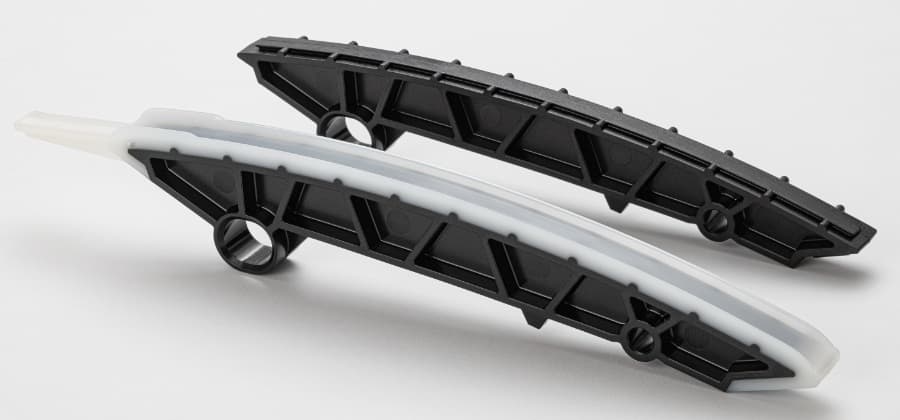
To confirm the method’s viability, BASF and partners produced a PA66 chain guide for Mercedes-Benz vehicles. Pöppelmann tested the component under near-industrial conditions, with excellent performance results.
Quote block:
“The project demonstrates that solvent-based recycling is a viable alternative for plastics that are difficult to mechanically recycle. It makes a significant contribution to the integrated circular economy, from vehicle to vehicle,” says Steffen Meyer, Team Leader Production Technology at Pöppelmann. Automotive Polyamides
This approach illustrates a flexible, scalable solution for automotive polyamides that are challenging to recycle with traditional mechanical methods.
Environmental Impact: Reducing Carbon Footprint
To quantify the sustainability benefits of both approaches, BASF commissioned a third-party life cycle assessment (LCA). The results were clear: both depolymerization and solvent dissolution significantly reduce CO₂ emissions compared to producing virgin polyamide from fossil sources or using waste-to-energy disposal.
-
Depolymerization converts difficult-to-recycle components into reusable monomers, reducing raw material extraction.
-
Solvent dissolution efficiently recovers polyamide from mixed shredding residues, minimizing waste. Automotive Polyamides
These innovations align with global carbon reduction targets and the growing regulatory pressure to implement circular solutions in automotive manufacturing.
Closing the Loop: Toward a Circular Automotive Economy
BASF’s chemical recycling pilots demonstrate that automotive polyamides can be recovered and reused at scale, paving the way for a vehicle-to-vehicle circular economy. Key takeaways include:
-
Material quality: Recycled polyamide matches virgin material performance, enabling direct reuse in automotive applications.
-
Scalability: Both methods are adaptable for industrial-scale operations.
-
Sustainability: Significant reductions in CO₂ emissions enhance environmental performance.
By addressing the challenges of difficult-to-recycle components, BASF’s work supports the broader EU vision for sustainable automotive materials and demonstrates that industrial recycling innovation is feasible and practical.
Implications for the Automotive Industry
The applications for these chemical recycling processes are extensive. Automotive manufacturers face increasing pressure to:
-
Meet ELV regulations: Recycling targets for end-of-life vehicles are becoming stricter across Europe.
-
Reduce reliance on fossil resources: Recovering polyamide through depolymerization or solvent dissolution offsets the need for virgin feedstock.
-
Support sustainable supply chains: Closed-loop recycling ensures consistency in material quality while lowering environmental impact.
The ability to convert used oil pans, shredding residues, and other complex polyamide fractions into high-performance materials represents a major step forward for sustainable automotive manufacturing.
Technical Insights: How Depolymerization Works
Depolymerization involves breaking polyamide chains back into monomers through controlled chemical reactions. In BASF’s pilot:
-
Collection: Used polyamide parts, such as oil pans, are gathered from end-of-life vehicles.
-
Processing: The material undergoes depolymerization, yielding caprolactam.
-
Purification: The monomer is purified to remove impurities.
-
Repurposing: Caprolactam is polymerized into new nylon, ready for automotive applications.
This closed-loop approach ensures the recycled polymer meets mechanical, chemical, and thermal specifications for demanding automotive components.
Technical Insights: How Solvent Dissolution Works
Solvent dissolution takes a different path, focusing on polyamide recovery without breaking the polymer chain:
-
Sorting: Shredding residues are separated to isolate polyamide fractions.
-
Dissolution: Polyamide is selectively dissolved in a suitable solvent.
-
Purification: Impurities are removed, yielding nearly pure polymer.
-
Recompounding: The polymer is extruded or molded into new automotive components.
This process is particularly effective for mixed or contaminated waste streams, offering a high-value recycling solution for material fractions traditionally considered unrecyclable.
Measuring Success: LCA and CO₂ Savings
The life cycle assessment conducted on both processes highlighted key benefits:
| Recycling Method | CO₂ Reduction vs. Virgin Polyamide | CO₂ Reduction vs. Waste-to-Energy |
|---|---|---|
| Depolymerization | Significant | Significant |
| Solvent Dissolution | Significant | Significant |
These figures demonstrate that chemical recycling is not only technically viable but also environmentally advantageous, reinforcing its potential for wide-scale adoption in automotive manufacturing.
Future Outlook: Scaling Chemical Recycling
BASF’s pilot projects at K2025 are more than proofs of concept—they provide a roadmap for scalable chemical recycling of automotive polyamides.
Future developments may include:
-
Expansion of industrial-scale depolymerization plants.
-
Broader implementation of solvent dissolution technologies for complex waste streams.
-
Integration of recycling processes into automotive supply chains to meet ELV and sustainability targets.
The combination of these strategies could transform automotive plastics management, ensuring circularity, cost efficiency, and regulatory compliance.
Conclusion
Chemical recycling of automotive polyamides is emerging as a game-changer for the automotive sector, bridging the gap between sustainability goals and industrial feasibility. BASF’s pilot projects—depicting both depolymerization and solvent dissolution—demonstrate that:
-
Closed-loop recycling is technically achievable.
-
Recycled polyamide can match virgin material performance.
-
Significant CO₂ reductions are possible, supporting environmental targets.
As the automotive industry faces tighter regulatory pressure and growing demand for sustainable materials, chemical recycling offers a practical, scalable, and environmentally responsible solution.
BASF’s work at K2025 signals a new era for circular automotive plastics, turning end-of-life components into valuable resources and setting the stage for a fully integrated, vehicle-to-vehicle circular economy.
More…