Game-Changing PPS Resin Recycling Technology Breakthrough Solves Plastic Waste Crisis – Polymer Price Trends

PPS resin recycling technology – Full price table (28/09/2026 →05/10/2026)
| ITEM | 28/09/2026 | 05/10/2014 | +/− | ||||||||||||
|---|---|---|---|---|---|---|---|---|---|---|---|---|---|---|---|
| Bottle grade PET chips domestic market | 8,700 yuan/ton | 8,750 yuan/ton | +50- | ||||||||||||
| Chinese bottle-grade PET chips FOB export price | 1,190 $/ton | 1,190 $/ton | — | ||||||||||||
| LDPE CFR Est China | 1,300 $/ton | 1,300 $/ton | — | ||||||||||||
| PET Semidull — Fiber chips | 8.550 yuan/ton | 8,650 yuan/ton | +100- | ||||||||||||
| PET Bright — Fiber chips | 8,600 yuan/ton | 8,700 yuan/ton | +100- | ||||||||||||
| Pure Terephthalic Acid PTA domestic market | 7,250 yuan/ton | 7,300 yuan/ton | +50- | ||||||||||||
| Pure Terephthalic Acid PTA FOB China | 950 $/ton | 950 $/ton | — | ||||||||||||
| Monoethyleneglycol (MEG) South China | 6,855 yuan/ton | 6,527 yuan/ton | -328- | ||||||||||||
| Monoethyleneglycol (MEG) CFR China | 800 $/ton | 710 $/ton | -90- | ||||||||||||
| Paraxylene PX FOB Taiwan market | 1,249 $/ton | 1,243 $/ton | -6- | ||||||||||||
| Paraxylene PX FOB South-Korea market | 1,238 $/ton | 1,232 $/ton | -6- | ||||||||||||
| Paraxylene PX FOB EU market | 1,594 $/ton | 1,131 $/ton | -463- | ||||||||||||
| Polyester filament POY 150D/48F domestic market | 9,300 yuan/ton | 9,500 yuan/ton | +200- | ||||||||||||
| Recycled Polyester filament POY 150/48F domestic market | 7,850 yuan/ton | 7,850 yuan/ton | — | ||||||||||||
| Polyester filament DTY 150D/48F domestic market | 10,400 yuan/ton | 10,450 yuan/ton | +50- | ||||||||||||
| Polyester filament FDY 68D/24F | 10,200 yuan/ton | 10,300 yuan/ton | +100- | ||||||||||||
| Polyester filament FDY 150D/96F domestic market | 9,500 yuan/ton | 9,600 yuan/ton | +100- | ||||||||||||
| Polyester staple fiber 1.4D 38mm domestic market | 8,630 yuan/ton | 8,730 yuan/ton | +100- | ||||||||||||
| Caprolactam (CPL) domestic market | 13,800 yuan/ton | 13,800 yuan/ton | — | ||||||||||||
| Caprolactam (CPL) CFR China | 1,780 $/ton | 1,780 $/ton | — | ||||||||||||
| Nylon 6 chips overseas market |
Northeast Asia / China export
1,700–1,900 USD/MT
FOB China / CFR Asia; competitive export levels
Southeast Asia
1,800–2,200 USD/MT
CFR SEA / import parity
Europe
2,100–2,700 USD/MT
FD / Delivered (e.g., Germany/EU)
North America
2,900–3,200 USD/MT
Delivered / domestic contract
Other (e.g., Middle East / India CIF)
Often 2,000–3,700+ USD/MT
Higher for delivered/import parity; India CIF China-origin recently ~2,150 USD/MT in Aug 2026
|
|
— | ||||||||||||
| Nylon 6 chips conventional spinning domestic market | 14,450 yuan/ton | 14,450 yuan/ton | — | ||||||||||||
| Nylon 6 chips high speed spinning domestic market | 14,500 yuan/ton | 14,500 yuan/ton | — | ||||||||||||
| Nylon 6.6 chips domestic market | 18,200 yuan/ton | 18,000 yuan/ton | -200- | ||||||||||||
| Nylon6 Filament POY 86D/24F domestic market | 16,000 yuan/ton | 16,000 yuan/ton | — | ||||||||||||
| Nylon6 Filament DTY 70D/24F domestic market | 18,000 yuan/ton | 18,000 yuan/ton | — | ||||||||||||
| Nylon6 Filament FDY 70D/24F | 16,000 yuan/ton | 16,000 yuan/ton | — | ||||||||||||
| Spandex 20D domestic market | 31,300 yuan/ton | 31,300 yuan/ton | — | ||||||||||||
| Spandex 30D domestic market | 30,800 yuan/ton | 30,800 yuan/ton | — | ||||||||||||
| Spandex 40D domestic market | 28,100 yuan/ton | 28,100 yuan/ton | — | ||||||||||||
| Adipic Acid China domestic market | 9,730 yuan/ton | 10,100 yuan/ton | +370- | ||||||||||||
| Adipic Acid Europe market | 2,200 $/ton | 2,200 $/ton | — | ||||||||||||
| Benzene domestic market East China | 9,900 yuan/ton | 10,400 yuan/ton | +500- | ||||||||||||
| Benzene CFR China | 1,198 $/ton | 1,220 $/ton | +22- | ||||||||||||
| Ethylene South East market | 1,140 $/ton | 1,140 $/ton | — | ||||||||||||
| Ethylene NWE market CIF | 861 Euro/ton | 865 Euro/ton | +4- | ||||||||||||
| Acrylonitrile (ACN) domestic market | 11,100 yuan/ton | 11,100 yuan/ton | — | ||||||||||||
| Acrylonitrile ACN Southeast Asia | 1,550 $/ton | 1,530 $/ton | -20- | ||||||||||||
| Acrylic staple fiber (ASF) CFR China | 15,975 yuan/ton | 15,975 yuan/ton | — | ||||||||||||
| VSF viscose staple fiber | 14,650 yuan/ton | 14,650 yuan/ton | — | ||||||||||||
| PP Powder domestic market | 10,050 yuan/ton | 10,050 yuan/ton | — | ||||||||||||
| Naphtha overseas market | 812 $/ton | 825 $/ton | +13- | ||||||||||||
| Phenol domestic market (Jinan Dezheng / Yanshan Petrochemical, Shandong) | 8,815 yuan/ton | 8,950 yuan/ton | +135- | ||||||||||||
| Recycled PET | 4,300 yuan/ton | 4,300 yuan/ton | — |
Game-Changing PPS Resin Recycling Technology Breakthrough Solves Plastic Waste Crisis
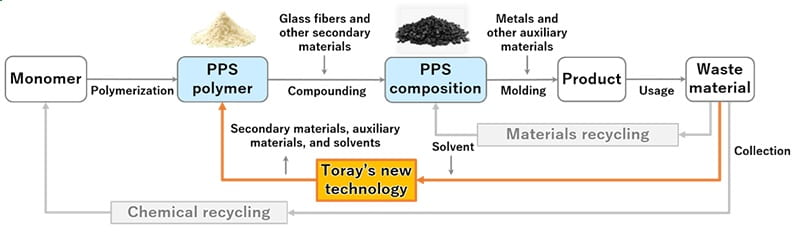
In a major development for sustainable industrial manufacturing, Toray Industries, Inc. has announced the development of the world’s first solvent-based recycling process designed to recover polyphenylene sulfide (PPS) directly from waste materials. This technology unlocks a clean, efficient recovery pathway for one of the world’s most resilient super-engineering plastics.
Rather than relying on energy-intensive chemical decomposition, this process selectively dissolves and separates PPS from complex composite waste while fully preserving its polymer architecture. The technique eliminates impurities and glass fibers without degrading the material’s underlying structure, addressing a long-standing challenge in global resource recovery.
Why Traditional Recycling Failed Super-Engineering Plastics
Polyphenylene sulfide (PPS) is prized across the automotive, aerospace, and electronics sectors for its exceptional thermal resistance, flame retardancy, and chemical immunity. However, those same protective qualities historically made PPS nearly impossible to recycle post-consumer.
Conventional mechanical recycling degrades plastic polymer chains, lowering the material’s melting point and mechanical strength with each cycle.
Chemical recycling typically requires breaking polymers down into individual monomers, an aggressive process that consumes significant energy and introduces residual contamination. Because virtually no standard solvents can dissolve PPS, millions of metric tons of high-performance components ended up in landfills or high-temperature incinerators at the end of their lifecycle.
The Science Behind Toray’s Selective Solvent Extraction
Toray overcame this technical barrier by leveraging decades of specialized PPS resin manufacturing expertise. The novel process follows a physical-chemical extraction route:
-
Selective Dissolution: Under controlled thermal conditions, a custom solvent system selectively targets and dissolves the PPS resin matrix out of complex waste components.
-
Contaminant Separation: Impurities, structural fillers, and glass reinforcement fibers are filtered out while the PPS remains dissolved in solution.
-
Controlled Recrystallization: The dissolved polymer is isolated and crystallized back into pure resin pellets.
Because the original polymer chain remains intact during separation, the extracted material matches the exact molecular weight, heat deflection, and melting threshold of virgin-grade PPS resin. PPS resin recycling technology
                 +--------------------------------+
                 | Complex PPS Waste Components   |
                 +--------------------------------+
                                 |
                                 v
                 +--------------------------------+
                 | Selective Solvent Dissolution  |
                 +--------------------------------+
                                 |
         +-----------------------+-----------------------+
         |                                               |
         v                                               v
+--------------------------------+             +-------------------+
| Structural Glass Fibers &      |             | Dissolved Pure    |
| Extraneous Contaminants        |             | PPS Resin         |
+--------------------------------+             +-------------------+
         |                                               |
         v                                               v
  (Filtered Out)                               +-------------------+
                                               | Controlled        |
                                               | Recrystallization |
                                               +-------------------+
                                                         |
                                                         v
                                               +-------------------+
                                               | Virgin-Equivalent |
                                               | Recycled PPS      |
                                               +-------------------+
Regulatory Drivers and Industrial Supply Scale-Up
This technological leap arrives as global regulatory pressure intensifies, particularly across the European Union. Emerging circular economy mandates require automotive manufacturers to incorporate verified percentages of post-consumer recycled (PCR) content into new vehicles.
Toray is currently scaling the technology through a Japanese Ministry of Economy, Trade and Industry (METI) project focused on circular economy autonomy. Demonstration testing is underway to quantify lifecycle cradle-to-gate greenhouse gas emission reductions relative to virgin resin production. Full-scale commercial supply is targeted for around 2030, establishing a circular supply chain spanning waste collection through high-tier component remanufacturing. PPS resin recycling technology
Broader Technical Context: Advanced Material Recovery Comparison
To contextualize where solvent extraction fits among modern plastic recovery methods, the following matrix compares primary industrial recycling strategies for technical polymers:
| Recycling Method | Structural Integrity Retained | Energy Input | Contaminant Removal Efficiency | Target Output Grade |
| Mechanical Recycling | Low (Chain Scission) | Low | Poor | Downcycled / Low-tier |
| Monomer Depolymerization | Medium (Re-polymerization) | Very High | Moderate | Virgin-Equivalent |
| Solvent Extraction (Toray) | High (Polymer Preserved) | Moderate | High | Virgin-Equivalent |
By keeping polymer chains intact while stripping out contaminants, solvent extraction bridges the gap between high performance and true closed-loop circularity for super-engineering thermoplastics.
More…