Revolutionary Polyurethane Chemical Recycling Model Launched in Japan to Eliminate End-of-Life Waste
Polyurethane Chemical Recycling Japan
Revolutionary Polyurethane Chemical Recycling Model Launched in Japan to Eliminate End-of-Life Waste
The global chemical sector is experiencing a monumental transformation as industrial leaders move away from traditional linear consumption models toward fully circular material lifecycles. Flexible polyurethane (PU) foam—an essential material found in automotive seating, high-end furniture, and bedding—has long posed a persistent environmental challenge. Standard mechanical recycling methods frequently degrade the material’s structural integrity, forcing recycled foam into downcycled, low-value applications or directing massive volumes toward incineration and landfills.
In an unprecedented collaborative effort announced in mid-October 2026, specialty chemicals giant Evonik joined forces with Japanese industry leaders Toyotsu Chemiplas Corporation and Sanyo Chemical Industries, Ltd. to commercialize a localized, closed-loop polyurethane recycling ecosystem across Japan. By combining advanced hydrolysis-based chemical recycling technology with sophisticated domestic logistics and polyol refinement, this landmark initiative sets out to completely redefine how post-consumer waste and industrial scrap are processed. Polyurethane Chemical Recycling Japan
The Polyurethane Bottleneck: Beyond Traditional Mechanical Recycling
Polyurethane foam is valued worldwide for its resilience, cushioning, and durability. However, these exact mechanical qualities make standard post-use recovery extraordinarily complex. Mechanical shredding and rebonding degrade the polymer network, yielding inferior products that eventually end up in incinerators. This linear trajectory causes significant material loss and drives high greenhouse gas emissions across global supply chains.
Chemical recycling breaks down the polymer chains at a molecular level. Instead of simply chopping foam into smaller pieces, chemical depolymerization breaks down the complex polyurethane matrix into its fundamental chemical precursors: high-purity polyols and functional amines.
Recovering these high-purity building blocks offers manufacturers a direct “drop-in” alternative to virgin petrochemical feedstocks. This process maintains full product performance while drastically cutting down reliance on crude oil extraction. Polyurethane Chemical Recycling Japan
Strategic Synergies Across the Industrial Supply Chain
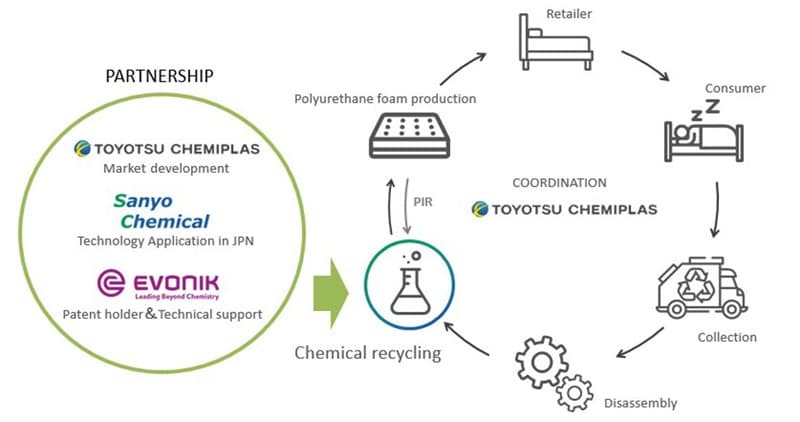
Building a viable circular economy requires more than breakthrough laboratory chemistry; it demands an integrated, end-to-end industrial architecture. The partnership between Evonik, Toyotsu Chemiplas, and Sanyo Chemical unites three complementary core competencies into a synchronized operational value chain.
| Partner Company | Primary Role & Operational Responsibility | Key Technical Contribution |
| Toyotsu Chemiplas Corp. | Logistics & Supply Chain Coordination | Aggregation networks for post-consumer foam and factory scrap |
| Sanyo Chemical Industries | Polyol Development & Formulation | Refining recovered compounds into commercial-grade polyols |
| Evonik | Technology Provider & Life Cycle Analysis | Proprietary hydrolysis chemical depolymerization process |
1. Reverse Logistics and Supply Chain Management
Toyotsu Chemiplas leads the critical first phase: building a reliable collection and sorting network throughout Japan. Aggregating post-consumer mattresses, vehicle seats, and industrial scrap from manufacturing plants ensures a steady flow of feedstock for chemical processing facilities. Polyurethane Chemical Recycling Japan
2. Proprietary Hydrolysis Chemical Recycling
Evonik supplies its proprietary hydrolysis depolymerization technology. Validated at its pilot plant in Hanau, Germany, Evonik’s process uses water and heat under precise catalytic conditions to break polyurethane bonds cleanly. This yields high-purity polyols and raw amines without generating toxic side products.
3. Formulation and Drop-In Application Development
Sanyo Chemical integrates the recovered monomers back into standard polyol manufacturing streams. By refining these molecules into commercial-grade formulations, Sanyo Chemical enables Japanese manufacturers to produce new, premium-grade polyurethane foam using up to 100% recycled polyol content without compromising quality or safety. Polyurethane Chemical Recycling Japan
Environmental Impact and Decarbonization Metrics
The introduction of chemical recycling for polyurethane foam directly targets the chemical industry’s Scope 1 and Scope 3 carbon emission standards. Traditional polyol manufacturing relies heavily on propylene oxide and ethylene oxide derived from fossil fuels. Replacing virgin petrochemical inputs with circular polyols yields substantial carbon reductions across the entire manufacturing life cycle.
Dr. Martin Trocha, Head of Comfort & Adhesives within Evonik’s Interface & Polyurethane Additives business line, emphasized that combining local Japanese logistics with advanced hydrolysis yields high-quality circular raw materials that measurably shrink industrial carbon footprints. Updated Life Cycle Assessments (LCAs) are currently underway to measure the exact reduction in emissions achieved by operating this closed-loop model within Japan’s national energy grid. Polyurethane Chemical Recycling Japan
Market analyses by sector intelligence firms like ChemAnalyst note that while immediate market price shifts for raw polyols, MDI, and TDI remain localized during the pilot evaluation phase, scaling this technology will shield manufacturers from petrochemical market volatility and stringent international carbon tariffs.
Market Implications for Global CleanTech Adoption
Japan’s commitment to resource circularity provides an ideal testing ground for commercial-scale chemical recycling. With land constraints making landfilling impractical and national policies prioritizing resource autonomy, localized recycling models—designed “in Japan, for Japan”—offer a clear blueprint for sustainable industrial manufacturing. Polyurethane Chemical Recycling Japan
This three-way partnership demonstrates that circular chemistry is transitioning from experimental trials to commercial deployment. As quality assessments finalize and localized value chains mature, the model provides automotive OEMs, furniture producers, and chemical distributors with a proven road map to fulfill extended producer responsibility (EPR) mandates, protect finite resources, and reach net-zero carbon goals.
Evonik Advances Plastic Chemical Recycling with New Pyrolysis Oil Purification Technologies
More…