Biodegradation Test – AIMPLAS Launches Rapid Biodegradation Test, Slashing Evaluation Time by Two-Thirds AIMPLAS, the Plastics Technology Centre, has unveiled a groundbreaking accelerated biodegradation testing method that significantly cuts down the time required to assess the compostability of plastic materials 22-05-2025 - Archive
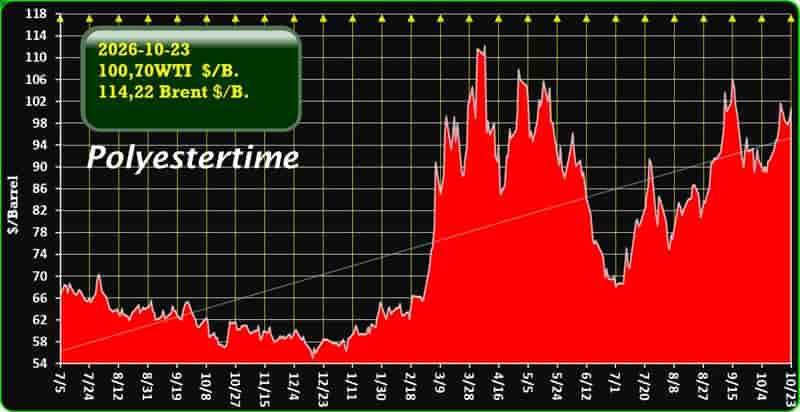
Crude Oil Prices Trend

?? U.S. Polyethylene Industry Expands Export Dominance Despite Trade Uncertainty
U.S. Net PE Exports Surpass 3 Million Tons in Q1 2025
The United States continues to cement its role as a net exporter of polyethylene (PE), one of the world’s most essential plastic commodities. According to new data analyzed by the Plastics Industry Association, U.S. producers exported more than 3.98 million tons of PE granules in the first quarter of 2025. This marks a 5.1% increase compared to the same period in 2024.
At the same time, imports fell to 882,000 tons, down 10.2% year-over-year, further widening the country’s trade surplus to over 3 million tons.
? Global Demand Led by China, Mexico, and Brazil
Top 5 PE Export Destinations (Q1 2025):
- China – 652,720 tons (16.4%)
- Mexico – 453,720 tons (11%)
- Brazil – 362,180 tons (9.1%)
- Canada – 266,760 tons (6.7%)
- Belgium – 246,760 tons (6.2%)
Together, these five countries accounted for nearly half of all U.S. polyethylene exports in Q1.
China, the largest single buyer, absorbed over 16% of total shipments, underscoring the strategic importance of this trade relationship. However, geopolitical tensions and tariff uncertainties continue to cast a shadow over future trade prospects.
Import Breakdown: A North American Affair
While exports flourish, U.S. polyethylene imports are largely dominated by Canada, which supplied a staggering 86.7% (764,394 tons) of all imported PE in Q1. Other notable import sources included Mexico (5%) and South Korea (1.5%).
? U.S. Competitive Edge Holds Strong
According to Perc Pineda, Chief Economist at the Plastics Industry Association, the U.S. maintains a strong global position thanks to several key advantages:
- Abundant feedstocks (like ethane from shale gas)
- High production capacity
- Favorable trade agreements
- Established logistics infrastructure
“Despite the uncertainty, the first quarter results confirm the competitive advantage of the U.S. polyethylene industry,” said Pineda. “Barring major disruptions, this position is expected to be maintained in the short term.”
⚠️ Tariff Concerns Remain on the Radar
While the U.S. PE industry enjoys a strong performance, the looming threat of tariff-based trade disputes—especially with China—remains a source of concern. Although duties have been temporarily suspended, any escalation could seriously impact U.S. petrochemical exports, which are heavily reliant on global demand.
? What This Means for the Market
- The U.S. is strengthening its foothold as a global PE supplier
- Export dependency makes the sector vulnerable to trade policy shifts
- Asia and Latin America will remain critical markets for U.S. producers
? Final Takeaway
With record-high exports, reduced imports, and a growing trade surplus, U.S. polyethylene producers are poised for short-term success. However, ongoing geopolitical and economic factors will require careful monitoring to sustain this momentum in the long run.

AIMPLAS Launches Rapid Biodegradation Test, Slashing Evaluation Time by Two-Thirds
AIMPLAS, the Plastics Technology Centre, has unveiled a groundbreaking accelerated biodegradation testing method that significantly cuts down the time required to assess the compostability of plastic materials. The new approach delivers results in just one-third of the time compared to conventional tests, marking a major leap forward for sustainability-focused innovation in the plastics industry.
A Critical Need for Speed in a Circular Economy
As the plastics sector pivots towards a more sustainable, circular economy model, compostable bioplastics are emerging as a key solution. These materials can be responsibly managed through composting or organic recycling, making them attractive options for companies seeking to reduce their environmental impact. Biodegradation Test
However, validating the biodegradability of new materials remains a challenge. Current certification protocols, such as EN-ISO 14855 in Europe and other international equivalents, involve lengthy and expensive biodegradation tests. This has long been a bottleneck in the development and certification of innovative biodegradable plastics.
Introducing AIMPLAS’ Accelerated Biodegradation Test
To address this issue, AIMPLAS has developed a novel accelerated test that simulates industrial composting conditions in a controlled environment. The method measures the conversion of polymeric carbon into carbon dioxide (CO2), allowing for a rapid assessment of how quickly materials break down.
With this fast-track evaluation tool, companies can now test their material formulations early in the R&D process. This means they can:
- Identify the most biodegradable candidates quickly
- Refine formulations more efficiently Biodegradation Test
- Develop or adjust additives with better performance
- Optimize resource allocation before pursuing full certification
A Valuable Pre-Certification Screening Tool
It’s important to note that this accelerated test does not replace official certification procedures, such as those outlined in UNE-EN 13432 and other related standards. Instead, it serves as a powerful technical and strategic filter, helping researchers and manufacturers zero in on the most promising options early in the development cycle.
By narrowing down the pool of viable candidates in advance, this method reduces both cost and time associated with full compliance testing. It also aligns with international biodegradation standards like EN-ISO 14855, helping companies stay on track toward global certification goals. Biodegradation Test
Empowering Innovation in Bioplastics
Thanks to AIMPLAS’ innovation, the plastics industry now has access to a highly effective tool for accelerating the development of biodegradable materials. By streamlining the evaluation process, companies can bring sustainable, compostable plastics to market faster—supporting both environmental goals and competitive innovation.
For industries committed to sustainability, AIMPLAS’ accelerated biodegradation testing marks a significant step forward in the race toward a circular economy.
Honeywell and ENEOS Launch World’s First Commercial Hydrogen Supply Chain via MCH
Honeywell has partnered with ENEOS, one of Japan’s top energy companies, to begin engineering the world’s first commercial-scale hydrogen supply chain using Honeywell UOP’s methylcyclohexane (MCH) dehydrogenation process. This groundbreaking project will cover the entire hydrogen value chain—from production to recycling—marking a significant leap in clean energy logistics and infrastructure. Biodegradation Test
A Complete Hydrogen Ecosystem
The initiative is designed to establish a complete hydrogen ecosystem, including:
- Hydrogen production
- Storage and transportation
- Distribution
- Recovery and recycling of key components
ENEOS plans to install the MCH processing unit within its existing refinery infrastructure in Japan. This aligns with the nation’s broader push toward achieving decarbonization goals and improving energy resilience.
Safe and Efficient Hydrogen Transport
At the heart of this supply chain is the Honeywell Liquid Organic Hydrogen Carrier (LOHC) Solution. This solution enables the conversion of hydrogen gas into methylcyclohexane through a proprietary Toluene Hydrogenation process. Once converted, the MCH can be transported safely via ship or tanker over long distances without the high-pressure or cryogenic storage traditionally required for hydrogen gas. Biodegradation Test
When the MCH reaches its destination, the hydrogen is extracted using Honeywell’s advanced MCH dehydrogenation technology. The leftover byproduct, toluene, can then be shipped back and reused, making the cycle not just efficient but also sustainable.
Meeting Global Energy Demands
Rajesh Gattupalli, President of Honeywell UOP, emphasized the importance of such solutions in the evolving global energy landscape:
“With global energy demand on the rise, regions are seeking to incorporate additional energy sources, including cost-effective hydrogen imports. Nations with strong renewable energy bases or hydrogen infrastructure are uniquely positioned to become major suppliers. Our MCH dehydrogenation process will assist ENEOS in enhancing the commercial viability of hydrogen to meet increasing energy requirements.” Biodegradation Testest
A Strategic Collaboration
The partnership between Honeywell and ENEOS reflects a long-term strategic commitment to hydrogen as a clean energy alternative. In 2024, Honeywell revealed plans to develop the world’s first commercial-scale LOHC project at multiple ENEOS facilities. These initiatives aim to pave the way for scalable hydrogen logistics across Asia and beyond.
Driving Energy Independence Through Innovation
Hydrogen is increasingly seen as a key component of future energy strategies—especially for heavy industries and nations seeking energy independence. Honeywell’s cutting-edge LOHC technology makes it feasible to move hydrogen across vast distances safely, unlocking new possibilities for global energy trade.
This project is expected to play a pivotal role in reducing emissions, enhancing energy security, and providing a blueprint for future commercial hydrogen ventures worldwide.
Looking Ahead
As demand for hydrogen continues to grow, innovations like Honeywell’s MCH dehydrogenation and LOHC solutions will be crucial in scaling supply chains efficiently. The collaboration with ENEOS sets a powerful example of how industrial partnerships can drive meaningful progress in clean energy deployment. Biodegradation Test
Stay tuned as Honeywell and ENEOS move from engineering to execution, setting new standards in sustainable hydrogen logistics.

AIBO Chemicals Develops Advanced Anti-Static Coating for Automotive Displays
Aibo Chemical Technology Co., Ltd., a South Korean company known for its high-end functional materials, announced a major breakthrough on May 20. The company has successfully developed a new anti-static coating designed specifically for use in automotive touch screen displays.
Why Anti-Static Coatings Matter in Vehicles
Modern vehicles increasingly rely on digital displays for navigation, infotainment, and vehicle control. However, these in-vehicle touchscreens face a critical challenge: static electricity buildup. Accumulated static can cause short circuits within the touch panels, potentially leading to system failures. In the highly regulated automotive sector, such malfunctions are often classified as serious defects, creating significant concerns for manufacturers. Biodegradation Test
To address this risk, manufacturers use anti-static coatings during the production of display panels. These coatings dissipate static electricity, ensuring the long-term reliability of touchscreens under varying environmental conditions.
Limitations of Current Industry Solutions
Most current anti-static coatings rely on carbon nanotube (CNT) materials. While CNTs are known for their high conductivity and thermal stability, they come with two significant downsides: high production costs and poor dispersion stability in solution. These issues increase manufacturing complexity and limit scalability.
AIBO’s Breakthrough: Conductive Polymer-Based Coating
Aibo Chemicals has tackled this challenge by investing five years into the development of a next-generation anti-static solution. Their new coating leverages conductive polymer materials, offering comparable conductivity to CNTs while dramatically improving dispersion stability and reducing production costs. Biodegradation Test
The result is a highly reliable and economically viable anti-static coating tailored for in-vehicle displays. According to Aibo, this innovation is positioned to replace traditional CNT solutions across the industry.
Commercialization and Industry Partnerships
Aibo Chemical is already in active discussions with several major players in the display industry. These include a leading South Korean panel manufacturer (referred to as L Company) and two prominent Chinese firms (B Company and I Company), covering regions such as China, Hong Kong, Macao, and Taiwan.
These strategic collaborations aim to fast-track the commercial adoption of Aibo’s coating across automotive display manufacturing pipelines. Biodegradation Test
Looking Ahead: Graphene and Next-Gen Materials
In parallel with commercialization efforts, Aibo is also working on enhancing the performance of existing CNT-based coatings. The company is developing advanced formulations that address dispersion issues while maintaining cost efficiency.
Moreover, Aibo has launched a research project focused on graphene-based coating materials, aiming to lead the evolution of the display materials market with a focus on technological innovation and competitiveness.
Market Outlook for Automotive Displays
The market for in-vehicle displays is poised for robust growth. According to the Korea Display Industry Association (KDIA), the rise of multi-screen configurations and increased demand for smart cockpit systems are fueling the expansion. The market is projected to grow at a compound annual growth rate (CAGR) of 7.8%. Biodegradation Test
AIBO’s Role in the Future of Display Technology
As a prominent South Korean company specializing in advanced materials and components, Aibo Chemicals continues to push the boundaries in coating technologies. With expertise in conductive polymers, CNTs, and now graphene, Aibo is strategically positioned to be a key enabler in the next era of automotive and display innovation.

Navigating the Complex World of Mixed Plastic Waste and Pyrolysis Oil in Europe
Understanding the Rapidly Evolving Recycling Market
The European market for mixed plastic waste and pyrolysis oil is undergoing a significant transformation. As chemical recycling gains traction, particularly in the form of pyrolysis, competition for waste feedstock is heating up. In 2023, pyrolysis-based plants processing mixed plastic waste—primarily polyolefins—accounted for roughly 60% of all operational chemical recycling capacity across Europe.
This surge underscores a key industry trend: the shift toward circularity, where waste is not just managed but transformed into valuable secondary products. Biodegradation Test
Why Transparency Matters in These Markets
Historically, both mixed plastic waste and pyrolysis oil markets have been opaque, making strategic planning difficult for recyclers, investors, and policymakers. The lack of transparent pricing, fragmented data, and inconsistent quality standards has made it challenging to benchmark and compare costs across the value chain.
Today, market participants need reliable, real-time pricing and performance data to stay competitive and compliant with EU regulations and sustainability goals.
Key Feedstocks and Pricing Dynamics
Mixed Plastic Waste Feedstocks
The pricing of mixed plastic waste includes a range of feedstocks such as:
- Mixed polyolefin bales
- Refuse-derived fuel (RDF) bales Biodegradation Test
- Unsorted materials recovery facility (MRF) waste
These materials serve as the backbone for both chemical recycling and energy recovery (burn-for-energy) operations. As demand increases, so does competition—and prices reflect that.
Pyrolysis Oil Grades
Pyrolysis oil, derived from breaking down plastics at high temperatures in the absence of oxygen, comes in different grades with varying market value:
- Naphtha substitutes (used in virgin polymer production)
- Non-upgraded pyrolysis oils
- Tyre-derived pyrolysis oils Biodegradation Testt
Accurate pricing of these oils is crucial, as it influences the economic viability of chemical recycling projects.
Conclusion: Stay Ahead in a Competitive Landscape
As chemical recycling technologies mature and regulatory frameworks evolve, staying updated with transparent, comprehensive data is no longer optional—it’s a necessity. Whether you’re a recycler, chemical producer, brand owner, or policymaker, understanding the pricing and supply dynamics of mixed plastic waste and pyrolysis oil will be critical to success.
Leverage tools like ICIS’ price benchmarks and supply trackers to lead the way in building a sustainable, circular plastic economy. Biodegradation Test

Toray Unveils Breakthrough in Nylon 66 Chemical Recycling
Revolutionary depolymerization technology sets new standards for sustainable plastic reuse
A Game-Changer in Plastic Recycling
Toray Industries, Inc. has announced a major advancement in the chemical recycling of nylon 66, a widely used plastic in the automotive and industrial sectors. With a new proprietary technology, the company can now efficiently depolymerize nylon 66 using subcritical water, recovering it as reusable raw monomers in a matter of minutes.
This innovative approach significantly boosts recycling rates and reduces environmental impact—positioning Toray as a leader in the global shift toward circular economies.
Why Nylon 66 Matters
Nylon 66 is in high demand, with Japan consuming 100,000 metric tons annually and the global market reaching 1.3 million tons.
Its strength and heat resistance make it indispensable in automotive textiles—such as airbags and tire cords—and under-the-hood plastic components like radiator tanks, cylinder head covers, and oil pans. Biodegradation Test
With tightening recycling regulations, particularly in Japan’s automotive sector, there’s an urgent need for efficient ways to repurpose used nylon-based materials—especially airbags. Nylon 66’s complex molecular structure has historically posed challenges for chemical recycling, but Toray’s solution changes the game.
What Sets Toray’s Technology Apart
Most chemical recycling of nylon involves nylon 6, where the monomer caprolactam is recovered. However, nylon 66 requires recovering two different monomers: hexamethylenediamine and adipic acid.
Leveraging its experience with nylon 6, Toray developed a proprietary process that uses subcritical water—a state of water under specific heat and pressure conditions—to break down nylon 66 rapidly and uniformly. The innovation lies in suppressing side reactions, which traditionally reduce yield and quality. Toray’s method achieves high-yield monomer recovery, enabling the material to be regenerated into fresh nylon 66 through repolymerization.
Even more compelling: carbon dioxide emissions are reduced by 50% compared to conventional production from petroleum-based sources. Biodegradation Test
Roadmap to Mass Production
Toray’s initial focus is on automotive materials, aiming to perfect technologies that:
- Separate nylon from multi-material components like airbags
- Depolymerize nylon 66 efficiently
- Refine and purify the resulting monomers
By 2025, Toray plans to establish a framework for quality verification and customer sampling. The goal is to be ready for full-scale production by 2030, aligning with anticipated stricter global plastic recycling mandates.
Toward a Circular Economy
This breakthrough is a cornerstone in Toray’s broader mission: creating comprehensive recycling technologies for both nylon 6 and nylon 66.
The company plans to extend these capabilities beyond automotive and apparel into other industrial uses, supporting a circular economy and the global push toward carbon neutrality. Biodegradation Test
Aligning with the Toray Sustainability Vision 2050
Toray’s innovation directly supports its Sustainability Vision for 2050, which includes goals like sustainable resource management and carbon reduction. Through continued research and development, the company aims to build a recycling-oriented society and contribute to a better future.
This initiative also reflects Toray’s long-standing corporate philosophy:
“Contributing to society through the creation of new value with innovative ideas, technologies, and products.” Biodegradation Test
Final Thoughts
Toray’s new recycling method for nylon 66 represents more than a technical breakthrough—it’s a bold step toward sustainability in one of the most material-intensive industries. With the potential to slash emissions, reduce waste, and meet growing regulatory demands, this innovation could set a new standard for how we think about plastic reuse in the 21st century.