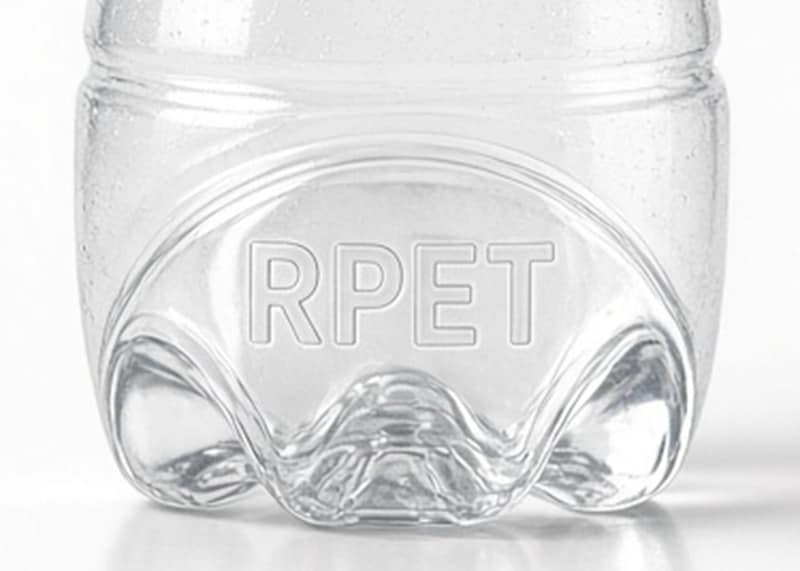
Revolutionary Breakthrough: New Light-Powered Recycling Technology Solves Waste PET Crisis – Polymer Price Trends
Chemical Recycling PET Technology – Full price table (02/11/2026 →09/11/2026)
| ITEM | 02/11/2026 | 09/11/2014 | +/− |
|---|---|---|---|
| Bottle grade PET chips domestic market | 9,000 yuan/ton | 8,350 yuan/ton | -650 |
| Chinese bottle-grade PET chips FOB export price | 1,240 $/ton | 1,150 $/ton | -90 |
| LDPE domestic market China | 13,100 $/ton | 12,000 $/ton | -1,100 |
| PET Semidull — Fiber chips | 8.550 yuan/ton | 8,000 yuan/ton | -550 |
| PET Bright — Fiber chips | 8,650 yuan/ton | 8,050 yuan/ton | -600 |
| Pure Terephthalic Acid PTA domestic market | 7,310 yuan/ton | 6,570 yuan/ton | -740 |
| Pure Terephthalic Acid PTA FOB China | 980 $/ton | 905 $/ton | -75 |
| Monoethyleneglycol (MEG) South China | 5,824 yuan/ton | 5,627 yuan/ton | -197 |
| Monoethyleneglycol (MEG) CFR China | 705 $/ton | 695 $/ton | -10 |
| Paraxylene PX FOB Taiwan market | 1,382 $/ton | 1,206 $/ton | -176 |
| Paraxylene PX FOB South-Korea market | 1,356 $/ton | 1,180 $/ton | -176 |
| Paraxylene PX FOB EU market | 1,349 $/ton | 1,245 $/ton | -104 |
| Polyester filament POY 150D/48F domestic market | 9,300 yuan/ton | 8,950 yuan/ton | -350 |
| Recycled Polyester filament POY 150/48F domestic market | 8,050 yuan/ton | 7,950 yuan/ton | -100 |
| Polyester filament DTY 150D/48F domestic market | 10,400 yuan/ton | 10,050 yuan/ton | -350 |
| Polyester filament FDY 68D/24F | 10,050 yuan/ton | 9,700 yuan/ton | -350 |
| Polyester filament FDY 150D/96F domestic market | 9,350 yuan/ton | 9,000 yuan/ton | -350 |
| Polyester staple fiber 1.4D 38mm domestic market | 8,950 yuan/ton | 8,600 yuan/ton | -350 |
| Caprolactam (CPL) domestic market | 13,625 yuan/ton | 12,600 yuan/ton | -410 |
| Caprolactam (CPL) CFR China | 1,750 $/ton | 2,100 $/ton | +350 |
| Nylon 6 chips overseas market |
China Export2,050-2,150 US$/mt Southeast Asia2,100-2,200 US$/mt Northeast Asia (Japan/Korea)2,150-2,300 US$/mt India2,180-2,320 Europe2,600-2,850 US$/mt North America2,900-3,200 US$/mt
|
China Export 2,300-2,450 $/mt Stable South Asia 2,400-2,550 $/mt Stable to firm India 2,450-2,650 $/mt Firm Europe (FD 2,750-3,000 $/mt Firm North America 2,900-3,150 $/mt Firm |
– |
| Nylon 6 chips conventional spinning domestic market | 14,650 yuan/ton | 13,400 yuan/ton | -1,250 |
| Nylon 6 chips high speed spinning domestic market | 14,550 yuan/ton | 13,700 yuan/ton | -750 |
| Nylon 6.6 chips domestic market | 18,500 yuan/ton | 18,800 yuan/ton | +300 |
| Nylon6 Filament POY 86D/24F domestic market | 15,900 yuan/ton | 15,750 yuan/ton | -150 |
| Nylon6 Filament DTY 70D/24F domestic market | 17,900 yuan/ton | 17,900 yuan/ton | – |
| Nylon6 Filament FDY 70D/24F | 16,200 yuan/ton | 16,200 yuan/ton | – |
| Spandex 20D domestic market | 31,200 yuan/ton | 31,200 yuan/ton | – |
| Spandex 30D domestic market | 30,700 yuan/ton | 30,700 yuan/ton | – |
| Spandex 40D domestic market | 28,000 yuan/ton | 28,000 yuan/ton | – |
| Adipic Acid China domestic market | 10,100 yuan/ton | 10,000 yuan/ton | -100 |
| Adipic Acid Europe market | 2,200 $/ton | 2,200 $/ton | – |
| Benzene domestic market East China | 9,850 yuan/ton | 8,150 yuan/ton | -1,700 |
| Benzene CFR China | 1,228 $/ton | 1,059 $/ton | -169 |
| Ethylene South East market | 1,170 $/ton | 1,180 $/ton | +10 |
| Ethylene NWE market CIF | 1,171 Euro/ton | 1,000 Euro/ton | -171 |
| Acrylonitrile (ACN) domestic market | 12,900 yuan/ton | 12,800 yuan/ton | -100 |
| Acrylonitrile ACN Southeast Asia | 1,600 $/ton | 1,342 $/ton | -258 |
| Acrylic staple fiber (ASF) CFR China | 16,250 yuan/ton | 16,875 yuan/ton | +625 |
| VSF viscose staple fiber | 14,750 yuan/ton | 14,750 yuan/ton | – |
| PP Powder domestic market | 11,800 yuan/ton | 11,000 yuan/ton | -800 |
| Naphtha overseas market | 935 $/ton | 818 $/ton | -117 |
| Phenol domestic market (Jinan Dezheng / Yanshan Petrochemical, Shandong) | 9,850 yuan/ton | 9,200 yuan/ton | -650 |
| Recycled PET | 4,900 yuan/ton | 4,900 yuan/ton | – |
Chemical Recycling PET Technology
The Challenge of Global Plastic Waste and Traditional Recycling Limitations
Polyethylene terephthalate (PET) is among the most widely consumed synthetic polymers on the planet. Valued for its transparency, structural strength, and barrier properties, PET forms the backbone of global beverage packaging, synthetic textiles, and industrial food containers. However, the vast volume of post-consumer plastic waste poses severe environmental challenges, filling landfills and polluting terrestrial and marine ecosystems worldwide. Chemical Recycling PET Technology
For decades, the plastic industry has relied predominantly on mechanical recycling to manage post-consumer waste. While mechanical sorting, shredding, and remelting provide a short-term solution, the process inherently degrades polymer chain integrity over time. Thermal stress during reprocessing shortens the polymer chains, resulting in lower-quality material that eventually becomes unsuitable for high-grade packaging applications. Consequently, mechanical recycling acts as a downcycling delay rather than a true closed-loop circular solution. Chemical Recycling PET Technology
Conventional chemical recycling pathways—such as high-temperature pyrolysis, gasification, or aggressive thermal depolymerization—offer an alternative by breaking polymers down into original monomeric building blocks. However, these traditional thermo-chemical routes suffer from steep energy requirements. Operating reactors at temperatures exceeding several hundred degrees Celsius incurs heavy financial costs and generates substantial carbon emissions, offsetting the environmental benefit of recycling. Chemical Recycling PET Technology
To overcome these structural limitations, global material scientists are turning toward low-temperature catalytic systems capable of depolymerizing waste polymers under ambient or mild conditions without sacrificing monomer yield or purity. Chemical Recycling PET Technology
Photothermal Catalysis: A Low-Energy Breakthrough by South Korean Researchers
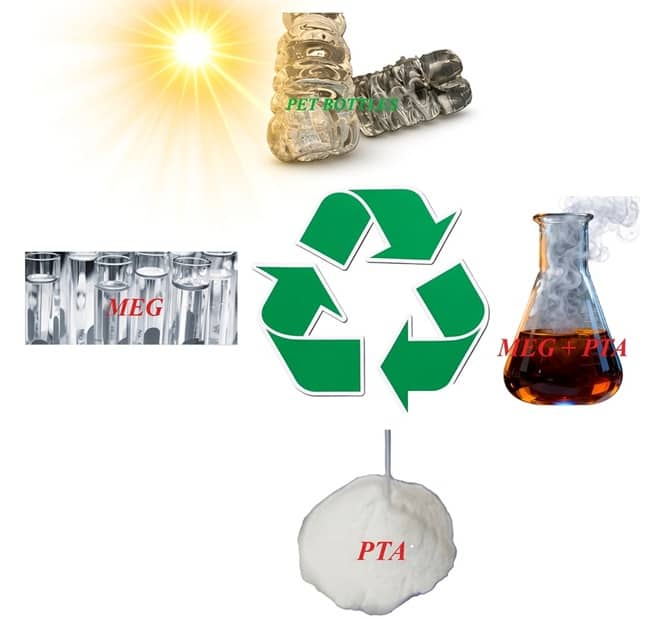
In response to the urgent demand for sustainable depolymerization methods, a research team led by Professor Jung-Ki Ryu from the Ulsan National Institute of Science and Technology (UNIST) Department of Energy and Chemical Engineering, in collaboration with Professor Soo-Jin Park’s team at POSTECH, has engineered a chemical recycling technology. Their novel approach utilizes photothermal catalysis—combining light absorption and low-level heat—to convert waste PET directly into solid terephthalic acid (TPA) and gaseous ethylene.
Unlike conventional energy-intensive chemical methods that require extreme heat and pressure, this system operates effectively at a mild 50°C under simulated sunlight. The reaction environment places pulverized PET powder alongside a specialized catalyst inside a dilute aqueous solution of sulfuric acid. Chemical Recycling PET Technology
+-----------------------------------------------------------------------+
|                     UNIST/POSTECH REACTION PROCESS                    |
+-----------------------------------------------------------------------+
| Input Materials: Waste PET Powder + Dilute Sulfuric Acid Solution    |
| Catalyst Composition: Porous Silicon + Carbon Nanomaterial + Cobalt   |
| Operating Conditions: Low Heat (50°C) + Simulated Solar Irradiation   |
+-----------------------------------------------------------------------+
                                   |
                                   v
+-----------------------------------------------------------------------+
|                           REACTION YIELDS                             |
+-----------------------------------------------------------------------+
| Polymer Conversion Rate: 73.2% (24-Hour Experimental Standard)       |
| Primary Recovered Products:                                           |
|   - Solid Phase: Terephthalic Acid (TPA) -> Up to 91.4% (Real Waste)   |
|   - Gas Phase:   Ethylene Gas            -> Up to 39.1% Yield         |
+-----------------------------------------------------------------------+
The core innovation lies within the structural architecture of the catalyst. The research team fabricated the catalyst by coating porous silicon particles with a conductive carbon-based nanomaterial integrated with cobalt species. Porous silicon offers an exceptionally high surface area for light absorption and chemical contact, while the carbon-cobalt surface layer facilitates thermal conduction and accelerates chemical bond cleavage across the polymer backbone. Upon absorbing light, the catalyst converts solar photon energy into localized thermal energy, accelerating polymer degradation right at the catalytic surface while maintaining low bulk fluid temperatures. Chemical Recycling PET Technology
Performance Benchmark: Lab Trials vs. Real-World Plastic Waste
During controlled 24-hour baseline experiments using standardized PET powder, the photothermal catalytic system achieved a total polymer conversion rate of 73.2%. The chemical reaction yielded 69.4% solid terephthalic acid and 39.1% gaseous ethylene, proving that light-assisted catalysis can successfully break strong ester bonds in synthetic polymers under mild operating parameters.
To verify whether the technology could handle real-world contamination and additives, the joint research team conducted performance testing on actual post-consumer plastics. They evaluated two common waste streams: standard transparent drinking bottles and dark-colored black food containers. Post-consumer plastics often contain dyes, additives, and structural modifiers that typically poison catalysts or impair optical reactions in light-driven processes. Chemical Recycling PET Technology
| Waste Plastic Feedstock | Terephthalic Acid (TPA) Yield | Primary Product State |
| Standard PET Powder (Lab) | 69.4% Yield (73.2% Conversion) | Solid Precipitate |
| Transparent PET Bottles | 91.4% Yield | Solid Precipitate |
| Black Food Containers (CPET) | 90.8% Yield | Solid Precipitate |
Remarkably, real-world post-consumer waste delivered higher yields of solid terephthalic acid than the initial baseline laboratory powder. Transparent PET bottles produced a TPA yield of 91.4%, while opaque black food containers yielded 90.8% TPA. Black plastics are historically notorious in mechanical and optical sorting streams because carbon black pigments absorb infrared light and interfere with standard sorting equipment; however, in this photothermal catalytic process, darker materials actually facilitate solar heat absorption, enhancing localized catalytic activity. Chemical Recycling PET Technology
Industrial Significance: Closing the Loop in Petrochemical Value Chains
The dual output of solid terephthalic acid and gaseous ethylene creates direct integration opportunities for global petrochemical supply chains. Chemical Recycling PET Technology
Terephthalic acid serves as one of the primary precursors used worldwide in virgin PET synthesis. By recovering high-purity solid TPA from low-temperature chemical degradation, resin manufacturers can feed recovered monomers directly back into polymerization reactors without requiring fossil fuel-derived aromatics such as paraxylene. This creates a closed-loop monomer-to-monomer pathway that produces new, food-contact-grade plastic resins indistinguishable from petroleum-derived virgin resins. Chemical Recycling PET Technology
                 +-----------------------------------+
                 |    Post-Consumer Waste Plastics   |
                 | (Bottles, Colored Containers, etc)|
                 +-----------------------------------+
                                   |
                                   v
                 +-----------------------------------+
                 | UNIST Low-Temp Photothermal Reactor|
                 |  (50°C + Solar Light + Catalyst)  |
                 +-----------------------------------+
                                   |
                +------------------+------------------+
                |                                     |
                v                                     v
   +--------------------------+         +--------------------------+
   |   Solid Phase Output     |         |    Gas Phase Output      |
   | Terephthalic Acid (TPA)   |         |      Ethylene Gas        |
   +--------------------------+         +--------------------------+
                |                                     |
                v                                     v
   +--------------------------+         +--------------------------+
   | Virgin-Grade PET Resin   |         | Polyolefins, Solvents,   |
   | Packaging & Textiles     |         | Industrial Feedstocks    |
   +--------------------------+         +--------------------------+
Simultaneously, ethylene gas represents one of the most fundamental building blocks of modern industrial chemistry. Ethylene serves as the base monomer for manufacturing polyethylene (HDPE and LDPE), vinyl chloride for PVC, ethylene oxide, and various industrial solvents. Capturing gaseous ethylene from waste streams diversifies the economic value of recycling facilities, transforming plastic waste into a versatile feedstock for chemical manufacturing sectors beyond polyester packaging alone. Chemical Recycling PET Technology
Engineering Challenges and Commercialization Requirements
While the laboratory results demonstrate exceptional monomer recovery, scaling photothermal chemical recycling into a commercially viable industrial technology requires solving specific downstream engineering challenges. Chemical Recycling PET Technology
First, product isolation and purification downstream from the reactor require capital-efficient processing steps. Solid terephthalic acid precipitates out of solution alongside small fractions of unreacted PET particles. Industrial facilities will need continuous solid-state separation technology to filter out residual polymers and guarantee pure monomer quality before repolymerization.
Second, the gas stream produced during photothermal catalysis contains both ethylene and small volumes of hydrogen gas generated by secondary reactions in the acid medium. Efficient gas separation membrane systems or cryogenic distillation units will be necessary to isolate pure ethylene for commercial sale while harvesting hydrogen as a clean secondary byproduct.
Finally, scaling up photothermal reactors requires optimizing light penetration through dense slurry mixtures. Chemical Recycling PET Technology
Unlike clear liquid solutions, industrial-scale plastic slurries require specialized reactor geometries—such as thin-film solar reactors, microfluidic channels, or internal fiber-optic lighting networks—to ensure artificial or natural solar radiation reaches all catalyst-coated particles uniformly. Chemical Recycling PET Technology
As UNIST and POSTECH researchers refine continuous-flow processing parameters, verifying economic viability against virgin monomer prices remains the final hurdle for industrial adoption. If scaled successfully, photothermal catalysis offers a scalable, low-carbon pathway to eliminate ocean plastic pollution, reduce industrial energy consumption, and build a truly sustainable circular economy for global polymer industries. Chemical Recycling PET Technology
The Brutal Truth Behind Plastic Recycling Technologies Performance
More…