EV battery – A Game-Changer for PET Preform Production Otto Systems continues to push the boundaries of injection moulding technology with the launch of the PET-Series 320. Engineered for high-volume, high-efficiency environments, this new platform supports moulds with up to 128 cavities 21-07-2025
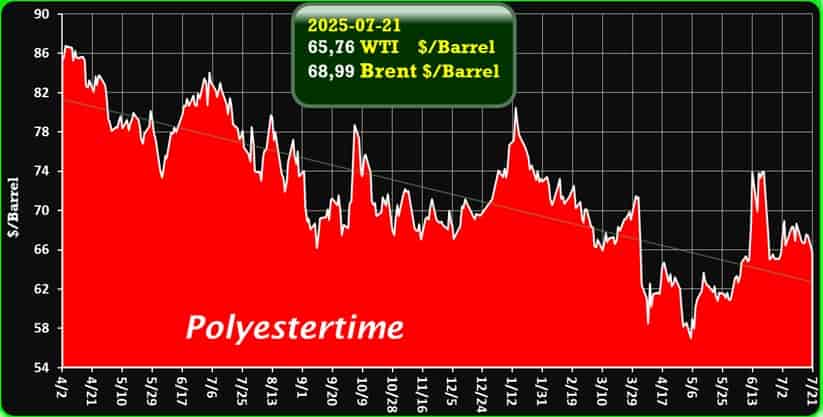
Crude Oil Prices Trend
Sustainable Packaging – Why This Matters Achieving an “A” score under CDP’s increasingly rigorous assessment framework reflects more than compliance—it signals strategy, innovation, and measurable climate action. CDP’s 2024 methodology now aligns with standards like the ISSB, TCFD, and TNFD, placing greater emphasis on transparency, governance, and integration of climate-related risks and opportunities
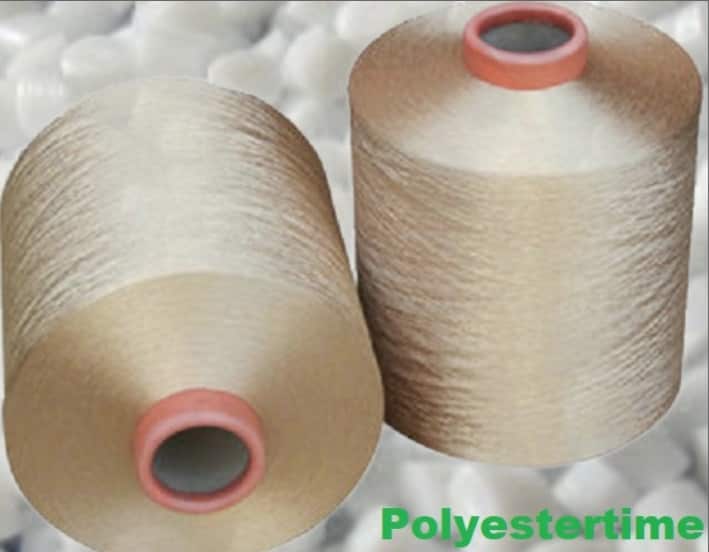
? Otto Systems Unveils PET-Series 320: Maximum Efficiency Meets Unmatched Mould Compatibility
By Otto Systems | July 2025
? A Game-Changer for PET Preform Production
Otto Systems continues to push the boundaries of injection moulding technology with the launch of the PET-Series 320. Engineered for high-volume, high-efficiency environments, this new platform supports moulds with up to 128 cavities — delivering unparalleled productivity while ensuring low operating costs and broad mould compatibility.
Whether you’re producing lightweight beverage preforms or durable containers for household and industrial use, the PET-Series 320 is built to handle demanding workloads while minimizing energy consumption and maximizing uptime. EV battery
? Expanding a Proven Product Portfolio
The PET-Series family already features 160- and 240-tonne machines tailored for fast-cycle, sub-5-second production. Alongside this, Otto Systems offers the HOD-Series, specifically developed for the Home and Office Delivery segment, catering to heavier preforms and larger packaging needs.
The new PET-Series 320 fills a critical performance gap by scaling up mould capacity and throughput, positioning itself as a versatile powerhouse for producers scaling operations or consolidating machine lines. EV battery
⚙️ Inside the PET-Series 320: Technology and Configurations
- Clamping Unit: Fully electric, delivering lock-to-lock times of less than 2.0 seconds
- Injection Groups: Three configurations available, supporting throughput up to 1,040 kg/h
- Mould Support: Compatible with 24 to 128 cavities, covering a wide array of top-entry moulds
- Energy Efficiency: Kinetic energy recuperation and efficient drives reduce electricity usage significantly EV battery
These features ensure that each cycle is not just fast, but also cost-effective and repeatable — supporting the demands of modern, high-speed production.
? 100% rPET Processing: Meeting Sustainability Goals
As global regulations push for more sustainable manufacturing, the PET-Series 320 rises to the occasion. Its advanced plasticising unit can process up to 100% recycled PET (rPET), aligning with both environmental targets and customer expectations.
This makes the machine ideal for brands that prioritize circular packaging models, while also adhering to EU and international compliance standards for recycled content in food-grade containers.
? Pick-Blow Combi Air Cool System: Consistent Quality at Speed
Otto Systems integrates its proprietary Pick-Blow Combi Air Cool system — a three-stage cooling concept that ensures precision without compromising speed:
- Water-cooled tubes in the removal plate for rapid cooling EV battery
- Air-cooled pins in the transfer plate for thermal balance
- Smart thermal management reduces reject rates significantly
Thanks to this innovation, customers benefit from enhanced part consistency, fewer post-processing issues, and improved overall equipment effectiveness (OEE).
? Boosting Profitability Through Smarter Design
One of the standout traits of the PET-Series 320 is its focus on total cost of ownership (TCO). Every design choice — from compact machine footprint to modular injection configurations — aims to lower energy bills, cut material waste, and reduce maintenance interruptions. EV battery
It’s not just a machine. It’s a strategic investment for businesses scaling up PET production without scaling up complexity or cost.
? Performance Snapshot
| Feature | Specification |
|---|---|
| Clamping Force | 320 tonnes (Fully Electric) |
| Mould Compatibility | 24 to 128 Cavities |
| Cycle Time | < 5 seconds |
| Throughput | Up to 1,040 kg/h |
| Material Compatibility | Up to 100% rPET |
? Closing Thoughts: A Smart Investment for Smart Manufacturers EV battery
The PET-Series 320 stands at the intersection of high-output precision manufacturing and cost-conscious operation. With sustainability, compatibility, and smart engineering at its core, it represents the future of injection moulding for PET applications.
If you’re scaling up, seeking greater efficiency, or transitioning to sustainable packaging, the Otto Systems PET-Series 320 offers the technology foundation you need to succeed.
? Stronger Magnets Without Rare Earths: A Breakthrough in Magnetic Materials
Researchers discover a high-pressure technique to transform iron oxide into a powerful, sustainable magnet—paving the way for the next generation of tech.
? A Magnetic Revolution: Iron Oxide’s Hidden Potential
In a groundbreaking development that could redefine the magnet industry, scientists at the University of Texas at Arlington have discovered a way to convert ordinary iron oxide nanoparticles into ultra-strong magnets. EV battery
This transformation is achieved not with expensive or rare elements, but with something as fundamental as pressure.
Published in the prestigious journal Nature Communications, this research challenges decades of assumptions in materials science. EV battery
The findings could significantly reduce our dependence on rare-earth metals, materials essential to everything from wind turbines to smartphones but costly and environmentally damaging to extract.
? How the Transformation Happens: Science at 180,000x Atmospheric Pressure
The research team—an international collaboration including Sandia National Laboratories and Danube University Krems—used a device known as a diamond anvil cell to apply extreme pressure to the nanoparticles. Specifically, they applied up to 18.8 gigapascals—that’s more than 180,000 times the atmospheric pressure at sea level.EV battery
Under this massive force, the iron oxide particles underwent a spontaneous rearrangement. They lined up into microscopic chains, a structure that resulted in a surprising and significant boost in their magnetic anisotropy—a key factor in a material’s magnetic strength and stability.
According to lead researcher Professor J. Ping Liu, “Conventional wisdom tells us that high anisotropy can only come from heavy elements like rare earths. But our findings suggest otherwise. We’ve demonstrated that iron oxide—a low-cost and widely available material—can achieve this under the right conditions.” EV battery
? Economic Impact: Breaking Free from Rare-Earth Dependence
Rare-earth elements such as neodymium and dysprosium are indispensable in today’s magnets, especially in high-performance applications like electric vehicles, wind turbines, and aerospace systems. However, their mining is labor-intensive, energy-consuming, and ecologically destructive. EV battery
These elements are not actually rae in abundance but are spread thinly across the Earth’s crust, making their extraction an expensive and complex process involving heavy chemicals and multiple refinement stages. Their supply chains are also geopolitically sensitive, often tied to a few countries.
By contrast, iron oxide is common, inexpensive, and relatively harmless to extract. The potential to develop powerful magnets using structured iron oxide particles opens the door to more sustainable manufacturing across multiple industries.
? Environmental Benefits: Cleaner, Greener Magnet Production
From an environmental perspective, this discovery couldn’t be more timely. The global push for sustainable and green technologies has placed increasing pressure on manufacturers to reduce their reliance on resource-heavy materials.
Rare-earth mining has been linked to deforestation, toxic waste generation, and soil degradation. EV battery
The use of iron oxide, which can be sourced and synthesized with much less environmental cost, aligns perfectly with the broader goals of a circular economy. The ability to create high-performance magnets without rare earths could be a game-changer for green energy sectors, including wind power and electric mobility. EV battery
⚙️ Applications Across Industries: From Motors to Medicine
Magnets are essential to modern life. They power electric motors in cars, enable data storage in hard drives, and even assist in medical imaging technologies.
The discovery that high pressure can significantly enhance magnetic properties in iron oxide suggests a future where these applications can be scaled more economically and sustainably. EV battery
Professor Liu envisions this technology enabling the creation of customizable magnetic materials designed for specific industrial needs. Whether it’s more efficient generators, longer-lasting batteries, or new kinds of magnetic sensors, the possibilities are vast.
Importantly, these applications aren’t just theoretical. With the right follow-up research and investment in pressure-based manufacturing processes, these new magnets could become a mainstream component in next-gen tech.
? Market Implications: Affordable Innovation at Scale
As demand for electric vehicles, smart devices, and green energy solutions continues to soar, so does the need for more efficient and affordable magnets. Companies that adopt pressure-enhanced iron oxide magnets could gain a significant competitive edge by cutting both costs and environmental liabilities.
Moreover, governments and international organizations advocating for reduced dependence on critical materials may offer incentives or subsidies for technologies that reduce reliance on rare earths—further boosting the commercial appeal of this breakthrough. EV battery
? What’s Next? Research, Scaling, and Commercialization
While the discovery is promising, researchers caution that much work remains. The behavior of iron oxide under extreme pressure needs to be further explored and understood at a fundamental level.
Key areas for future research include:
- Optimizing the pressure-induced transformation process
- Developing scalable industrial methods EV battery
- Ensuring material stability and durability in real-world applications
If successful, these efforts could lead to a new class of mass-producible, high-performance, and eco-friendly magnets—all without relying on rare-earth elements.
♻️ EU Plastic Packaging Waste Contribution Set to Increase by 2028: What It Means for You
Published: July 21, 2025 • Estimated reading time: 7 minutes
? What Is the EU Plastic Waste Contribution?
Often referred to as the “EU plastic tax,” this financial mechanism is formally known as the
European Union Own Resource Based on Non-Recycled Plastic Packaging Waste. It is not a direct tax on businesses or consumers, but rather a contribution imposed on EU member states according to the volume of non-recycled plastic packaging they produce annually. EV battery
This measure plays a central role in financing the EU’s multiannual budget while advancing thecircular economy goals and reducing the region’s reliance on single-use plastics.
? Current Rate vs. Upcoming Increase
As of today, the contribution rate is €0.80 per kilogram of non-recycled plastic
packaging waste. However, this rate is set to rise in 2028, making it even more
expensive for member states to generate unrecycled plastic waste. EV battery
Although the exact new rate has not been finalized, the financial impact is expected to significantly intensify, creating a stronger economic incentive for countries to invest in:
- Advanced recycling systems
- Plastic reduction policies
- Eco-design and reusable packaging alternatives
? Purpose: Driving a Circular Economy
The ultimate goal of this contribution is not merely fiscal—it’s environmental. It aims to:
- Encourage EU countries to recycle more and waste less
- Boost the adoption of sustainable packaging
- Accelerate the transition to a circular economy EV battery
With plastic pollution posing a severe threat to marine ecosystems, public health, and climate objectives, this policy aligns with the EU’s broader sustainability strategy, including the Green Deal and Fit for 55 packages.
? Potential Impact Across the EU
This financial pressure will likely trigger a domino effect across governments, industry, and
consumers. Here’s how:
? For Governments:
- Stronger national mandates on plastic recycling and reuse
- Increased public funding toward waste management infrastructure
- Regulations targeting plastic-heavy industries
? For Businesses:
- Higher indirect costs on plastic packaging EV battery
- Push toward eco-friendly materials and packaging innovation
- New compliance requirements on reporting and recycling rates
?️ For Consumers:
- Potential price hikes on plastic-packaged goods rPET Processing
- More visible recycling labels and sustainable packaging choices
- Increased awareness and responsibility around plastic use
? A Closer Look: Why This Isn’t Just a “Tax” EV battery
Despite frequent references to it as a “plastic tax,” it’s important to emphasize that this is not a direct levy on plastic manufacturers or end-users. It’s an intra-governmental
budget contribution mechanism.
However, the indirect effects will ripple outward through the economy. As member
states face higher contributions, they may:
- Introduce national taxes on plastic packaging
- Enforce stricter Extended Producer Responsibility (EPR) schemes
- Penalize businesses with poor recycling records EV battery
? Policy Implications and Industry Strategy
Companies that operate across EU markets—especially in retail, e-commerce, logistics, and food packaging—must begin adapting now.
Proactive strategies include:
- Switching to biodegradable or compostable packaging
- Investing in closed-loop packaging systems
- Collaborating with local recycling initiatives
- Redesigning products to minimize material use
Those who act early will not only reduce their risk exposure but also enjoy first-mover
advantages in sustainability branding and consumer trust.
? Country-Level Differences and Implementation
The way this contribution affects each member state depends heavily on their current plastic waste management systems. Countries with low recycling rates will face a higher financial burden and may need to enact rapid reforms. EV battery
This could widen the policy gap between frontrunners like Germany or the Netherlands and lagging countries where recycling infrastructure is still underdeveloped.
? How This Affects Your Sustainability Reporting
For businesses subject to environmental, social, and governance (ESG) reporting, this change will impact:
- Your Scope 3 emissions (packaging waste)
- Your EU Taxonomy alignment scores
- Stakeholder expectations on environmental risk
It’s highly recommended that businesses begin tracking their plastic packaging metrics and align them with EU Green Deal disclosure requirements. EV battery
? What to Do Next: Action Steps for 2025–2028
- Audit your plastic use and recycling output today
- Set reduction targets aligned with EU thresholds
- Invest in alternative materials and reusable systems
- Engage suppliers on circular design principles
- Communicate transparently with customers and regulators
? Final Thoughts: From Penalty to Opportunity EV battery
The increase in the EU plastic packaging contribution is not just a cost to manage—it’s an
opportunity to lead. Forward-thinking organizations will treat this not as a tax
burden but as a strategic driver for innovation, sustainability, and customer loyalty.
Whether you’re a policymaker, entrepreneur, sustainability officer, or concerned citizen, the
message is clear: reduce, recycle, and rethink plastic packaging before 2028.
? Michelin’s Leap from Tires to Tomorrow’s Materials Industry
From motorsports to green chemistry: How Michelin is shaping the future of composite materials and bio-based innovation. EV battery
? From Rubber Roots to Sustainable Revolution
Michelin, globally known for its high-performance tires, is now accelerating into a broader role—leading innovation in composite materials and bio-based chemistry. The company is channeling its expertise from decades of tire development into revolutionizing industries that demand robust, lightweight, and sustainable materials.
From the automotive and marine sectors to industrial machinery and advanced textiles, Michelin is setting its sights on transforming how high-performance materials are made and used.
? The Tire: A Composite Engineering Masterpiece
At its core, a tire is a marvel of material science. It blends polymers, metals, textiles, and reinforcing agents into a single unit that must deliver performance under extreme conditions—heat, friction, pressure, and wear. EV battery
Michelin’s decades-long involvement in motorsport, particularly with its MICHELIN Pilot Sport Endurance line for the iconic 24 Hours of Le Mans, has pushed the limits of composite material development. These innovations are now being adapted for non-mobility applications where strength, resilience, and efficiency are paramount.
? Strategic Shift: From Tires to High-Performance Composites
Michelin’s ambition is bold: to become a global leader in high-performance composite materials. The company is actively investing in R&D and acquiring specialized companies to accelerate this vision. EV battery
Among these strategic acquisitions is the Flex Composite Group (FCG), which specializes in lightweight, durable composite solutions for sectors like marine, defense, sports, and industrial manufacturing.
By leveraging its legacy in tire production, Michelin is extending its reach to clients that require cutting-edge mechanical strength, reliability, and eco-efficiency in their materials.
⚙️ Real-World Applications Powered by Michelin’s Expertise
Michelin’s knowledge is already yielding high-impact innovations across multiple sectors. Here are some standout examples:
- Marine Safety: Neoprene-coated fabrics designed for semi-rigid inflatable boats and emergency buoys offer exceptional grip and durability, even under severe weather conditions.
- Firefighting Gear: Multi-layered textiles engineered to maintain body temperature below 43°C during operations, enhancing both safety and endurance.
- Heavy Industry: Conveyor belts capable of withstanding temperatures up to 400°C—essential for mining and agriculture workflows.
- Sports & Racing: Aerodynamic carbon fiber components used in racing cars, bicycle frames, and other performance gear—thanks to Michelin’s subsidiary Angeloni Group. EV battery
? Bio-Based Breakthrough: The Promise of 5-HMF
Michelin is not only transforming physical materials—it’s reshaping chemistry itself. The company is pioneering the production of 5-HMF (5-hydroxymethylfurfural), a sustainable, non-toxic molecule derived from biomass that could replace petroleum-based inputs in industrial chemistry.
Starting in 2026, the world’s first industrial-scale 5-HMF production unit will launch in Péage-en-Roussillon, France. Backed by €60 million in funding from the European Union and the France 2030 initiative, this plant aims to produce up to 3,000 tons per year.
This biosourced molecule has versatile potential across industries like cosmetics, electronics, construction, agriculture, transportation, and aerospace. The projected global market could exceed 40,000 tons by 2030. EV battery
? ResiCare: The Safe, Scalable, Bio-Based Adhesive
Launched in 2016 as an internal innovation project and now a standalone start-up, ResiCare is Michelin’s bridge between bio-based chemistry and composite materials. Its mission? To create adhesives that are not only high-performing but also safe for both workers and the planet.
ResiCare’s formulations based on 5-HMF eliminate the need for harmful substances like formaldehyde and resorcinol, making them compliant with the most stringent health and environmental standards. EV battery
Developed in collaboration with IFP Energies nouvelles (IFPEN), this initiative marks a crucial step toward European chemical sovereignty. It’s an example of how sustainability and innovation can go hand-in-hand.
“The launch of this first production unit for a biosourced molecule crucial to green chemistry represents a milestone in bringing ResiCare’s activities to an industrial scale.” EV battery
— Maude Portigliatti, Director of Michelin’s Polymer Composite Solutions Division
? What This Means for Industry and Innovation
Michelin’s pivot represents more than product diversification—it’s a blueprint for the industrial evolution of materials. The shift toward composites and biosourced molecules places Michelin at the center of a new ecosystem where sustainability, safety, and performance converge.
It’s a transformation rooted in technical expertise, but scaled through innovation and long-term vision. Whether it’s in the air, at sea, on the road, or in a lab—Michelin is reshaping the future of materials science.
? Final Thoughts: Michelin as a Materials Pioneer EV battery
From the complexity of motorsport tires to the subtleties of biomolecular chemistry, Michelin is setting a new industrial standard. The company is no longer just a tire manufacturer—it’s a composite materials and green chemistry innovator with global ambitions.
As the world seeks alternatives to petroleum-based products and unsustainable manufacturing, Michelin’s investments in R&D, sustainability, and scalable solutions signal a powerful shift. The materials of the future will not only perform better—they will be safer, cleaner, and smarter. And Michelin is driving that transformation. EV battery
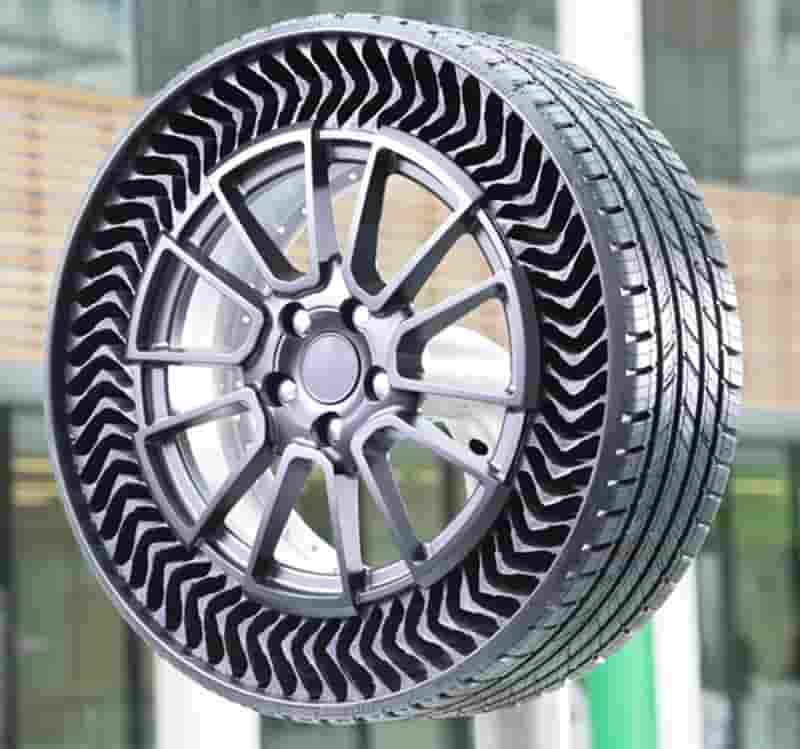
? Electric Cars with 5,000 km Range? Here’s How the Future Is Charging Forward
Published: July 21, 2025
? A Breakthrough in Battery Technology
Imagine a world where electric vehicles (EVs) can travel up to 5,000 kilometers on a single charge. It sounds like science fiction, but this transformative vision is rapidly becoming a scientific reality. A team of researchers from Pohang University of Science and Technology (POSTECH) and Sogang University in South Korea has developed a battery innovation that could reshape the future of sustainable transportation.
This advancement, led by Professors Soojin Park, Youn Soo Kim, and Jaegeon Ryu, promises to multiply the range of today’s electric vehicles by ten. At its core is a radically redesigned lithium-ion battery featuring a high-capacity silicon anode and a next-generation polymer binder. EV battery
? Why Silicon Matters: The Science Behind the Shift
The heart of this technological leap lies in the use of silicon as the battery’s anode. Silicon has the potential to store up to 10 times more energy than conventional graphite, making it a game-changer for EV battery performance. But its potential has long been held back by a critical flaw: volumetric expansion.
When silicon interacts with lithium during charging cycles, it expands, causing stress and degradation that shorten battery life. The challenge has always been to harness its power without compromising durability or stability. EV battery
? The Role of the Advanced Polymer Binder
To overcome this limitation, the Korean research team developed a novel polymer binder. This material uses a combination of hydrogen bonding and Coulombic forces to hold the silicon particles together and accommodate their expansion, while keeping the internal structure stable. EV battery
By integrating polyethylene glycol (PEG), the binder also enhances the mobility of lithium ions—resulting in improved conductivity and higher energy density. This design unlocks the full power of silicon, allowing batteries to store significantly more charge without compromising lifespan or safety.
⚙️ From Lab to Road: Industrial Viability EV battery
The research, first published in March 2024, has already generated global excitement. However, translating this lab-based success into widespread commercial application presents several hurdles.
- Manufacturing Challenges: Scaling up production will require substantial modifications to existing battery factories and investment in new infrastructure.
- Cost Considerations: Advanced materials like silicon and PEG are more expensive than traditional alternatives. Whether the final battery packs can be produced at a price point accessible to everyday consumers remains a major question. EV battery
- Safety Testing: The batteries must undergo extensive real-world testing to meet rigorous automotive safety standards before being adopted by car manufacturers.
⏱️ Timeline to Market: A Cautious but Steady Road Ahead
While the promise is enormous, the researchers are taking a measured approach. Their roadmap includes comprehensive reliability and longevity assessments before mass-market deployment.
Experts estimate a 5 to 7-year timeline for the technology to mature into commercial EV models—assuming successful testing and industry buy-in.
Despite this timeline, the direction is clear: battery performance will be the primary battleground for EV innovation in the next decade, and this South Korean breakthrough could be the next big leap forward. EV battery
? What a 5,000 km Range Really Means
Let’s break this down. A typical electric car today might cover 300–500 km per charge. Even the most advanced models, like Tesla’s Model S Long Range, barely exceed 600–700 km under optimal conditions. EV battery
Now imagine a vehicle that can drive from Paris to Istanbul, or New York to Los Angeles, on a single charge. That’s what a 5,000 km battery unlocks. It eradicates the fear of range anxiety and makes electric vehicles a truly practical option for long-distance drivers, commercial fleets, and rural populations.
This level of performance also drastically reduces the need for frequent charging, lessening pressure on public charging infrastructure and simplifying the EV ownership experience.
? Implications for the Climate and Automotive Industry EV battery
If successful, this battery technology could accelerate the global shift away from fossil fuels. By removing one of the last psychological and technical barriers to EV adoption, automakers could scale their electric offerings without compromise.
Greater EV penetration means:
- ⚡ Less oil consumption
- ? Lower CO₂ emissions
- ?️ Cleaner air in cities
- ? New green economy jobs in battery and materials manufacturing
It also presents an opportunity for Asian nations like South Korea to strengthen their leadership in global battery production, further challenging dominant players like China and emerging competition from Europe and North America. EV battery
? UX and Practical Considerations
From a user experience (UX) standpoint, a 5,000 km battery enables:
- Less Frequent Charging: Charge once per month instead of weekly or daily.
- Longer Lifespan: Fewer cycles mean less wear on the battery overall.
- Simplified Planning: No need to route trips based on charging station availability.
This doesn’t just affect consumers—it impacts ride-sharing companies, delivery services, and public transport systems, where downtime equals lost revenue. EV battery
? How to Stay Ahead: For Automakers and Tech Leaders
For automakers, this is a pivotal moment. R&D teams should be watching closely and preparing to integrate advanced silicon-based technologies into future models. Likewise, battery startups and suppliers must align their innovation roadmaps to remain competitive.
OEMs that successfully integrate next-gen batteries early will gain significant first-mover advantages—not just in range, but in marketing, pricing power, and sustainability credentials. EV battery
? The Road Ahead
While still in development, the promise of a 5,000 km-range electric car is no longer a distant dream. It’s the next logical step in an EV revolution that’s just getting started.
The future of mobility will be defined not just by how fast or sleek a vehicle is—but by how far it can go, how sustainably it gets there, and how effortlessly it integrates into daily life.
With South Korea leading the charge, a new chapter in energy and automotive innovation is unfolding—and it’s one the whole world should watch closely.