Plastic Recycling Crisis Deepens as Cheap Virgin Resin and EU Export Rules Squeeze Operators
Plastic Recycling Crisis Deepens as Cheap Virgin Resin and EU Export Rules Squeeze Operators
The global plastic recycling industry is confronting a difficult contradiction. Governments and brands are demanding more recycled material, yet many recyclers cannot sell their output at prices that cover the cost of collecting, sorting and processing plastic waste.
Low-cost virgin polymers, excess petrochemical production and tighter rules governing international waste shipments are placing pressure on operators across Europe and other major markets. Recycling plants are being asked to expand their role in the circular economy while competing against newly manufactured plastic whose price is closely linked to fossil-fuel and petrochemical markets.
This imbalance is turning the plastic recycling crisis into an industrial-capacity problem, not simply a waste-management problem.
Key points
-
Cheap virgin polymers are weakening demand for recycled PET, polyethylene and polypropylene.
-
Global petrochemical overcapacity is helping to establish a low price floor for new plastic.
-
European recyclers face high energy, labour, compliance and feedstock-processing costs.
-
The EU now requires stricter controls and digital documentation for many waste shipments.
-
Exports of plastic waste from the EU to non-OECD countries will be prohibited from 21 November 2026.
-
Mandatory recycled-content rules may support long-term demand, but many recyclers need relief before that demand fully develops.
Virgin plastic remains difficult to compete against
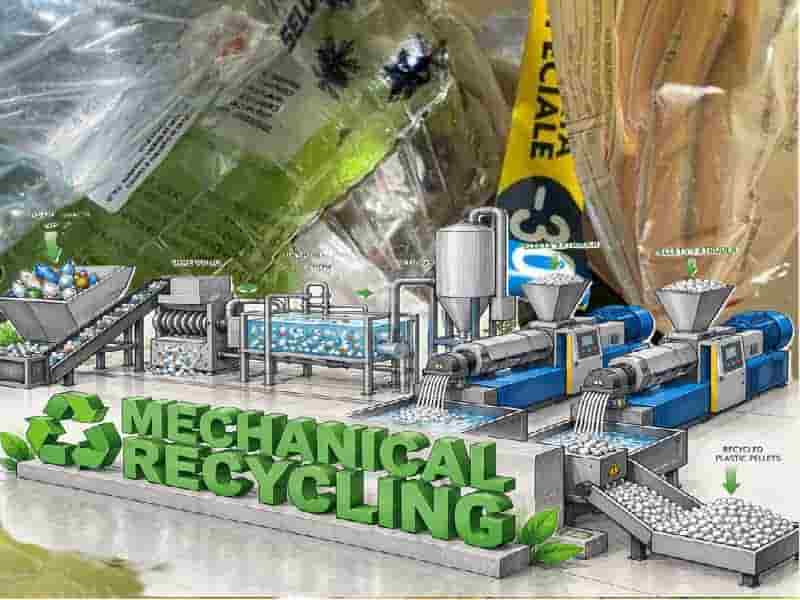
Mechanical recycling requires plastic waste to be collected, transported, sorted, washed and reprocessed. Contamination must be removed, equipment must be maintained and the resulting material must meet increasingly demanding technical specifications.
Virgin resin does not carry the same collection and decontamination burden. When newly produced resin is abundant and inexpensive, manufacturers may select it instead of recycled material unless regulation, procurement policies or customer commitments require recycled content.
The European Commission has acknowledged that recyclers are being affected by high energy costs, unpredictable virgin-plastic prices, weak demand and competition from inexpensive imported polymers. It has also warned that these pressures have contributed to financial losses, bankruptcies and reductions in European recycling capacity.
Installed EU plastic-recycling capacity reached approximately 13.2 million tonnes in 2023, according to the Commission. However, growth slowed substantially, and the Commission projected a net capacity reduction of roughly one million tonnes by the end of 2025—an amount comparable to France’s recycling capacity.
That contraction matters because capacity cannot always be restored quickly. Once a facility closes, its specialist workforce, supply agreements, permits and local collection relationships can be difficult to rebuild.
Chinese overcapacity is affecting global material prices
China’s petrochemical expansion is an important part of the market equation. Large additions of polymer and chemical-production capacity can increase the volume of material seeking buyers in domestic and international markets.
Recent Financial Times reporting on Europe’s broader chemical industry described how heavily expanded Chinese production is placing European plants under pressure. Although that report focused on chemicals rather than plastic recycling alone, it illustrates the same industrial dynamic: large-scale capacity additions can push export prices below the production costs faced by European operators.
For plastic recyclers, the practical consequence is straightforward. An abundant supply of virgin PET, high-density polyethylene and polypropylene can suppress prices throughout the market. Recycled polymers are then expected to follow those lower prices even though their production costs are based on an entirely different supply chain.
Temporary increases in oil or resin prices may improve recycling margins, but they do not provide a dependable business model. Recycling Europe warned in June that short-term relief linked to higher fossil-fuel prices should not be mistaken for a structural recovery.
Europe’s new shipment system changes trading conditions
Regulatory changes are also reshaping the movement of plastic waste.
Most provisions of the revised EU Waste Shipment Regulation began applying on 21 May 2026. The same date marked the launch of the Digital Waste Shipment System, or DIWASS, which replaces many paper-based processes with electronic documentation and data exchange.
The system is intended to improve traceability, strengthen enforcement and make legitimate waste movements more transparent. In the longer term, digitalisation could reduce uncertainty and help authorities distinguish compliant shipments from illegal or poorly documented trade.
The transition can nevertheless create immediate operational challenges. Exporters, brokers, carriers and recycling facilities must adapt their documentation, internal controls and digital processes. Errors or incomplete records can lead to inspections, shipment delays, storage charges and other unplanned costs.
For low-margin plastic shipments, even a relatively small delay can eliminate the expected return from a transaction.
Not every shipment is subject to exactly the same procedure. Requirements depend on factors including the type of plastic waste, its contamination level, its destination and whether it is being shipped for recovery or disposal. Businesses should therefore avoid treating the new rules as a single blanket restriction.
The November export ban is approaching
A more consequential change will take effect on 21 November 2026, when exports of plastic waste from the EU to non-OECD countries will be prohibited.
The ban is designed to prevent European waste from being sent to countries that may lack adequate treatment capacity, environmental controls or enforcement resources. It also reflects the EU’s intention to take greater responsibility for the waste it generates.
Environmentally, the objective is clear. Economically, however, the restriction will require Europe to find alternative outlets for material that previously moved abroad.
Some waste may be redirected to European facilities or authorised destinations in OECD countries. Some could attract investment in new domestic sorting and recycling infrastructure. But where local processing capacity and end-market demand are insufficient, lower-quality material may instead face longer storage periods or move toward incineration and landfill.
The ban will therefore test whether Europe has created enough demand for recycled polymers—not merely enough collection targets.
Waste exports remain substantial
Plastic-waste trade has not disappeared while the new rules are being phased in.
Data published by the Basel Action Network indicate that EU plastic-waste exports to non-OECD countries increased during the first months of 2026. The organisation reported approximately 67 million kilograms exported per month in April.
Those figures should be interpreted carefully because trade classifications do not always reveal the final quality of treatment. They nevertheless demonstrate the scale of the material flows that will be affected when the November prohibition begins.
Turkey, an OECD member, has also become an increasingly important destination for European plastic waste. This creates a further policy question: restricting shipments to non-OECD countries may not solve the underlying problem if large volumes are simply concentrated in a smaller number of permitted destinations.
Under the revised regulation, the European Commission can scrutinise exports to OECD countries and intervene where shipments are associated with environmental harm or unsustainable treatment.
Regulation alone cannot make recycling profitable
Mandatory recycled-content requirements can provide recyclers with a more stable source of demand. The EU already requires PET beverage bottles to contain at least 25 percent recycled plastic, with a broader 30 percent target for plastic beverage bottles scheduled for 2030.
The Packaging and Packaging Waste Regulation is expected to extend recycled-content obligations to additional packaging formats over time. These measures can reduce dependence on voluntary purchasing commitments, which are often weakened when virgin resin becomes cheaper.
Demand mandates, however, must be credible and enforceable. Recyclers need confidence that imported material marketed as recycled meets equivalent traceability, environmental and quality standards. Otherwise, European facilities could comply with higher operating standards while competing against products whose recycled origin is difficult to verify.
Policymakers must also consider the timing mismatch. Recycling plants need sufficient demand and financial stability now, while some of the strongest mandatory-content provisions will influence the market only gradually.
Local demand must be closer to local supply
The industry’s logistical structure remains another weakness.
Plastic waste is generated in dispersed locations, but specialised recycling capacity and manufacturing demand may be concentrated in different regions. Transporting low-density or contaminated material over long distances adds cost and emissions before recycling has even begun.
A more resilient system would connect collection, sorting, reprocessing and manufacturing within shorter and more predictable supply chains. That requires investment not only in recycling plants but also in product design, collection quality, sorting technology and manufacturing equipment capable of using recycled feedstock.
Converters and brands also need specifications that recognise the realities of recycled materials. Where product standards are unnecessarily restrictive, technically usable recyclate can be excluded even when its performance is suitable for the intended application. plastic recycling crisis
What could stabilise the recycled-plastic market?
No single measure will resolve the current plastic recycling crisis. A viable response is likely to require several coordinated interventions.
Enforce recycled-content requirements
Binding targets create more reliable demand than voluntary sustainability pledges. Enforcement must include effective documentation and verification of imported recycled material.
Improve traceability
Digital systems such as DIWASS can help regulators follow waste movements and identify inconsistencies. Similar traceability is needed for the origin and recycled content of finished polymers and plastic products.
Reward verified environmental benefits
Public procurement, producer-responsibility fees and other economic instruments can favour products with credible recycled content and lower lifecycle impacts.
Reduce unnecessary virgin-plastic production
Recycling capacity will remain vulnerable when petrochemical expansion continually adds more low-cost virgin resin than markets require. Waste policy and industrial policy must therefore be considered together.
Build regional end markets
Investment should connect recyclers with packaging producers, manufacturers and other reliable buyers located within economically practical distances.
Improve design for recycling
Packaging made from incompatible polymers, complex multilayer structures, problematic pigments or difficult-to-remove components lowers recycling yields and raises processing costs.
The long-term case for recycling remains strong
The present downturn does not eliminate the strategic need for recycled plastic.
European legislation is moving toward higher recycled-content requirements, stronger traceability and greater responsibility for domestically generated waste. Manufacturers also face pressure to reduce their exposure to fossil raw materials and demonstrate more resilient material supply chains.
These trends can support recyclers over the long term. But future demand targets will have limited value if existing plants close before the market matures.
The central question is no longer whether plastic recycling is environmentally desirable. It is whether governments and manufacturers will create market conditions in which compliant recycling facilities can remain operational.
Without that bridge, Europe risks collecting more plastic while losing the industrial capacity needed to turn it into a usable secondary raw material.
Frequently asked questions
Why is recycled plastic sometimes more expensive than virgin plastic?
Recycled plastic includes the cost of collection, sorting, washing, contamination removal, testing and reprocessing. Virgin resin can become cheaper when fossil feedstocks are inexpensive or petrochemical production exceeds demand.
What is DIWASS?
DIWASS is the European Union’s Digital Waste Shipment System. It enables electronic processing and exchange of information for waste shipments covered by the EU’s regulatory procedures.
When will the EU ban plastic-waste exports to non-OECD countries?
The prohibition is scheduled to take effect on 21 November 2026.
Will the export ban stop all plastic-waste exports?
No. The specific ban applies to exports from the EU to non-OECD countries. Shipments to OECD countries remain possible under applicable controls, monitoring and consent procedures.
Can recycled-content targets support recycling plants?
Yes. Binding targets can create stable demand for recycled polymers. Their effectiveness depends on enforcement, traceability, equivalent standards for imports and a timetable that supports existing capacity.
What is the main threat to plastic recyclers?
The most immediate threat is the combination of weak selling prices, expensive processing, insufficient demand and competition from low-cost virgin or imported material.
High-Quality Plastic Recycling: Site Zero Shows Europe’s Circular Future
More…