Recycled Plastic – EU Advances Rules for Chemically Recycled Plastic in Bottles: A Game-Changer for Circular Economy ? Introduction: Tackling Plastic Waste at the Source 11-07-2025 - Archive
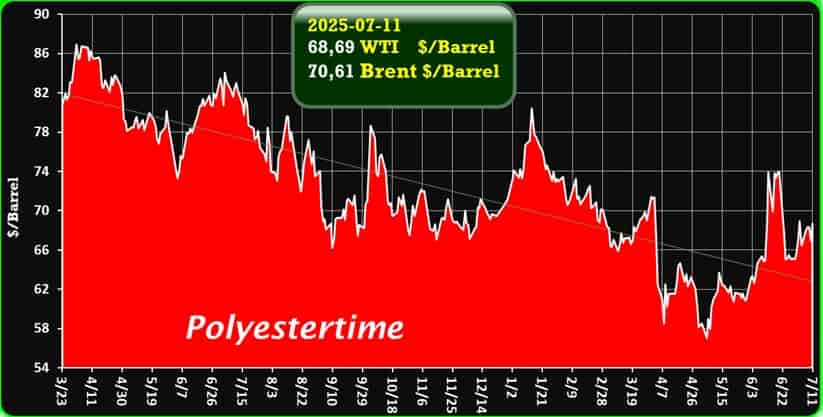
Crude Oil Prices Trend
? OMV and ADNOC Secure EU Approval for $13.4B Nova Chemicals Acquisition
? Overview: A Transformative Step in the Global Petrochemical Landscape
In a major development for the global chemicals and energy industry, the European Commission has approved the $13.4 billion acquisition of Nova Chemicals by Borouge Group International, a joint venture backed by Austria’s OMV and the UAE’s ADNOC (Abu Dhabi National Oil Company).
Announced in March 2025, this transformative deal marks the birth of a new global player in the polyolefins market. Following the merger, Borouge Group International is set to become the world’s fourth-largest polyolefins producer. Recycled Plastic
? Regulatory Green Light: EU Merger Clearance Secured
The European Commission granted approval under the EU Merger Regulation, confirming that the transaction does not pose competition risks within the European Economic Area (EEA). The decision was based on a thorough market analysis which concluded that the merged entity’s combined market share remains limited.
This clearance represents a critical milestone for the deal, removing one of the largest potential barriers to implementation in Europe.
⚠️ Remaining Hurdles: The Shadow of Foreign Investment Scrutiny
Despite receiving unconditional antitrust approval, the merger may still face **additional regulatory scrutiny**. The European Commission could subject the deal to a **foreign direct investment (FDI) review**, following a pattern observed in ADNOC’s attempted acquisition of Covestro. Recycled Plastic
As of late May 2025, the Commission had paused its review temporarily but has since set a new deadline: July 28. By then, regulators will decide whether to initiate a full-scale FDI investigation.
This illustrates the increasing role of **geopolitical considerations** in cross-border M&A activity, especially when involving critical industries like petrochemicals and energy.
? Corporate Structure: Global Footprint, Local Roots
Once the deal is finalized, Borouge Group International will be headquartered in Vienna, Austria, further cementing OMV’s strategic footprint in Central Europe.
The group will also establish a strong presence in the Middle East, with regional headquarters in Abu Dhabi. The company plans a primary listing on the Abu Dhabi Securities Exchange (ADX) and is exploring a potential dual listing in Vienna to increase capital access and investor visibility. Recycled Plastic
? Strategic Value: A Global Polyolefins Powerhouse Emerges
This merger is not just about scale—it’s about reshaping the global polyolefins market, which plays a critical role in the production of plastics used across packaging, automotive, healthcare, and construction sectors.
With this acquisition, Borouge is projected to generate an estimated $500 million in annual EBITDA, representing a powerful new force capable of challenging established players in the petrochemical value chain.
? Timeline: What’s Next for the Deal?
- March 2025: Deal announced by OMV and ADNOC
- June 2025: EU Merger Regulation approval granted
- July 28, 2025: Deadline for EU FDI investigation decision
- Q1 2026: Expected closing and legal formation of Borouge Group International
While regulatory clarity is progressing, the final completion of the acquisition is still subject to ongoing reviews and potential national-level scrutiny.
? Market Implications: Why This Deal Matters Recycled Plastic
In a world shifting toward decarbonization and circular materials, the polyolefins market remains vital due to its extensive use in everyday life. This deal will:
- Strengthen EU-Gulf relations in strategic energy sectors
- Enable OMV and ADNOC to pool R&D and infrastructure
- Expand Borouge’s product portfolio with North American market access via Nova Chemicals
The acquisition aligns with long-term trends in global value chain consolidation and resource security.
? International Dynamics: Strategic Collaboration in a Fragmented World
Beyond the financial and industrial merits, this transaction signals a growing wave of transcontinental partnerships. In an era of increasing geopolitical fragmentation, resource-rich nations like the UAE are seeking technological partners in Europe to ensure supply chain resilience. Recycled Plastic
For OMV, it marks a bold step in diversifying its petrochemical operations and strengthening its standing within the European and global energy matrix.
? Economic & Energy Sector Relevance
Petrochemicals are central to modern industry. With rising demand for lightweight materials, packaging, and medical plastics, companies are scaling production while preparing for stricter **environmental and ESG standards**.
This merger positions Borouge to compete on cost, innovation, and sustainability—especially as regulatory pressures on carbon-intensive industries continue to increase.
? Key Takeaways
- The OMV-ADNOC $13.4B Nova acquisition has received EU competition clearance
- The new company, Borouge Group International, will be headquartered in Vienna with a strong presence in Abu Dhabi
- Potential foreign investment review could still impact the deal’s closing timeline
- Once completed, Borouge will become the fourth-largest global polyolefins producer Recycled Plastic
- This deal underscores the shift toward cross-regional industrial consolidation
♻️ EU Advances Rules for Chemically Recycled Plastic in Bottles: A Game-Changer for Circular Economy
? Introduction: Tackling Plastic Waste at the Source
Plastic pollution continues to be a major environmental challenge across the globe. In response, the European Commission is taking a bold step by launching a public consultation on new rules for calculating and verifying recycled content in single-use plastic (SUP) beverage bottles, including materials from chemical recycling.
These new rules are more than policy—they are part of a wider effort to transition towards a circular economy, reduce landfill waste, and accelerate innovation in recycling technologies. The initiative is aligned with the EU’s Action Plan for the Chemicals Industry, which aims to make Europe a global leader in sustainable chemical manufacturing. Recycled Plastic
? What Is Chemical Recycling and Why It Matters
Unlike mechanical recycling, which processes plastics through shredding and melting, chemical recycling breaks down plastic polymers into their molecular building blocks. This allows for the production of virgin-like materials, especially useful for food-grade packaging, where high purity is essential.
While mechanical recycling is often more energy-efficient, it’s not always feasible due to contamination or material degradation. This is where chemical recycling shines—offering a viable alternative when quality and safety standards are strict.
? Scope of the Initiative: New EU Rules at a Glance
- Calculation Methodology – Establishing a standard way to quantify chemically recycled content in SUP beverage bottles.
- Verification Requirements – Enabling third-party audits to ensure credibility, with lighter requirements for SMEs.
- Reporting Guidelines – Making data transparent and consistent across the EU. Recycled Plastic
This initiative will provide the first EU-wide framework to integrate chemically recycled content into the plastics economy—boosting both market confidence and investor certainty.
? The Methodology: How Recycled Content Will Be Calculated
? Fuel-Use Excluded Rule
Central to the Commission’s approach is the “fuel-use excluded” allocation rule. This means that plastic waste used to generate fuels or energy recovery cannot be counted toward recycled content. This aligns with the EU Waste Framework Directive, which defines recycling as a process that produces new materials or products—not energy.
⚖️ Balancing Transparency and Simplicity
To ensure the system is robust yet user-friendly, companies will:
- Require annual third-party verification for chemical recycling.
- Benefit from simplified procedures if they’re SMEs (every three years).
- Be expected to vet partners’ self-declarations within the supply chain.
National authorities will carry out risk-based controls to ensure compliance without creating unnecessary bureaucracy.
? Why This Matters: Strategic and Environmental Benefits
? Environmental Impact
By valuing chemical recycling, the EU is creating economic incentives to keep plastic in circulation rather than incinerating it or dumping it in landfills. This supports broader sustainability goals, including:
- Reducing greenhouse gas emissions from waste burning.
- Enhancing resource efficiency. Recycled Plastic
- Minimizing plastic pollution in ecosystems.
? Economic Upside
These rules will:
- Boost investment in cutting-edge recycling technologies.
- Enhance the competitiveness of the EU chemical industry.
- Strengthen the position of manufacturers that depend on plastics.
Ultimately, this helps establish Europe as a hub for clean-tech innovation in plastic management.
? Building a Level Playing Field for Innovation
The rules are designed to be technology-neutral, ensuring fair market access for all recycling methods that meet the criteria. Whether companies use mechanical or chemical recycling, the goal is to:
- Create consistent rules across member states.
- Support cross-border trade in recycled materials.
- Provide certainty to investors and developers working in sustainable material sectors.
The methodology is expected to serve as a blueprint for other industries such as automotive, textiles, and electronics. Recycled Plastic
? Timeline: What Happens Next?
- Public consultation deadline: 19 August 2025 – via the EU’s Have Your Say Portal
- Technical committee review: Autumn 2025 – vote by Member States.
- Official adoption: Late 2025 – entry into EU law.
? Background: SUP Directive and Recycled Content Targets
The Single-Use Plastics Directive (SUPD) sets aggressive targets for recycled content:
- 25% recycled PET in SUP bottles by 2025.
- 30% recycled content in all SUP bottles by 2030.
? Implementation in Two Phases
- Phase One – Mechanical PET recycling based on food contact safety rules (Implementing Decision 2023/2683).
- Phase Two – Expanded scope to include chemical recycling under the new rules.
? Key Takeaways for Readers & Stakeholders
- The EU is setting clear rules to promote chemically recycled plastics in SUP bottles. Recycled Plastic
- The initiative brings together regulatory certainty and sustainability goals.
- Stakeholders are encouraged to submit feedback before 19 August 2025.
Hyundai Accelerates Circular Economy Efforts: A Sustainable Shift in Automotive Manufacturing
A Comprehensive Circular Economy Strategy
Hyundai’s commitment to sustainability is outlined in its 2025 Sustainability Report, where the company detailed its progress across three key pillars: environment, social, and governance (ESG). Recycled Plastic
By focusing on these areas, Hyundai is taking a holistic approach to improving its environmental impact and social responsibility, all while maintaining a strong governance structure to support long-term sustainability goals.
The circular economy model adopted by Hyundai seeks to close the loop on materials used in manufacturing by reusing and recycling materials throughout the lifecycle of its vehicles. This approach not only reduces the consumption of virgin materials but also minimizes waste and lowers carbon emissions—key objectives in Hyundai’s mission to achieve carbon neutrality by 2045.
Recycling and Bio-Based Materials
One of the key areas of focus for Hyundai is the increased use of recycled and bio-based materials in its vehicles. The company is expanding both its internal and external capabilities to ensure that more recycled plastics are incorporated into vehicle components. This includes using recycled materials in chassis, bodies, electrification systems, and both interior and exterior parts of the vehicle. Recycled Plastic
Hyundai has also ventured into using bio-based materials, which are derived from natural sources such as fibers, seashells, and other biological substances. By replacing virgin plastics with these sustainable alternatives, the company aims to significantly reduce its reliance on petroleum-based products. As part of this shift, bio-based fabrics made from sugar cane and corn are being used in car interiors, along with plant-based paints that have a lower environmental footprint.
One example of this sustainable approach is the IONIQ 5, which features armrests and seat covers made from recycled PET plastic—equivalent to 32 plastic bottles—bio-based fabrics, and sustainable paints. Another vehicle in Hyundai’s lineup, the IONIQ 6, incorporates Econyl—a material made from recycled fishing nets—in its floor mats, further demonstrating the company’s commitment to using recycled materials in its production process. Recycled Plastic
Advancing Vehicle Recycling and the ‘One-Stop’ Service
In 2024, Hyundai reported that it had recovered approximately 200,000 tonnes of resources from end-of-life vehicles, a significant milestone in its recycling efforts. This progress was bolstered by the implementation of a ‘one-stop’ end-of-life vehicle service in South Korea, allowing motorists to request vehicle pick-up, dismantling, and material recycling through Hyundai’s website. This convenient, customer-friendly service further emphasizes the company’s commitment to reducing waste and maximizing the reuse of vehicle materials.
Moreover, Hyundai is not just focused on recycling materials from vehicles’ bodies and interiors; it is also working to develop a battery closed-loop system. This system aims to reclaim core materials such as cobalt, lithium, and nickel from end-of-life vehicle batteries, ensuring that valuable resources are reused and minimizing the environmental impact of mining for new materials. Recycled Plastic
Hyundai’s Vision for Sustainable Mobility
At the heart of Hyundai’s sustainability initiatives is its overarching commitment to sustainable mobility. As stated by José Muñoz, the President and CEO of Hyundai Motor Company, “Hyundai is committed to sustainable mobility in the vehicles we offer and the processes we use to produce them.” The company recognizes that reducing the environmental impact of vehicles throughout their lifecycle, including manufacturing, is crucial for advancing a future of emissions-free mobility.
Hyundai’s ambitious goal of carbon neutrality by 2045 is a testament to its commitment to making the automotive industry more sustainable. The company’s efforts in vehicle recycling, using recycled and bio-based materials, and reclaiming valuable resources from end-of-life vehicles and batteries are all integral components of this broader vision. Hyundai believes that these efforts will not only benefit the environment but also contribute to a better quality of life for future generations.
The company’s vision is summed up in its ‘Progress for Humanity’ initiative, which underscores the belief that advancing emissions-free mobility is both a sound business strategy and a shared responsibility.
Through this initiative, Hyundai aims to ensure that cleaner air and a healthier environment are priorities for future generations. Recycled Plastic
Optimizing for a Sustainable Future: Key Takeaways
- Vehicle Recycling: Hyundai is expanding its use of recycled materials, including plastics, bio-based fabrics, and even fishing nets, to reduce the need for virgin materials and minimize waste.
- Battery Recycling: The development of a closed-loop battery system will help reclaim critical materials like cobalt, lithium, and nickel from end-of-life batteries, reducing the environmental impact of mining.
- One-Stop Service: The introduction of a customer-friendly recycling service in South Korea makes it easier for consumers to contribute to the circular economy by recycling their end-of-life vehicles.
By embracing these circular economy principles, Hyundai is not only creating more sustainable vehicles but also paving the way for a future where resource efficiency, waste reduction, and environmental protection are at the forefront of the automotive industry. This approach will not only help Hyundai meet its sustainability goals but also encourage other companies in the sector to follow suit. Recycled Plastic
For Hyundai, sustainability isn’t just about reducing emissions; it’s about rethinking how cars are built, used, and recycled, ensuring that the entire lifecycle of a vehicle is considered in its environmental impact. The company’s continued progress in these areas will be crucial in achieving its carbon neutrality target by 2045, and its efforts should serve as a model for others in the industry.
⚛️ Quantum Leap: Graphene Unlocks Spin Control Without Magnets
? What Is Spintronics and Why Does It Matter?
In the relentless race toward faster, more energy-efficient technology, one field stands at the cutting edge: spintronics. Unlike traditional electronics, which harness the electric charge of electrons, spintronics leverages a quantum property called spin—a kind of intrinsic angular momentum that electrons possess.
Mastering spin-based currents could revolutionize computing. Imagine devices that are not just smaller and cooler but also exponentially more efficient. But there’s been a persistent problem: manipulating spin currents required external magnetic fields—bulky, power-hungry, and unsuitable for integration on microchips. Recycled Plastic
A New Method Emerges from Delft University
Enter a game-changing breakthrough by a research team from Delft University of Technology (TU Delft) in the Netherlands. Led by Talieh Ghiasi, the team discovered a magnet-free method to control spin in the wonder material graphene.
Their approach was remarkably elegant: instead of forcing graphene into submission using external magnets, they gently nudged it from underneath. How? By placing a monolayer of graphene atop a special magnetic crystal known as chromium thiophosphate (CrPS₄).
? The Magic of Magnetic Proximity Effect
This innovative material pairing triggers what’s known as the magnetic proximity effect. In simple terms, it allows the magnetic field from CrPS₄ to “leak” into the graphene without direct contact—no physical magnet required.
This quantum interaction unleashes two forces within graphene:
- Spin-orbit coupling – links the motion of electrons to their spin.
- Exchange interaction – favors alignment of spins in a particular direction.
The result? A highly coveted quantum state called the Quantum Spin Hall Effect (QSH).
? Understanding the Quantum Spin Hall Effect (QSH)
The QSH state is nothing short of magical. Electrons race along the edges of the graphene like athletes on quantum highways—fast, predictable, and extraordinarily energy-efficient. Recycled Plastic
Even better: their spins are perfectly aligned, and the current is incredibly stable. It’s immune to minor flaws or impurities in the material—ideal for building resilient, low-power quantum circuits.
The TU Delft team confirmed that these quantum edge currents flowed consistently across distances of tens of micrometers—a meaningful length in the realm of nanotechnology.
? Unexpected Bonus: Room-Temperature Anomalous Hall Effect
As if the QSH breakthrough wasn’t enough, the team stumbled upon another phenomenon: the Anomalous Hall Effect (AHE).
Here’s the twist: electrons deflect sideways even without an external magnetic field. And unlike QSH, this anomalous behavior persists at room temperature.
Why is this huge? Because it opens the door to practical, everyday devices using spintronics—no need for cryogenic cooling systems or lab-only prototypes.
? Real-World Applications of the Breakthrough Recycled Plastic
This dual discovery—QSH and room-temperature AHE—unlocks a range of exciting possibilities:
- ⚡ Next-gen logic circuits – ultra-fast and ultra-thin components with lower heat production.
- ? Efficient memory storage – compact spin-based memory with greater longevity.
- ? Quantum data transfer – stable spin channels could bridge long distances in quantum computing.
- ? AI hardware – future neural networks powered by quantum spin could operate at blazing speeds with low power draw.
?️ The Temperature Challenge
There’s a catch: the Quantum Spin Hall effect still requires extremely low temperatures to work. That means we’re not yet at the point of deploying this in mainstream electronics.
But progress is on the horizon. The researchers aim to make QSH robust at higher temperatures. They’re also exploring new material combinations to achieve room-temperature quantum spintronics. Recycled Plastic
? What Makes This Research Unique
Let’s highlight the key innovations that make this study a landmark in quantum material science:
- ✅ First demonstration of QSH in graphene using magnetic proximity instead of magnets.
- ✅ Observation of room-temperature AHE—a vital stepping stone for real-world adoption.
- ✅ Publication in Nature Communications, peer-reviewed and publicly accessible.
? Consistency, Branding, and Reusability
Every article on your WordPress site should follow a consistent visual structure. Here’s how this format supports that:
- ? Reusable layout templates with consistent header/footer structure.
- ?️ Visual balance between icons, white space, and typography.
- ? Clear separation of content blocks for future repurposing into videos, slides, or newsletters.
? Conclusion: A New Age for Quantum Materials Recycled Plastic
The discovery by TU Delft’s team represents a turning point in quantum material engineering. By enabling the control of electron spin without external magnets, the path to compact, efficient, and scalable spintronic devices is now clearer than ever.
As the research matures and room-temperature operation becomes viable, expect to see spintronics move from labs to laptops, and from theory to transformation.
“This work is a major milestone—one that brings quantum spin devices one step closer to your pocket.” – Dr. Talieh Ghiasi, TU Delft
? Arkema Expands in Asia with New Rilsan® Clear Transparent Polyamide Unit
Arkema is doubling down on sustainable innovation in Asia. With an ambitious new investment in Singapore, the company is reinforcing its global leadership in bio-based polymers, targeting high-performance transparent applications across consumer and industrial markets.
? Strategic Expansion: A New Milestone for Arkema
After the recent ramp-up of its state-of-the-art Rilsan® polyamide 11 plant in Singapore, Arkema is set to strengthen its production capabilities even further. The French specialty chemicals leader announced a new $20 million transparent polyamide unit on its Singapore platform, slated to go live in Q1 2026. Recycled Plastic
- ? Location: Singapore (existing platform)
- ? Investment: ~$20 million USD
- ? Operational Timeline: First quarter of 2026
- ? Impact: Tripling global production of Rilsan® Clear
? Why Singapore? A Hub for Global Growth
Singapore is a key hub for Arkema’s Asian operations due to its world-class logistics, robust industrial infrastructure, and proximity to high-growth markets in the region. The new unit will operate alongside Arkema’s advanced bio-based polyamide 11 plant, which recently boosted global production capacity by 50%.
- ? Optimize supply chains for fast-growing Asian markets
- ♻️ Integrate sustainable production methods close to key customers
- ? Accelerate R&D and application development for diverse industries
? Spotlight on Rilsan® Clear: Transparency Meets Sustainability
Rilsan® Clear is not your average polymer. It’s a game-changer in the realm of transparent materials. Designed for demanding applications, it combines aesthetics with exceptional durability and eco-friendliness. Recycled Plastic
? Key Features of Rilsan® Clear
- ✅ High transparency for premium visual appeal
- ✅ Lightweight and flexible, perfect for wearable and portable devices
- ✅ Strong chemical resistance across a wide range of temperatures
- ✅ Bio-based origin with up to 62% renewable carbon content
- ✅ Fully recyclable via Arkema’s Virtucycle® program
The flagship grades, Rilsan® Clear G850 and G820, are based on renewable resources and deliver outstanding transparency and performance for industries that demand both style and strength.
? Markets & Applications: Meeting the Demand for Sustainable Innovation Recycled Plastic
Arkema’s move isn’t just about production—it’s about addressing real, growing demand. As consumers and manufacturers seek sustainable alternatives, transparent bio-polymers are gaining traction in several industries:
- ? Eyewear: Lightweight, durable, stylish frames
- ? Consumer Electronics: Casings and connectors with sleek aesthetics
- ? Medical Devices: Biocompatible, strong, and chemical-resistant housings
- ? Home Appliances: Transparent and robust parts
♻️ Circular Economy: Powered by Virtucycle®
Sustainability isn’t just a buzzword—Arkema backs it up with action. The company’s Virtucycle® recycling program ensures that advanced polymers like Rilsan® Clear remain in use and out of landfills. Recycled Plastic
How it works:
- ? Collection of end-of-life polymers from industrial partners
- ? Sorting and cleaning for reuse
- ♻️ Reintroduction into manufacturing loops
This closed-loop approach aligns perfectly with modern ESG goals and carbon reduction strategies—making it easier for Arkema’s clients to meet their own sustainability benchmarks.
?️ Visual & Branding Consistency
- ? Consistent branding: Use Arkema’s brand palette and iconography
- ? Image optimization: Compress images using AVIF or WebP
- ? Navigation cues: Use breadcrumb trails and clear CTAs
Ensure images contain ALT text and semantic metadata to enhance discoverability in Google Image Search and LLM content extraction. Recycled Plastic
? How KHS is Reinventing Bottle Cap Inspection with Artificial Intelligence
Published: July 2025 | Category: Smart Manufacturing, AI in Industry
? Smarter Bottling Begins with Smarter Caps
In 2024, the European Union introduced a game-changing regulation: all non-returnable PET bottles must feature tethered caps. While this move promotes sustainability and reduces litter, it also increases the number of closure designs on the market. With this rise in cap variety, quality control in the bottling process has become significantly more complex.
To tackle this complexity, KHS GmbH—a global leader in filling and packaging solutions—has upgraded its proven inspection systems with advanced artificial intelligence (AI). The result? A revolutionary leap in efficiency, accuracy, and adaptive performance in bottle cap inspection. Recycled Plastic
? Introducing AI-Powered Cap Inspection with Innocheck TSI
KHS has integrated AI into its trusted Innocheck TSI inspection system, transforming it into a next-generation tool for modern bottling lines. This AI-enhanced version now features a proprietary fault-detection module capable of identifying even the most subtle anomalies in real time.
The technology relies on a sophisticated combination of high-resolution camera imaging and deep learning algorithms to inspect each cap individually. Once a closure is captured in detail, the AI analyzes it for signs of defects such as incorrect orientation, misalignment, damage, or detachment from the bottle neck.
? How the AI Works: Real-Time Intelligence Meets Engineering Precision
The AI model embedded in the system operates on a feedback loop powered by continuous learning. Here’s how it works:
- Image Capture: The system logs every bottle cap with high-definition camera technology. Recycled Plastic
- Data Analysis: AI software compares each image against a dynamic library of “normal” and “defective” closure patterns.
- Learning Cycle: When a new defect type is detected, the model automatically adapts and updates its parameters.
- Decision Output: If a flaw is confirmed, the bottle is flagged or rejected from the line—immediately.
This intelligent adaptation ensures the system doesn’t fall behind as new tethered cap designs emerge, giving KHS customers a powerful advantage in quality assurance.
?️ Compatible with New and Existing Machinery
One of the most strategic benefits of the AI-enhanced Innocheck TSI system is its retrofit capability. Whether you’re operating a brand-new bottling line or an older production unit, the updated fault detection module can be seamlessly integrated.
This backward compatibility allows beverage manufacturers to adopt smart inspection tools without undertaking costly overhauls or equipment replacement, thereby maximizing ROI.
? Beyond Caps: AI-Powered Future of Packaging Inspection Recycled Plastic
While tethered cap inspection is currently the focus, KHS has announced plans to expand its use of AI to other areas of inspection technology. This could include label detection, fill level checks, seam inspection for cans, and more.
As machine learning models become more refined and industry datasets grow, these smart inspection systems will likely evolve into a full suite of self-improving quality control modules across the entire packaging process.
? Why This Matters: Regulation Meets Innovation
The rise of tethered caps is just one chapter in the broader narrative of eco-centric packaging mandates. As governments push for sustainability and waste reduction, manufacturers must embrace flexibility and resilience in their production methods.
KHS’s approach proves that regulatory compliance doesn’t have to be a burden—it can be an innovation catalyst. By using AI to proactively improve inspection, KHS supports both industry efficiency and environmental responsibility. Recycled Plastic
? Benefits at a Glance
- ✅ Real-time defect detection for complex tethered cap types
- ✅ Patent-pending AI algorithms ensure continuous model training
- ✅ Increased inspection speed and accuracy
- ✅ Compatible with both new and legacy Innocheck TSI systems
- ✅ Future-ready platform for expansion across quality control operations