Sustainable Food Packaging – Braskem Expands Green Polyethylene Production in Brazil 15 Years of I’m green™: A Milestone in Sustainable Innovation Braskem, a leader in sustainable petrochemicals, is celebrating 15 years since launching its pioneering biobased polyethylene under the I’m green™ brand 08-05-2025 - Archive
Sustainable Food Packaging
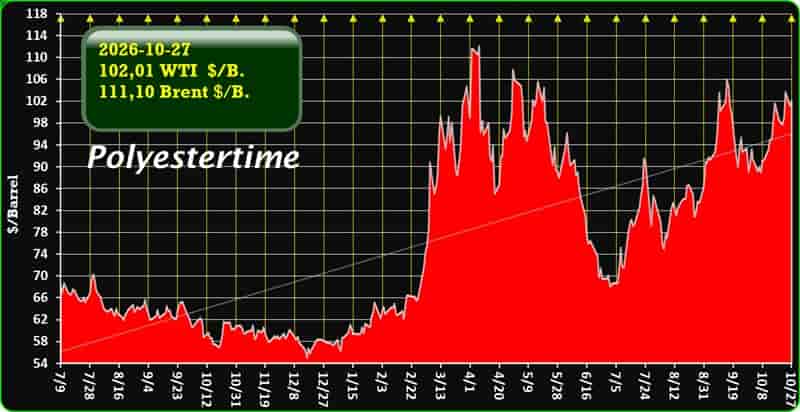
Crude Oil Prices Trend

Braskem Expands Green Polyethylene Production in Brazil
15 Years of I’m green™: A Milestone in Sustainable Innovation
Braskem, a leader in sustainable petrochemicals, is celebrating 15 years since launching its pioneering biobased polyethylene under the I’m green™ brand. To mark this milestone, the company has announced a new boost in production capacity at its bio-ethylene plant in Triunfo, Brazil.
The facility now produces 275,000 tonnes of bio-ethylene per year, a slight but significant increase from the previous 260,000 tonnes. This ethylene is derived entirely from sugarcane-based ethanol, offering a renewable and low-carbon alternative to fossil feedstocks. Sustainable Food Packaging
From 200,000 to 275,000 Tonnes: Steady Growth Toward Sustainability
The current capacity is now 37% higher than the original output when Braskem first entered the green plastic market. While the most substantial increase occurred in 2021—thanks to a $90 million investment—this latest increment reflects Braskem’s ongoing commitment to scaling up its renewable materials.
At the Triunfo site, the bio-ethylene is used to manufacture both biobased polyethylene and EVA (ethylene vinyl acetate). These materials perform identically to their fossil-based counterparts, making them ideal for use in packaging, consumer goods, and more—while dramatically reducing carbon emissions.
A Global Vision: New Bio-Ethylene Plant Planned in Asia
Braskem isn’t stopping with Brazil. In collaboration with SCGC, a major Thai conglomerate, the company is preparing to construct a second bio-ethylene facility in Asia through its joint venture Braskem Siam. This plant is expected to add another 200,000 tonnes per year of renewable ethylene capacity to meet growing global demand. Sustainable Food Packaging
Looking Ahead to 2050: Carbon Neutrality in Sight
“In 2025, we celebrate not only 15 years of the I’m green™ brand, but also Braskem’s extraordinary journey in sustainable chemistry,” said Walmir Soller, Vice President for North America, Europe, and Asia, and CEO of Braskem BV. “The 2023 expansion was a crucial step in our mission to become carbon neutral by 2050.”
Braskem’s strategy demonstrates how large-scale industry can shift toward a greener, circular economy, driven by innovation and renewable resources. Sustainable Food Packaging

SGL Carbon to Close Lavradio Production Site Amid Restructuring
SGL Carbon has announced the planned closure of its production facility in Lavradio, Portugal, as part of a broader restructuring of its underperforming Carbon Fibers business unit. The Lavradio plant, one of seven global sites in this segment, currently employs around 250 workers who are involved in producing acrylic fibers and precursors for carbon fiber manufacturing.
Why Is the Lavradio Site Closing?
The decision follows a strategic review aiming to reduce losses and concentrate on profitable areas. The company first disclosed plans to overhaul its Carbon Fibers operations in a press release on February 18, 2025. Sustainable Food Packaging
Lavradio’s closure stems from a significant drop in global demand for fiber products and an oversupply in the market, which has pushed prices to unsustainable levels. European manufacturing, especially in energy-intensive sectors like this, has become increasingly uncompetitive compared to Asian counterparts due to higher production costs. These market pressures have left the Lavradio facility particularly vulnerable.
Closure Timeline and Employee Impact
The shutdown will occur in several stages, with production expected to cease in June 2025. Full site decommissioning is scheduled to complete by the end of 2026, pending regulatory and operational milestones. Sustainable Food Packaging
Approximately 190 jobs will be cut in the initial phase, with the company working closely with employee representatives and stakeholders to ensure a fair and legally compliant process.
“We regret the impact this has on our employees, but Lavradio’s ongoing losses leave us no viable alternative,” said Dr. Stephan Bühler, the board member overseeing the Carbon Fibers unit.
CEO Andreas Klein added: “It’s a tough decision rooted in long-term sustainability for the SGL Carbon Group.”
What’s Next for SGL Carbon?
This move is part of a larger transformation effort. While Lavradio is set for closure, SGL Carbon is actively exploring tailored strategies for its other Carbon Fibers locations. Each site will be evaluated on its individual merits, and further updates will follow as decisions are finalized. Sustainable Food Packaging
At this time, no additional closures or changes have been confirmed.

Metpack and BASF Launch Home-Compostable Coated Paper for Food Packaging
A Breakthrough in Sustainable Packaging
Metpack, a leader in extrusion coating based in Istanbul, has teamed up with BASF to unveil a certified home-compostable coated paper for food packaging. Their innovation, Ezycompost paper, is coated with BASF’s biopolymer ecovio® 70 PS14H6, offering an eco-friendly alternative to plastic while maintaining high performance.
Outstanding Performance Meets Compostability
This next-gen material is DIN EN 13432 and AS 5810 certified for home composting. It delivers FDA-approved food-contact safety and excellent barrier properties against liquids, oils, and grease—even at temperatures up to 100°C. Unlike traditional packaging, it leaves no microplastics in compost and supports organic recycling, helping to close the nutrient loop in a circular economy. Sustainable Food Packaging
Flexible for Industry, Safe for the Planet
Ezycompost offers a 40% thinner coating than PLA (polylactic acid) and allows for faster production using standard forming lines. It performs on par with polyethylene (PE) in coating speeds, with no chill roll adhesion, strong sealing, and excellent printability. The material is compatible with mono- and co-extrusion processes, requiring no adhesives.
Designed for Versatile Applications
From cold and hot drink cups to microwaveable and deep-freeze trays, this paper is suitable for a wide range of food packaging formats. It answers growing societal and legislative calls to shift away from pure plastic toward paper-based, compostable solutions. Sustainable Food Packaging

Blow Moulding 2025: Innovation & Sustainability in Plastic Packaging
Blow Moulding 2025, the leading international event for the blow moulding industry, returns to Brussels, Belgium on December 10–11, 2025. Now in its 9th edition, this annual conference, exhibition, and networking platform brings together the full spectrum of the packaging supply chain.
The Global Impact of Blow Moulding
According to Nortal Consulting, over 36 million tonnes of polymer—primarily PET and HDPE—were processed via blow moulding in 2024. This global production, valued at around $97 billion, fuels packaging across both consumer and industrial sectors.
Why Attend Blow Moulding 2025?
This two-day event offers expert presentations, panel discussions, and interactive exhibition zones. Attendees can connect with raw material suppliers, machine builders, toolmakers, brand owners, recyclers, and sustainability professionals. It’s the ideal venue to explore cutting-edge trends and share innovations shaping the industry. Sustainable Food Packaging
Holistic Focus on Packaging Solutions
Blow Moulding 2025 doesn’t stop at bottles. The agenda covers complete packaging ecosystems—including caps, closures, labels, sleeves, dispensing systems, and secondary packaging. From raw material selection to end-of-life management, every phase of the product lifecycle is in scope.
Join the Conversation
As sustainability and circularity become central concerns, this event provides an invaluable platform for dialogue, discovery, and development. Sustainable Food Packaging
? Don’t miss your chance to be part of the future of packaging.
Visit the official site to learn more and register: Blow Moulding 2025

EIA Cuts WTI Forecast to Near $60/Barrel Amid Ongoing Trade Uncertainty
The U.S. Energy Information Administration (EIA) has revised its outlook for West Texas Intermediate (WTI) crude prices, lowering projections due to ongoing trade tensions and market volatility.
WTI and Brent Price Forecasts Reduced
According to the latest Short-Term Energy Outlook (STEO), the EIA now expects WTI crude at $61.81 per barrel in 2025, marking a drop of $2.07 from the previous forecast. The 2026 projection is even lower at $55.24 per barrel, down $2.24 compared to April’s report.
Brent crude, the international benchmark, has also seen a downward revision. Prices are now forecast at $65.85 per barrel in 2025 and $59.24 per barrel in 2026, reflecting similar declines. Sustainable Food Packaging
Trade Tariffs Add Uncertainty
The EIA’s updated forecast reflects tariffs announced by President Donald Trump on April 2, though it does not account for a 90-day suspension granted to select countries. It also excludes potential retaliatory tariffs from China.
This creates an unpredictable trade environment, leading to concerns of a tariff-driven economic slowdown, which in turn could dampen oil demand.
Global Oil Supply and Demand Outlook
Despite lower price expectations, global oil production continues to rise. The EIA now forecasts global liquid fuels output at 104.13 million b/d in 2025 and 105.43 million b/d in 2026, both modestly higher than previous projections.
Global consumption is forecast at 103.71 million b/d in 2025, up by 70,000 b/d, and 104.61 million b/d in 2026, which is actually 70,000 b/d lower than previously expected.
U.S. Consumption and Production Trends
In the United States, oil consumption is set to reach 20.5 million b/d in 2025, a slight increase, but fall to 20.44 million b/d in 2026. Meanwhile, U.S. oil production is expected to hit 13.42 million b/d in 2025 and 13.49 million b/d in 2026, both lower than previously estimated. Sustainable Food Packaging
TotalEnergies Corbion and Coexpan Lead €7.6M PLA Packaging Innovation
Greco Project Aims to Revolutionize Sustainable Food Packaging in Europe
A major European research initiative, Project Greco, is set to transform the food packaging industry with a €7.6 million funding boost from the Horizon Europe programme. Spearheaded by TotalEnergies Corbion, Coexpan, Aimplas, and European Bioplastics, the project brings together 22 partners committed to advancing polylactic acid (PLA) solutions for sustainable food packaging.
Launch Set for June in Valencia
Greco officially kicks off on June 16–17 at Aimplas headquarters in Valencia, Spain. The initiative focuses on developing next-generation PLA copolymers, functional coatings, and eco-friendly chemical processes tailored to the diverse requirements of the food packaging sector.
“Our goal is to create sustainable and circular solutions that reduce waste and environmental impact,” said Dimitrios Bikiaris, project coordinator at Aristotle University of Thessaloniki.
Packaging Designed for Performance and Planet
The project aims to deliver high-performance, recyclable, and biodegradable packaging. From flexible films for berries to rigid containers for cheese, the goal is to extend shelf life, retain aroma and moisture, and align with the EU Packaging and Packaging Waste Regulation. Sustainable Food Packaging
Greco’s R&D efforts will focus on improving PLA’s biodegradability, production efficiency, and material quality, using an iterative development approach.
Industry-Backed Innovation
TotalEnergies Corbion is developing advanced PLA copolymers to enhance both recyclability and functionality. Their 75,000-ton per year PLA plant in Rayong, Thailand, produces the well-known Luminy PLA portfolio, which is widely used in packaging, consumer goods, and automotive sectors.
The company also leads in chemical recycling of PLA waste through hydrolysis depolymerisation, reinforcing circular economy principles. Sustainable Food Packaging
End-of-Life and Certification Focus
Greco will explore mechanical and chemical recycling, and test biodegradability in marine, soil, and composting environments. Certification partners TÜV Austria and DIN Certco will help shape new standards based on real-world findings.
Aimplas brings cutting-edge tools like reactive extrusion and mechanochemistry to customize PLA copolymers and additives, paving the way for scalable, green packaging solutions.
Engaging Consumers and the Market
Beyond the lab, Greco includes a social dimension—gathering consumer insights to ensure the resulting products meet sustainability expectations and usability needs.
“Greco shows how collaboration and innovation can power Europe’s bioeconomy,” said Hasso von Pogrell of European Bioplastics.