Circular Plastics – K 2025: SACMI PVS Robot – The Final Frontier of Automatic PET Preform Control Previewed at the Düsseldorf fair, SACMI sets a new benchmark in PET preform inspection with full robotic automation 30-09-2025
Circular Plastics
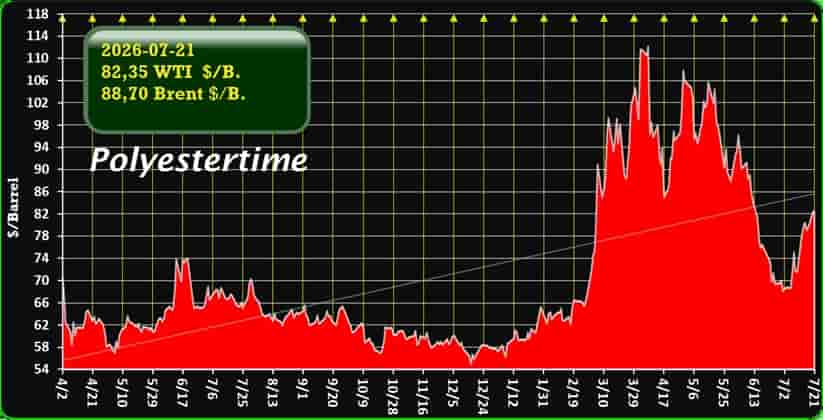
Crude Oil Prices Trend

Adapa Installs Two New Lines in Germany
Austrian packaging leader Adapa enhances its German operations with advanced blown film extrusion technology.
Overview
Adapa, a prominent Austrian manufacturer of flexible packaging, has recently installed two state-of-the-art 9-layer Quadex blown film extrusion lines at its facility in Kempten, Bavaria, Germany. These new lines are designed specifically for the production of shrink film and were supplied by the Canadian company Macro Engineering & Technology.
With this strategic investment, Adapa aims to expand its capabilities in high-quality shrink packaging, currently utilizing PvdC and planning to incorporate EVOH in the future.
Technology Behind the Lines
The newly installed extrusion lines are part of the Quadex series, known for their advanced coextrusion capabilities. Circular Plastics
These lines support up to 9 layers, enabling the production of complex film structures with enhanced barrier properties and mechanical strength.
Markus Stephan, Managing Director of Adapa Germany Kempten, emphasized the importance of user-friendly operation and robust technical support in selecting Macro Engineering as their partner. “The ease of use of the lines and the after-sales technical support were decisive factors in choosing to collaborate with Macro,” he stated.
About the Supplier
Macro Engineering & Technology, based in Canada, has been a leader in extrusion technology since 1978. The company specializes in coextrusion lines for blown, cast, and biaxially oriented film, offering solutions with up to 13 layers. Their portfolio also includes sheet extrusion lines, coextrusion dies, air rings, and winding systems. Circular Plastics
Macro’s commitment to innovation and customer support has made them a trusted partner for packaging manufacturers worldwide.
About Adapa Group
Headquartered in Wiener Neudorf, Austria, the Adapa Group is a leading producer of high-barrier flexible packaging. Their products serve a wide range of industries including food, tobacco, hygiene, and pharmaceuticals.
Originally founded as Schur Flexibles in 2012, the company rebranded to Adapa in 2022. Today, Adapa operates across 20 European locations, including a site in Italy, and employs over 2,000 people. Circular Plastics
The group generates annual revenues of approximately €530 million.
Impact and Future Outlook
The installation of these new extrusion lines marks a significant step forward for Adapa’s production capabilities. By integrating advanced technology and expanding material options, the company is well-positioned to meet evolving market demands and regulatory requirements.
This move also reflects Adapa’s commitment to innovation and sustainability in packaging solutions, reinforcing its role as a key player in the European flexible packaging industry.
K 2025: SACMI PVS Robot – The Final Frontier of Automatic PET Preform Control
Previewed at the Düsseldorf fair, SACMI sets a new benchmark in PET preform inspection with full robotic automation.
Introduction
At the upcoming K 2025 fair in Düsseldorf, SACMI is set to unveil a breakthrough in PET preform quality control: the all-new PVS Robot.
Designed to push off-line inspection towards total automation, this system eliminates the need for manual intervention during format changeovers, setting a new global standard for productivity and precision. Circular Plastics
Alongside the PVS Robot, SACMI will also showcase the innovative CVS OneCam, a compact, flexible vision system, and the upgraded Spark Tester, now even more versatile and intelligent.
Together, these technologies reinforce SACMI’s position as the market leader in vision systems for quality and process control.
The New PVS Robot
Building on the success of the PVS002, the new PVS Robot represents a major leap forward in automated preform inspection.
With an integrated Scara robot for handling and a fully automated format warehouse, the system can manage preforms from different presses without requiring manual format changeovers. Circular Plastics
This innovation directly addresses one of the industry’s biggest challenges: reducing downtime while maintaining inspection precision.
By combining modular design with robotic automation, SACMI has created a solution that is scalable, user-friendly, and future-proof.
Automation & Handling
At the core of the PVS Robot is its automation-first approach.
The system offers flexible handling options, including:
- Roller-type positioners with automatic format changeovers.
- Bin picking systems supported by an articulated robot and advanced 3D sensors. Circular Plastics
These features simplify operator tasks, reduce the risk of errors, and guarantee seamless transitions between different formats.
In high-volume manufacturing environments, this translates to a significant boost in operational efficiency.
Performance & Precision
The PVS Robot is capable of inspecting up to 1,200 preforms per hour (excluding weighing) with a precision level comparable to that of a quality control laboratory.
Its modular and scalable structure supports integrated weighing systems and configurable compliance thresholds, enabling manufacturers to tailor the inspection process to their specific needs. Circular Plastics
“With the PVS Robot, SACMI combines lab-grade precision with industrial-scale automation, setting a new benchmark for quality control in PET preform production.”
CVS OneCam: Compact, Simple, Effective
Alongside the PVS Robot, SACMI introduces CVS OneCam, an embedded vision system designed for low-complexity applications.
Compact yet powerful, CVS OneCam delivers complete real-time quality control with minimal integration effort. Circular Plastics
Unlike traditional inspection systems that require multiple cameras and complex setups, CVS OneCam uses a single, integrated platform to control the entire inspection cycle.
This makes it an ideal choice for manufacturers seeking a cost-effective, space-saving solution.
The Revamped Spark Tester
The third highlight of SACMI’s K 2025 showcase is the upgraded Spark Tester.
Now more compact, versatile, and intelligent, the new design enhances both usability and performance.
By incorporating smarter diagnostic features and improved adaptability, the Spark Tester ensures reliable performance across a wide range of applications.
It complements SACMI’s broader vision system portfolio by delivering consistent, high-quality testing results. Circular Plastics
Impact on the Industry
With its comprehensive portfolio of vision systems, SACMI continues to lead the way in automation and quality control for the PET industry.
The introduction of the PVS Robot, alongside CVS OneCam and the new Spark Tester, signals a decisive move toward fully automated, AI-powered manufacturing.
For manufacturers, these innovations promise not just better inspection accuracy, but also reduced labor costs, faster format changes, and higher throughput.
In an industry where efficiency and precision drive competitiveness, SACMI’s solutions provide a clear strategic advantage. Circular Plastics
Conclusion
The K 2025 fair marks an important milestone for SACMI and for the PET preform industry as a whole.
With the launch of the PVS Robot, the company is moving quality control towards a new era of complete automation.
Supported by the CVS OneCam and the revamped Spark Tester, SACMI demonstrates once again why it remains the global leader in innovation. Circular Plastics
For businesses looking to stay ahead in the rapidly evolving packaging industry, SACMI’s solutions offer a future-ready toolkit for ensuring quality, efficiency, and scalability.

Recycled Terephthalic Acid (rTFA) Quality Standards: What Manufacturers Need to Know
Global Market Overview
The global recycled terephthalic acid (rTFA) market was valued at USD 2,289.2 million in 2023 and is projected to rise from USD 2,379.7 million in 2024 to USD 3,214.7 million by 2031. This growth, at a CAGR of 4.39%, is driven by increasing adoption of sustainable practices and circular economy initiatives within plastics and textile industries.
As regulations tighten, manufacturers face higher expectations for rTFA quality and traceability, especially for food-contact and high-clarity applications. Circular Plastics
Key Quality Parameters for rTFA
Purity and Chemical Composition
Purity is fundamental. High-performance polyester or food-contact resins demand rTFA with over 99.5% terephthalic acid content. Contaminants such as acetaldehyde, dimethyl terephthalate, oligomers, heavy metals, and color bodies must be minimized.
Moisture and Volatile Matter
Moisture levels must stay below 0.2% by weight to prevent hydrolytic degradation during polymerization. Controlling volatile compounds ensures thermal stability and consistent product performance. Circular Plastics
Color, Clarity, and Optical Properties
Metrics like yellowness index and haze are critical for applications such as clear PET bottles. Minimal coloration avoids costly bleaching or corrective treatments downstream.
Heavy Metals and Contamination Control
Strict limits on lead, cadmium, mercury, and chromium apply, especially for food-contact uses. Effective feedstock screening and purification are essential for compliance.
Traceability and Chain of Custody
Manufacturers must document recycling processes, batch testing, and feedstock origins. A robust chain of custody ensures compliance and instills confidence among regulators and buyers. Circular Plastics
Regulatory and Standards Frameworks
China’s Recycled Plastics Standards
China’s State Administration for Market Regulation will enforce new national standards from . These will require precise test methods and technical specifications, raising the bar for rTFA producers entering Chinese markets.
Food Contact Regulations in Other Jurisdictions
In March 2025, India’s Food Safety and Standards Authority (FSSAI) amended its rules to allow recycled PET in food-contact applications, provided strict quality and migration limits are met (SGS source). Circular Plastics
Voluntary Standards and Industry Initiatives
Industry collaborations, such as the Selenis–Circ project, demonstrate rTFA parity with virgin PTA. These initiatives evaluate chemical, optical, and mechanical performance metrics (Selenis press release).
Technological Routes and Their Effect on Quality
Hydrolysis and Methanolysis
Hydrolysis yields high-purity terephthalic acid directly, while methanolysis produces dimethyl terephthalate that requires further conversion. Both demand purification steps to remove impurities and color bodies. Circular Plastics
Feedstock Selection and Pretreatment
Quality begins with feedstock. Segregating PET, removing contaminants, and applying pretreatment (washing, de-labeling, alkaline treatment) reduce impurities before depolymerisation.
Purisfication Techniques
Techniques such as crystallization, activated carbon decolorization, and ion exchange are critical. Advanced analytical testing validates purity and compliance with regulatory standards. Circular Plastics
Quality Audits, Certifications, and Documentation
Compliance requires adherence to ISO 9001 and, for food-contact uses, certifications such as regulatory letters of no objection. Third-party audits verify integrity in manufacturing, testing, and storage processes.
Batch documentation should include certificates of analysis, feedstock traceability, and proof of compliance with impurity thresholds. Consistent internal QC and external audits strengthen market credibility.
Manufacturers Leading in rTFA Quality
Selenis and Circ have pioneered rTFA from blended textile waste, demonstrating its performance equivalence to virgin PTA. Similarly, Indorama Ventures, Alpek, Far Eastern New Century, SK Chemicals, and Loop Industries are advancing rTFA for applications requiring food-grade and high-clarity properties. Circular Plastics
Challenges in Meeting Quality Standards
Manufacturers face cost pressures due to advanced purification, feedstock variability, and regulatory testing requirements. Inconsistent global standards also create uncertainty, making it harder for producers to scale uniformly across regions.
Recommendations for Manufacturers
- Invest in advanced feedstock sorting and purification technologies.
- Maintain rigorous analytical testing protocols (HPLC, GC-MS, etc.).
- Engage regulators early to align on compliance requirements.
- Document processes for traceability and chain of custody. Circular Plastics
- Participate in industry standardization efforts to influence practical frameworks.
Conclusion
High-quality rTFA is becoming a cornerstone of sustainable plastics. Manufacturers who emphasize purity, traceability, and regulatory compliance will gain competitive advantage as global demand for sustainable PET alternatives accelerates. With strong process control and certification strategies, rTFA can replace virgin PTA in a wide range of applications while meeting safety and performance requirements. Circular Plastics
Morris Packaging, UFlex Partner to Deliver Sustainable Woven Bag Solutions
Summary
Morris Packaging LLC and UFlex Packaging Inc. have formed a strategic partnership to co-develop woven bag solutions for pet food, lawn & garden and industrial customers. The collaboration combines regional market insight and customer relationships from Morris Packaging with UFlex’s flexible packaging technologies and global scale.
The goal: deliver sustainable, high-performance woven packaging that expands product choice and supply reliability for manufacturers and distributors across the U.S.
What the partnership delivers
The alliance pairs Morris Packaging’s customer-focused footprint with UFlex’s manufacturing know-how. Together they will:
- Develop next-generation woven bag products tuned to pet food and industrial requirements. Circular Plastics
- Scale manufacturing and distribution to improve availability and lead times.
- Prioritize materials and designs that reduce lifecycle environmental impact.
Executives described the partnership as a way to diversify product lines, expand technology access and offer more consistent, locally supported supply to regional customers.
Customer benefits & target markets
The initial focus includes pet food, lawn & garden, and broader industrial applications. Customers can expect:
- More flexible product options (sizes, barrier properties, printing choices).
- Improved supply reliability through combined capacities.
- Access to sustainable packaging choices that meet evolving retailer and regulatory expectations. Circular Plastics
Quotes from leadership emphasize value and market confidence. Jim Bob Morris, CEO of Morris Packaging, said the collaboration will “position ourselves to provide unsurpassed value to the marketplace.” UFlex’s product development lead highlighted greater alignment and choice for U.S. customers.
Sustainability & innovation focus
Sustainability is a core pillar. The partners will leverage material science, improved manufacturing efficiencies and design-for-reuse/recycling principles where feasible.
Key approaches include using lower-impact resins, improving film-to-bag conversion efficiencies, and designing packaging that simplifies downstream recycling or reuse in supply chains. Circular Plastics
Performance & technical tips for site owners
If you publish this announcement on WordPress, follow these site-first tactics to ensure fast load times and strong Core Web Vitals scores:
| Focus | Action |
|---|---|
| Images | Serve responsive images (srcset), compress, and include descriptive alt text (e.g., “Morris Packaging and UFlex partnership announcement photo”). |
| Fonts | Use system fonts or preload critical webfonts and avoid render-blocking fonts. |
| Scripts | Defer non-critical JS, inline critical CSS, reduce third-party tags on the landing page. |
| Caching | Enable server-side caching, set long cache TTLs for static assets, and use a CDN. |
Keep paragraphs short and headings clear — this aids readability and mobile scanning. Use the theme’s responsive container widths and let WordPress handle block spacing so the layout adapts across devices. Circular Plastics
Contact & next steps
For more information, customers and partners should contact Morris Packaging sales or visit both companies’ press pages for full specs and certified materials data sheets.

Announcing World-First Food-Safe Recycled Polypropylene for European Markets
Introduction
For the first time in history, a recycled polypropylene (rPP) material has met the strict food-safety standards set by the European Union. This milestone innovation allows recycled plastics to be safely used in food-grade packaging, unlocking new pathways for sustainability and circularity in the packaging industry. Circular Plastics
The initiative is spearheaded by Prevented Ocean Plastic, in collaboration with Bantam Materials UK Ltd, and backed by leading packaging companies across Europe. It is projected to stop more than 500 million plastic cups from entering the ocean in its first year alone—enough to wrap around the Earth.
A Breakthrough in Food-Safe Recycling
The material is collected from coastal regions at risk of ocean pollution, then cleaned and processed using novel recycling technology. Each batch is scientifically tested by third parties to ensure compliance with stringent EU food-contact standards.
The end result is a high-quality, food-safe recycled polypropylene that can replace virgin plastic in packaging applications. By closing the loop, this breakthrough strengthens the industry’s shift toward circular economies and reduces reliance on fossil-based plastics.
Supply Chain and Technology
The development of food-grade rPP relies on a carefully designed supply chain with built-in accountability and quality controls. Here is how it works:
| Stage | Details |
|---|---|
| Feedstock Source | Post-consumer polypropylene collected in Southeast Asia. |
| Collection & Sorting | Prevented Ocean Plastic centres segregate and sort the material under audited standards. |
| Processing | PCR rPP pellets are toll-processed by PETMAN in Austria using Starlinger Viscotec equipment with EU-approved food-safety protocols. |
| Food Safety Testing | Every batch undergoes NIAS (Non-Intentionally Added Substances) testing to support Annex III compliance documentation. |
This meticulous process ensures that food packaging manufacturers can trust the quality, safety, and performance of recycled polypropylene in sensitive applications.
Traceability and Standards
One of the defining strengths of this initiative is its rigorous approach to traceability. Each step of the chain is verified under the Prevented Ocean Plastic Standards, which are third-party audited to guarantee compliance and transparency. Circular Plastics
Key identifiers (RIN, RON, RFN) are listed with the European Commission, providing regulatory clarity and recognition across EU markets. This ensures that the recycled content is fully documented, traceable, and aligned with international food-safety expectations.
Industry Support and Market Impact
“For Innovia, a source of EU food contact approved polypropylene (PP) from a mechanically recovered post-consumer source is a game changer. We can now make films for label and flexible packaging in the food and beverage space and contribute to circularity and sustainability. Circular Plastics
A great team of people have contributed to the process and have accelerated this mechanically recovered post-consumer PP to the eagerly awaited EU food contact rPP.”
Innovia Films is just one of several packaging leaders backing the adoption of this material. By enabling food-grade applications, the innovation creates new demand for recycled plastics and accelerates the transition toward sustainable packaging systems.
Scaling for Global Sustainability
The program is part of a scalable franchise model that can be replicated in coastal communities worldwide. By focusing on areas most vulnerable to plastic leakage, the initiative directly addresses the ocean plastics crisis while generating economic opportunities for local collectors. Circular Plastics
This dual benefit—environmental impact and community development—positions the project as a model for how the packaging industry can achieve both sustainability and social responsibility at scale.
Conclusion
The arrival of food-safe recycled polypropylene marks a turning point for the packaging industry. With strong industry backing, regulatory compliance, and a transparent supply chain, this innovation has the potential to redefine how plastics are used, recycled, and valued in Europe and beyond. Circular Plastics
By preventing millions of plastic items from entering the ocean and advancing circularity in packaging, Prevented Ocean Plastic’s initiative demonstrates how science, policy, and industry collaboration can align to deliver lasting change.
Samsara Eco Opens First Plant to Scale Circular Plastics
Australian biotech pioneers enzymatic recycling at scale, opening a landmark facility that moves circular materials from research to mainstream production.
Introduction
Samsara Eco, a leading Australian biotech company, has opened its first plant dedicated to scaling circular plastics production.
Located in Jerrabomberra, Australia, this facility represents a major step forward in the company’s mission to produce virgin-identical, low-carbon materials at industrial scale. Circular Plastics
With its opening, Samsara Eco is signaling a new era for recycled nylon, polyester, and other high-value plastics that can be used across fashion, packaging, and automotive industries.
The company’s breakthrough lies in its proprietary EosEco enzymatic recycling technology, powered by AI, which breaks down complex mixed plastics into reusable raw materials.
By doing so, Samsara Eco offers a scalable solution to one of the world’s most urgent environmental challenges: plastic waste.
The Jerrabomberra Facility
The new headquarters and production facility in Jerrabomberra has been designed to transition Samsara Eco’s innovations from laboratory-scale research into full-scale manufacturing. Circular Plastics
It combines research, production, and pilot testing, making it both a commercial plant and a research hub.
The facility is equipped to produce recycled materials at a scale that can support global brand demand.
With the ability to produce the equivalent of hundreds of thousands of garments annually, the plant sets the stage for mass-market adoption of circular plastics.
EosEco Enzymatic Technology
At the heart of the new plant is EosEco, Samsara Eco’s AI-powered enzymatic recycling platform. Circular Plastics
Unlike mechanical recycling, which often downgrades plastic quality, enzymatic recycling breaks plastics down at a molecular level.
This process produces virgin-quality materials suitable for demanding applications such as performance textiles and automotive parts.
EosEco has been developed to handle mixed plastics streams, including challenging materials like polyester blends and nylon.
By expanding the types of plastics that can be effectively recycled, Samsara Eco is solving a problem that traditional systems cannot address. Circular Plastics
A Milestone for Circularity
CEO and founder Paul Riley describes the opening as a “true tipping point for circularity.”
In just four years, Samsara Eco has advanced from bench research to pilot plants and now a fully operational facility.
This rapid progression demonstrates both the urgency of addressing plastic waste and the scalability of enzymatic solutions.
“The opening of Jerrabomberra is a proud milestone for us and the broader circular economy.
Our new facility will help brands deliver circularity with the capacity to produce the equivalent of hundreds of thousands of garments annually.” — Paul Riley, CEO, Samsara Eco Circular Plastics
Applications Across Industries
The recycled materials produced at Jerrabomberra will enter multiple industries, from apparel and packaging to automotive manufacturing.
Virgin-identical recycled nylon and polyester are particularly valuable to global fashion brands seeking sustainable sourcing.
One of Samsara Eco’s early adopters is lululemon, which plans to feature these circular materials in upcoming product lines.
Additional pilot programs are underway with partners across textiles and packaging, highlighting the technology’s commercial viability. Circular Plastics
Collaborations & Partnerships
Collaboration remains central to Samsara Eco’s approach.
The Jerrabomberra facility is already hosting advanced research initiatives, including efforts to develop recycling solutions for spandex with The LYCRA Company.
In addition, Samsara Eco is working with Deakin University’s Recycling and Clean Energy Commercialization Hub, part of the Australian Government’s Trailblazer Universities Program.
These partnerships ensure that the technology will continue to evolve, expanding to cover even the most complex plastics. Circular Plastics
Global Impact of Circular Plastics
The implications of Samsara Eco’s work extend far beyond Australia.
By creating recycled materials that match the performance of virgin plastics, the company is helping global brands achieve their sustainability goals without compromising quality or performance.
Moreover, the scalability of enzymatic recycling provides a clear pathway for industries worldwide to reduce dependence on fossil fuel–based raw materials.
As regulations tighten and consumer demand for sustainable products grows, circular plastics will become a defining feature of modern supply chains.
The Future of Enzymatic Recycling
Looking ahead, Samsara Eco plans to expand its network of plants and continue developing enzymes capable of breaking down even more types of plastics.
The long-term vision is a world where plastic never becomes waste but instead serves as a renewable resource in a closed-loop system. Circular Plastics
With global partners already on board, Samsara Eco’s next challenge is scaling production to meet the rapidly increasing demand for sustainable materials.
If successful, enzymatic recycling could become the new global standard for plastic reuse.
Conclusion
The opening of Samsara Eco’s Jerrabomberra plant is more than just a milestone for one company—it’s a turning point for the circular economy.
By proving that enzymatic recycling can scale from laboratory innovation to industrial production, Samsara Eco is setting the stage for a new era in plastics.
From fashion to automotive and beyond, the materials produced at this facility will redefine how industries source, manufacture, and recycle. Circular Plastics
For brands, policymakers, and consumers alike, this moment marks the beginning of a mainstream circular plastics economy.