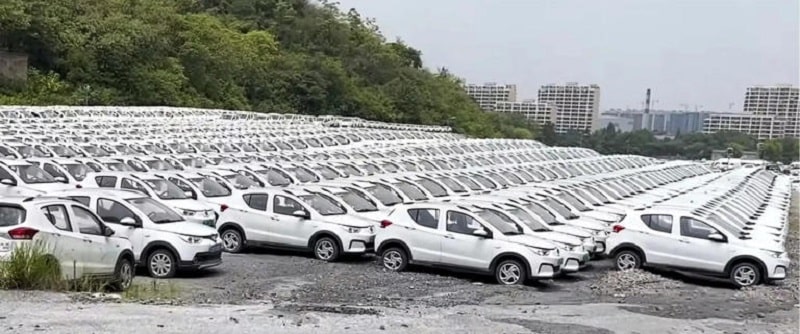
China car market – China’s booming car market shows worrying signs of slowdown as government incentives fade, consumer confidence weakens, and electric vehicle growth cools across the world’s largest auto industry in October 2025 12-11-2025
China car market
The Chinese passenger vehicle market has taken a turn. According to data from the China Passenger Car Association (CPCA), retail sales of passenger vehicles — including sedans, MPVs and SUVs — in China declined by 0.8 % year-on-year in October 2025, falling to approximately 2.27 million units. Reuters+2Investing.com+2
This marks the first contraction after eight straight months of growth in the market. Angel One+1
Why the slowdown?
Two main forces are at play. First, the stimulus that helped power the market has begun to fade. Generous government sales incentives, including tax breaks and trade-in subsidies, had fuelled the upturn. Reuters+1 As these programs taper off, demand for new vehicles is losing momentum. Secondly, consumer confidence is showing cracks. China’s broader economic backdrop—growth slowing to 4.8 % year-on-year in the third quarter of 2025—is weighing on big-ticket purchases. China car market
New-Energy Segment: Growth persists, but less robust
The new-energy vehicle (NEV) market — covering electric vehicles (EVs) and plug-in hybrids — still expanded in October, but the pace has decelerated. Growth for NEVs rose just over 7 % last month, compared to double-digit rises in earlier months. Reuters+1 For the first ten months of 2025, NEV retail sales hit 10.27 million units, which equates to roughly 53 % of all passenger vehicle retail sales in the country. China car market
What this means for the full year and beyond
While October’s dip is modest, it signals a shift. For the first ten months, total passenger vehicle sales in China rose 9 % to 19.395 million units from the same period a year earlier. However, that strong performance is now partly built on earlier gains. China car market
With incentives fading and competition intensifying, analysts expect growth to flatten or even fall next year. For example, one major bank projects possible declines of 3-5 % in 2026 if support programmes are withdrawn entirely. South China Morning Post+1
Implications for manufacturers and market dynamics
The slowdown highlights increasing saturation in China’s largest auto market. With eight months of expansion followed by a contraction, manufacturers must adjust strategies. Domestic competition is fierce, particularly in the NEV space. Some companies are shifting focus to exports and overseas markets to offset domestic softness. Reuters+1
Moreover, the wind-down of incentives may force rationalisation of production, particularly among weaker players, and intensify pressure on margins. China car market
Strategic take-aways
-
Market watchers should view the October decline as a cautionary signal, not a minor blip.
-
For automakers, reliance on subsidies is increasingly risky — building demand organically and globally will matter more.
-
For consumers, diminishing incentives could lead to price stabilisation or even upward pressure if demand rebounds.
-
For policy makers, balancing stimulus tapering with support for technological transition (especially EVs) will be critical to sustaining the automotive ecosystem.
In summary, China’s car market is entering a more mature phase. The robust growth driven by incentives and pent-up demand is receding. While underlying demand remains for new-energy vehicles and global exports, the domestic market’s shift from expansion to consolidation is now visible. The modest 0.8 % decline in October is a sign that the era of rapid growth may be giving way to a more measured future. China car market