Fibre to fibre recycling – Re&Up Accelerates Circular Textiles With Fibre-to-Fibre Recycling, Unlocking Scalable Next-Generation Fabrics For Fashion, Workwear And Sustainable Global Supply Chains 03-02-2026
Fibre to fibre recycling
Re&Up and the evolution of circular textiles
Re&Up is emerging as one of the most forward-looking circulartech companies in the global textile industry. Built on the industrial heritage and technical expertise of the Sanko Group, Re&Up focuses on fibre-to-fibre recycling and next-generation fabric innovation that can scale across fashion, workwear and industrial textiles.
At a time when textile waste continues to grow and regulatory pressure is accelerating, Re&Up positions itself at the intersection of sustainability, performance and industrial feasibility. The company’s mission is clear: transform end-of-life textiles into high-quality raw materials that can genuinely replace virgin fibres within circular supply chains. fibre to fibre recycling
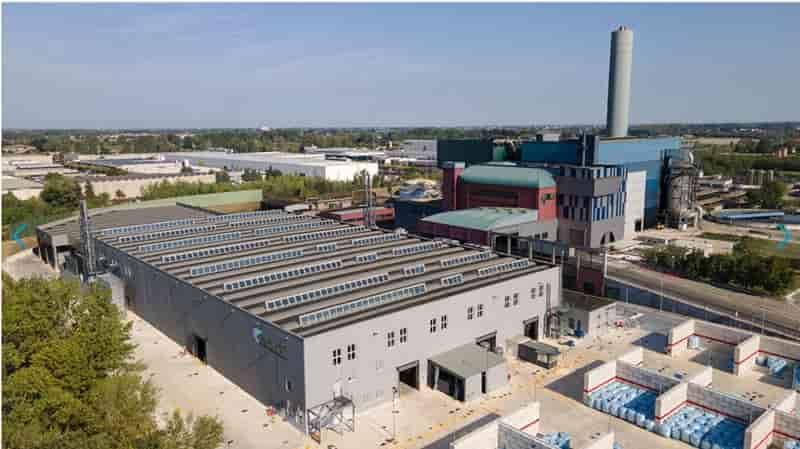
Headquartered in the Netherlands, with recycling operations in Türkiye, Re&Up is investing in infrastructure designed to support long-term textile-to-textile recycling at industrial scale.
Fibre-to-fibre recycling beyond downcycling
Traditional recycling methods often result in downcycled fibres with limited applications. Re&Up takes a fundamentally different approach by focusing on fibre-to-fibre recycling that preserves material value and performance. fibre to fibre recycling
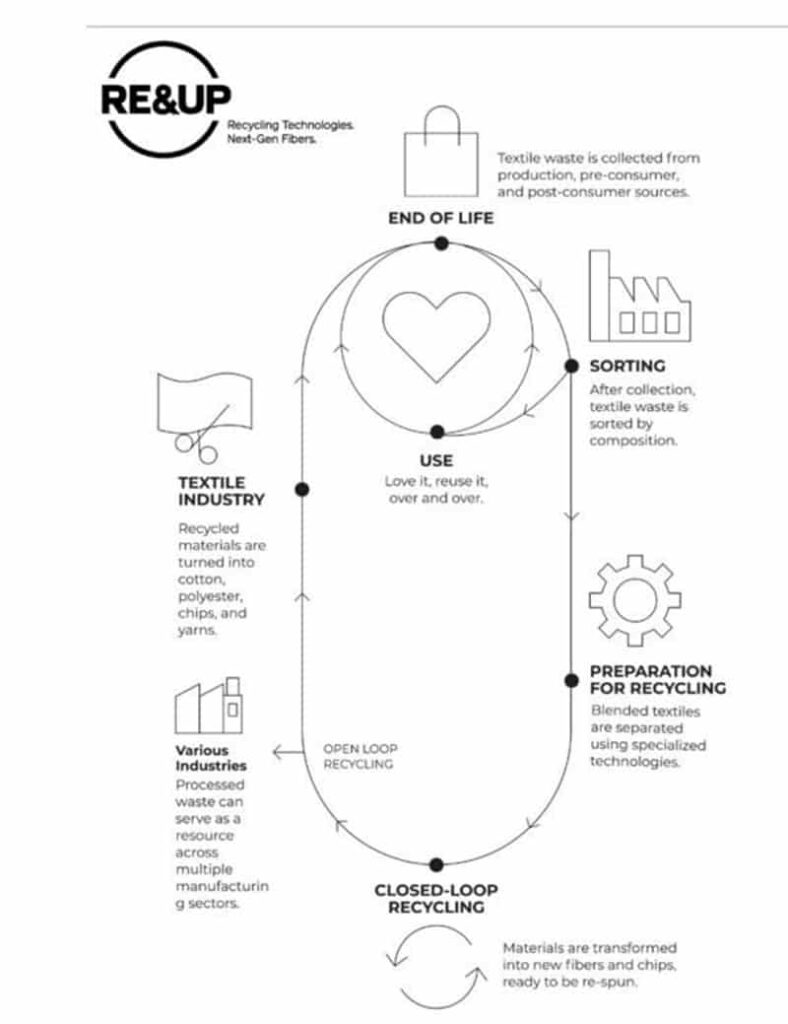
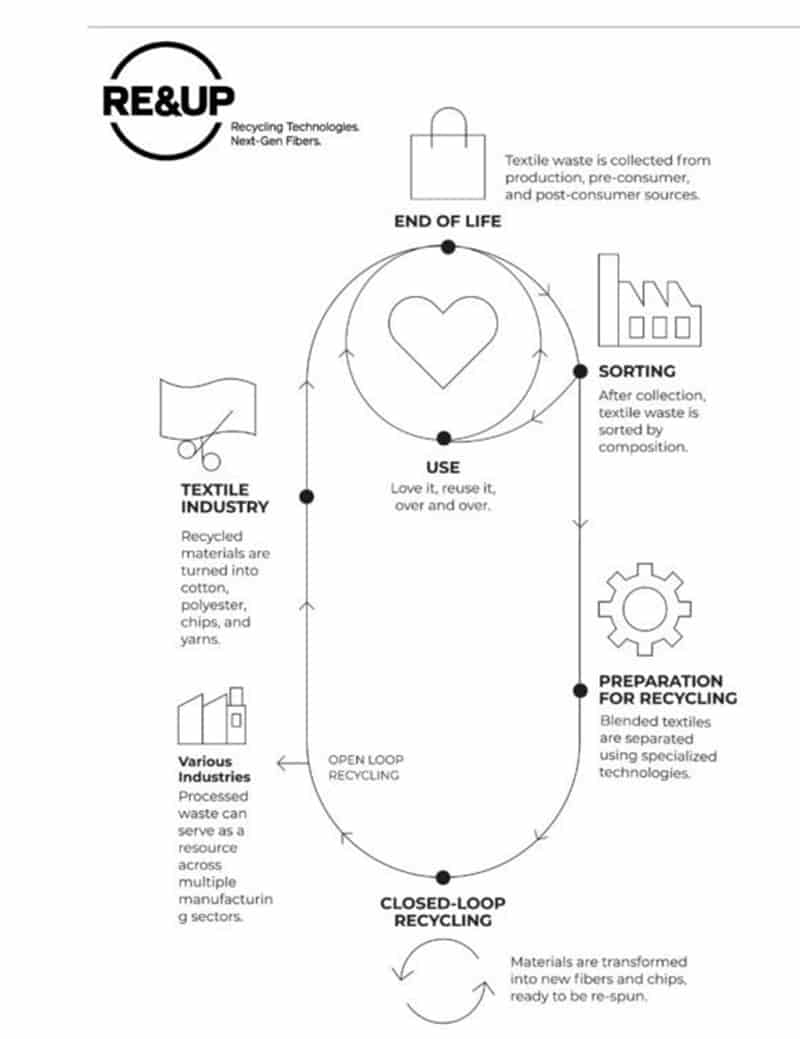
Using a patent-pending proprietary process, Re&Up can convert non-rewearable textiles into new raw materials suitable for high-quality textile production. This process is feedstock-agnostic, meaning it can handle cotton, polyester and polycotton blends without requiring extreme levels of pre-sorting.
By combining advanced mechanical and thermomechanical technologies, Re&Up processes both pre-consumer and post-consumer textile waste. This flexibility is critical for addressing real-world waste streams, which are often mixed, inconsistent and complex. fibre to fibre recycling
Dual recycling pathways for cotton and polyester
A key innovation within the Re&Up system is the ability to operate two parallel recycling pathways. One pathway is optimised for textiles with high cotton content, while the other is designed for materials with high polyester content.
This dual approach allows blended fabrics to be separated and transformed into next-generation cotton and next-generation polyester fibres. These recycled fibres are engineered to meet the quality, consistency and performance standards required by brands, manufacturers and end users. fibre to fibre recycling
As a result, Re&Up enables recycled materials to function as true alternatives to virgin fibres rather than secondary options with limited use cases. This capability is essential for closing the loop in textile production and enabling scalable circularity.
Supporting brands with next-generation materials
Re&Up works closely with fashion brands, workwear suppliers and industrial partners to integrate recycled fibres into their products. Next-generation cotton and polyester developed through fibre-to-fibre recycling are designed to align with existing manufacturing processes, reducing friction for adoption.
Consistency, traceability and performance are central to Re&Up’s material strategy. By delivering reliable recycled fibres at scale, the company helps brands meet sustainability targets without compromising product quality or durability. fibre to fibre recycling
This approach is particularly relevant for workwear and uniforms, where performance requirements are stringent and material failure is not an option.
Building closed-loop supply chains through partnerships
Collaboration is a core pillar of Re&Up’s circular strategy. Through its UK sourcing agent, the company partners with workwear suppliers, reuse organisations, local authorities and high street brands to secure valuable textile feedstock that is unsuitable for reuse. fibre to fibre recycling
These partnerships focus on pre- and post-commercial textiles that would otherwise be discarded despite retaining significant material value. Before processing, materials are tested and certified to ensure compliance with brand standards and data protection requirements.
The result is a closed-loop supply chain model where organisations can return end-of-life garments and re-enter the system as buyers of recycled fibres made from their own textile waste. This practical implementation of circular textiles moves sustainability from theory to operational reality. fibre to fibre recycling
Enabling EPR readiness and design for recyclability
As extended producer responsibility frameworks gain momentum across Europe and the UK, Re&Up is actively contributing to discussions around textile-to-textile infrastructure and regulatory readiness.
The company advocates for design for recyclability, encouraging brands to consider fibre composition, construction and end-of-life pathways at the product development stage. Fibre-to-fibre recycling is significantly more effective when garments are designed with circular systems in mind. fibre to fibre recycling
By aligning material innovation with policy evolution, Re&Up supports brands in preparing for future compliance while improving environmental outcomes today.
Shaping the future of sustainable fabrics
As a new member of UKFT, Re&Up is committed to shaping the future of the UK textile industry through collaboration, innovation and knowledge sharing. The company actively engages with brands, local government and technical partners to accelerate the transition toward circular textiles.
Beyond reducing textile waste, Re&Up is redefining what recycled materials can achieve. Fibre-to-fibre recycling, next-generation fabrics and scalable circular infrastructure are no longer experimental concepts but emerging industrial realities. fibre to fibre recycling
Through its technology and partnerships, Re&Up demonstrates that sustainable textiles can meet the demands of performance, quality and scale, setting a new benchmark for the future of fabrics.
More…