Europe Ends Naiveté: Powerful Rapid Trade Defense Proposal Shocks Global Markets
EU rapid trade defense tool
Europe Ends Naiveté: Powerful Rapid Trade Defense Proposal Shocks Global Markets
A Dramatic Turning Point in European Trade Policy
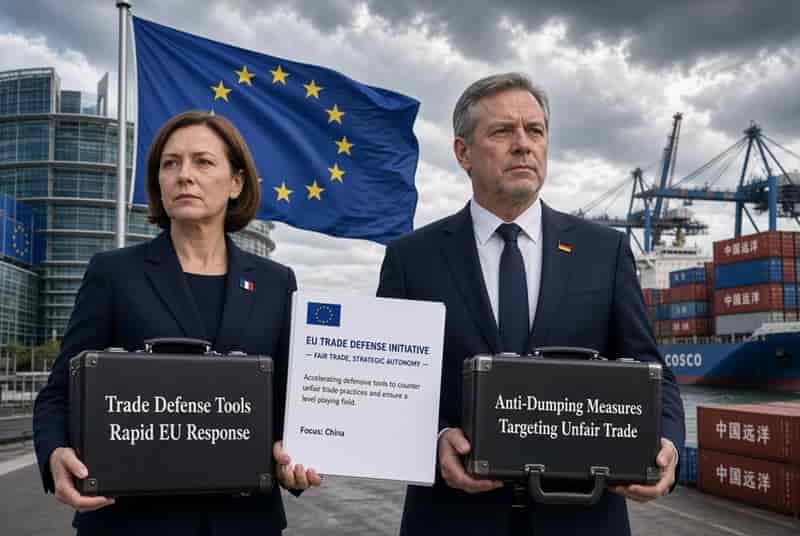
In an aggressive move to safeguard the European Union’s economic perimeter, French President Emmanuel Macron and German Chancellor Friedrich Merz have jointly called for a brand-new, rapid-action trade defense mechanism. In a joint letter sent to European Commission President Ursula von der Leyen, the leaders of the bloc’s two largest economies outlined a bold framework designed to strike back against unfair foreign market practices within a matter of days.
This initiative represents a pivotal shift away from Europe’s traditional, slow-moving bureaucratic defense mechanisms. Aimed squarely at countering aggressive state-led subsidies, market dumping, and currency manipulation, the proposal seeks to give Brussels trade firepower comparable to the United States’ long-standing Section 301 trade authority. EU rapid trade defense tool
Why the Push for an “EU Section 301” Strategy Now?
European policymakers argue that global trade has increasingly become weaponized. The rapid influx of heavily subsidized products from third countries—particularly in sectors such as electric vehicles, hybrid cars, polyethylene terephthalate (PET), and industrial chemicals—has placed severe pressure on domestic European manufacturers.
According to economic analysts monitoring the proposal, the European Union’s goods trade deficit with China reached approximately €360 billion ($400 billion) last year, creating an unsustainable structural imbalance. To combat this, Paris and Berlin are demanding two new instruments:
-
Supply Diversification Rules: Mandating strict limits on single-source dependency for critical supply chain inputs.
-
Rapid Single-Market Access Restrictions: Granting the European Commission emergency powers to restrict market entry to nations that systematically undermine fair competition.
Key Operational Changes Proposed by France and Germany
To eliminate decision-making bottlenecks, the Franco-German proposal introduces significant procedural streamlined measures:
Reverse Qualified Majority Voting: Under the proposed rules, any retaliatory measure recommended by the European Commission would be automatically adopted unless a qualified majority of EU member states actively votes against it. This lowers the hurdle for enforcement compared to traditional trade votes.
Deployment Within Days: Rather than taking months or years to investigate trade violations, emergency procedures could be triggered rapidly—what diplomats refer to as a “red button” option—to restrict harmful imports before irreversible industrial damage occurs. EU rapid trade defense tool
Sector-Wide Investigations: Instead of targeting individual companies or narrow product categories, the EU would run comprehensive, cross-industry inquiries to protect entire supply chains.
Global Repercussions and Escalating China Tensions
While the joint Franco-German text avoids naming a single country, Beijing remains the primary target of the strategy. Officials in China responded swiftly to the emerging policy shift. Spokespersons for China’s Ministry of Commerce urged France and Germany to refrain from pushing the EU toward protectionist tools, calling the move a violation of World Trade Organization (WTO) principles that threatens to disrupt global supply chains.
Beijing warned that attempts to decouple or overstretch national security concepts will backfire, maintaining that economic ties and interdependence between Europe and China should not be viewed as a threat. Meanwhile, high-level diplomatic discussions continue as EU Trade Commissioner Maroš Šefčovič prepares for key bilateral meetings with Chinese Commerce Minister Wang Wentao to address mounting friction in sectors like automobiles and medical devices. EU rapid trade defense tool
What Lies Ahead for EU Trade Policy?
The Franco-German paper arrives just ahead of a crucial EU leadership summit in Brussels, where Chinese trade imbalances and broader geo-economic risks top the agenda. European Commission President Ursula von der Leyen welcomed the input, noting that it aligns with her mandate to strengthen European economic sovereignty. EU rapid trade defense tool
However, turning this proposal into active law will still require official legislative drafting and consensus building across the European Parliament and all member states—a process expected to take several months. As global economic competition intensifies, the message from Paris and Berlin is unequivocal: Europe’s period of economic passivity has officially come to an end.
China Export Surplus: A Stark Warning for Global Industry
More…