Revolutionizing Circular Supply: How Borouge Boldly Accelerates European Mechanical Recycling Capacity
Scaling Circular Supply: How Borouge Accelerates European Mechanical Recycling Capacity
The Strategic Expansion of European Mechanical Recycling Capacity
The industrial transformation toward circular economies has reached a decisive turning point across the European market. Sustainable resource management is no longer merely a corporate social responsibility objective; it has evolved into a central pillar of industrial competitiveness, supply chain resilience, and regulatory compliance. In response to increasing market demands, Borouge International has announced capital investments aimed at scaling its European mechanical recycling capacity across key operational sites in Niedergebra, Germany, and Wildon, Austria.
This strategic expansion is specifically designed to address the surging demand for mechanically recycled polyolefins throughout Europe. As brand owners, industrial manufacturers, and converters face tighter regulatory deadlines—most notably driven by the European Union’s Packaging and Packaging Waste Regulation (PPWR)—securing high-quality, traceable, and reliable recycled plastics has become an operational imperative. By strengthening its regional manufacturing infrastructure, Borouge International is addressing critical bottlenecks in the secondary raw materials market, offering industrial clients predictable access to high-performance circular polymers. European mechanical recycling capacity
Strengthening Regional Assets in Germany and Austria
The targeted capital allocation directly enhances the capabilities of two specialized infrastructure assets within Borouge International’s European manufacturing network:
-
Borouge International Niedergebra (Germany): Formerly operating as mtm plastics, this facility specializes in converting complex post-consumer mixed polyolefin waste into high-grade recycled mixed polyolefin (rPO) compounds. The upcoming site expansion will increase annual production output by approximately 9 kilotonnes. The additional processing capacity, scheduled to come online in the first quarter of 2027, will produce rigid material formulations engineered for heavy-duty industrial applications, durable goods, and rigid packaging systems.
-
Borouge International Wildon (Austria): Operating on the foundation of the former Ecoplast facility, the Wildon site focuses on high-purity recycled polyethylene (rPE) production. This location will receive capacity enhancements yielding up to an additional 5 kilotonnes annually. Expected to become fully operational in the fourth quarter of 2027, the expanded facility will supply high-grade secondary resins tailored primarily for flexible packaging applications, including industrial film, protective wraps, and consumer bags. European mechanical recycling capacity
These two expansions complement the company’s existing facility in Elin Pelin, Bulgaria, which maintains an annual output exceeding 20 kilotonnes of premium post-consumer recycled polypropylene (rPP). Together, these interconnected facilities establish a comprehensive mechanical recycling portfolio covering rigid PP, flexible PE, and mixed polyolefin resource streams across the European continent.
Regulatory Drivers and the Impact of PPWR Mandates
The timing of these infrastructure investments aligns with evolving legislative structures across the European single market. The implementation of the PPWR establishes binding targets for minimum recycled content in plastic packaging, forcing consumer brands and industrial suppliers to re-evaluate their raw material sourcing strategies.
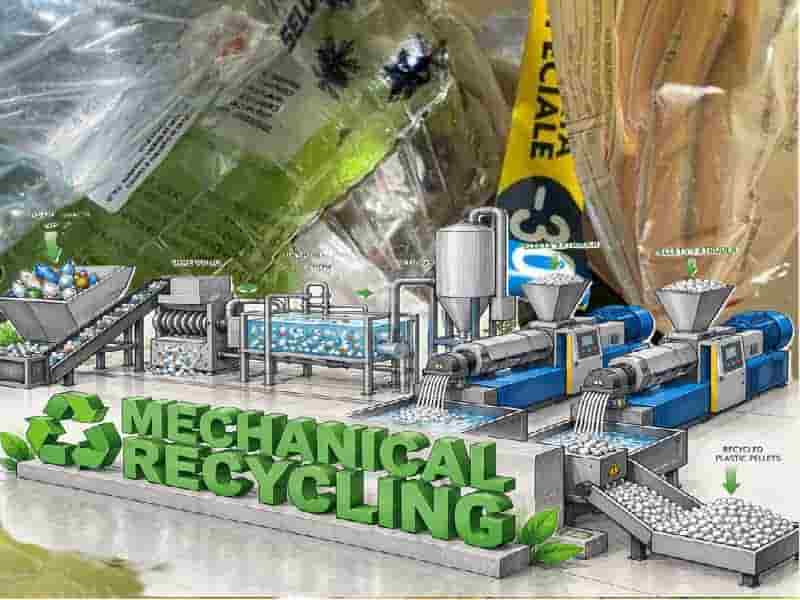
Historically, the secondary plastics market suffered from supply volatility, inconsistent pellet quality, and fragmented collection systems. By applying advanced sorting, washing, and compounding technologies across its European sites, Borouge International bridges the gap between raw waste streams and high-specification polymer grades. Facilities operating under this network maintain RecyClass certification, providing full supply chain traceability from feedstock collection to final pellet production. This certification enables downstream customers to verify recycled content claims and meet stringent environmental compliance standards, including the Blue Angel mark and national plastic packaging tax exemptions. European mechanical recycling capacity
Furthermore, Dirk Langhammer, Senior Vice President of Circular Solutions at Borouge International, highlighted that circular materials represent a strategic asset necessary to strengthen broader industrial competitiveness. Access to reliable domestic recycling networks mitigates exposure to international supply disruptions, volatile ocean freight markets, and global virgin resin price fluctuations.
Global Coordination and Portfolio Synergy
While the strategic expansion focuses heavily on reinforcing European mechanical recycling capacity, it operates as part of a globally coordinated circular economy strategy. In North America, the company supplies high-grade recycled polyethylene film formulations through the Syndigo facility in Indiana, while Asian operations rely on structured partnerships with certified local recycling suppliers.
The expanded European assets feed directly into two primary product lines designed for distinct market tiers:
-
Borcycle M: A premium portfolio of mechanically recycled polymers and customized compounds derived from post-consumer feedstock, engineered specifically for high-performance and demanding structural applications.
-
Recleo: A versatile line of fit-for-purpose recyclates and tailored compounds engineered for a broad spectrum of standard packaging and industrial uses.
Life Cycle Assessments (LCAs) conducted across these processing assets demonstrate that mechanical recycling delivers substantial carbon footprint reductions compared to conventional fossil-derived virgin polyolefins. On average, processing post-consumer waste into high-grade recyclates generates approximately 30 percent lower carbon dioxide emissions relative to equivalent virgin plastic production.
Technical Web Structure & Semantic Landmark Layout
To optimize this content for advanced web crawlers, search indexing systems, screen readers, and Large Language Model (LLM) parsing engines, the structural architecture of the published web page should implement standard semantic HTML5 landmark tags without nesting main navigational menus or sidebars ahead of the primary article body. European mechanical recycling capacity
Borouge International Expands Global Growth and Recycling Investments
More…