Bamboo Recycled Glass fiberTextile sector Polyethylene Terephthalate Polypropylene Polymers Plastic Waste Recycling Biodegradable Plastic 07-12-2021 - Archive
Bamboo Recycled Glass fiberTextile sector Polyethylene Terephthalate Polypropylene Polymers Plastic Waste Recycling Biodegradable Plastic
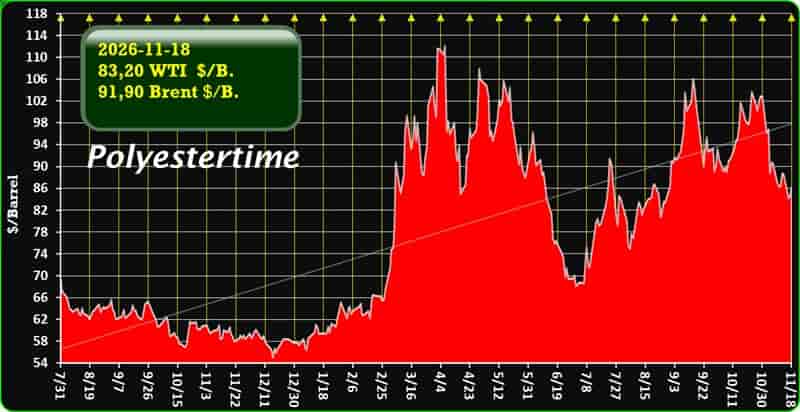
Crude Oil Prices Trend

-Investor Conference “Mid & Small in Milan”: interview with Adriano Vivaldi (Aquafil)
At the Investor Conference of the “Mid & Small in Milan” there is also talk of the circular economy. To our microphones Adriano Vivaldi, Aquafil CFO
The textile industry holds the sad leadership of one of the most polluting sectors in the world. According to the analysis of the European Environment Agency, the fashion sector emits more greenhouse gases than international flights and maritime transport combined for a total of 10% globally.
Unfortunately, the negative data does not end there since every year the oceans are invaded and literally suffocated by over 0.5 tons of synthetic fibers which make up 35% of the microplastics released into the environment, not to mention the excessive consumption of water for the production. The numbers are alarming and are further aggravated by the consequences of fast fashion or disposable fashion which mainly uses polyester and non-biodegradable materials.
Suffice it to say that in the last 25 years the quantity of clothes purchased per person has increased by 40% for an annual per capita consumption of textile products of 26 kg of which at least one third is disposed of suddenly. It is therefore even more urgent to find virtuous solutions that protect the environment and people in the name of a real circular economy that can also meet the objectives set in the European Green Deal.
We talked about it with Adriano Vivaldi, Executive Director Chief Financial Officer of Aqualil, one of the major players in the world in the production of synthetic fibers that operates from an absolutely innovative and sustainable perspective.
Question: How has Aquafil performed in 2021?
Answer: I believe it has been a positive year for Aquafil S.p.A. which has absolutely succeeded in demonstrating the ability to react in the face of the crisis and the pandemic, even drawing benefits from them. The year is now ending positively, although in recent months the increase in the costs of utilities will have a marginal and temporary impact on costs. To cope with this eventuality, we have already implemented price increase policies that have already been accepted by customers as a demonstration of the goodness of the downstream market. Both the quality of our traditional products and those of the ECONYL® brand are becoming increasingly popular and this is certainly helpful from a commercial point of view.
Q: What are the prospects for the textile sector for 2022?
A: If by textile sector it refers to our business area which is dedicated to yarns for textile applications, the prospects are very positive because, always recalling the ECONYL® brand, it is a product increasingly appreciated by the various brands and we have a truly sustained demand in this area. We are therefore analyzing the proposals to cope with the increase in demand, precisely because the brand is becoming more and more requested and absolutely appreciated by the market.
D: Aquafil is a virtuous example of circular economy at the service of strategic sectors such as fashion, which is notoriously on the podium of the most polluting in the world. How are fashion brands gradually evolving towards sustainable solutions?
A: Surely this is a topic that is at the top of all the Boards of Directors of the large companies that represent these brands. There is already a reaction from the sector in this regard, and we as a reality try to make our contribution, hoping that it will be increasingly incisive for the circular economy. We try in every way to avoid the creation of waste for the planet and our applications – especially as regards eco-design – are oriented towards the creation of easily recyclable products, considering this as the main road.
This is an objective that cannot be achieved in a few months, but which will last for years, even decades, but it is important to start now to give an imprint that will gradually give its results.
READ ALSO : What are the clothes that pollute the environment the most

-Alto Packaging installs Amut Ecotech, Erema extrusion line
The new extrusion line and technology will help the New Zealand firm to produce food-contact packaging from rPET.
Amut Ecotech, a designer of plastic recycling plants based in Novara, Italy, has partnered with Austria-based Erema to install and commission Alto Packaging Ltd.’s first extrusion line for food-grade polyethylene terephthalate (PET) sheets in the New Zealand market. Alto Packaging produces rigid plastic packaging from eight plants in New Zealand and four in Australia.
Alto Packaging’s plant in Albany, New Zealand, now processes 100 percent washed postconsumer flakes into 100 percent food-contact grade monolayer thermoforming sheet.
According to a news release from Amut Ecotech, Alto, which is a division of Pact Group, invested in the new food-grade PET sheet extrusion line as a part of Pact Group’s vision to lead a circular economy through packaging in Australia and New Zealand.
The plant features Erema’s Vacurema PET recycling technology as well as the Amut Inline Sheet production technology. Melt goes straight from the Vacurema 1716 T Basic to the Amut plant without the detour of pelletizing, Amut Ecotech reports. The postconsumer PET material is decontaminated and predried prior to extrusion in the vacuum reactor of the Vacurema Basic, which has a throughput of up to 1,500 kilograms per hour. After high-capacity filtration by Erema’s SW-RTF backflush filter and online intrinsic viscosity measurement, the melt goes into the Amut Inline Sheet plant where it is processed into thermoforming sheet from 0.15 millimeters to 1.2 millimeters of thickness. Amut Ecotech says the monolayer thermoforming sheet produced from the pure rPET is 100 percent food-contact compliant.
Bamboo Recycled Glass fiberTextile sector Polyethylene Terephthalate Polypropylene Polymers Plastic Waste Recycling Biodegradable Plastic
-Nayara Energy begins construction of a polypropylene plant
Russian energy giant Rosneft backed Nayara Energy, earlier known as Essar Oil, has chalked out massive expansion plans for India which include setting up of a greenfield petrochemical complex and ramping up its existing refining capacity from 20 million tonnes per annum (mtpa) to 46 mtpa at Vadinar near Jamnagar in Gujarat, said the company.
The total envisaged investment for expansion, of which a major part is towards building a new petrochemical complex, is about Rs.1.5 lakh crore, they said. The expansion plans also include increasing its retail presence and additional investment at the captive port of Vadinar.
When contacted principal secretary to Gujarat chief minister, M K Das, confirmed the development. The company has recently received necessary environmental clearances for the expansion project and it aims to carry out the proposed expansion on the existing land spread over 2,275 hectares and does not require any additional land.
Nayara’s proposed refinery expansion will be focused on production of fuel products as well as petrochemical feedstock. The strong demand growth outlook will require capacity addition of nearly 224 MTPA refining capacity in India and this is likely to create considerable need of polypropylene, ethylene and other petrochemical capacity in India by 2025, Nayara has said in a presentation to the government. A senior official at Nayara Energy when contacted refused to comment on the development.
In August 2017, Petrol Complex Pte Ltd, a subsidiary of PJSC Rosneft Oil Company acquired 49.13% and Kesani Enterprises Company Ltd, a consortium led by Trafigura Group Pte Ltd and Russian private equity fund United Capital Partners, acquired another 49.13% from the Essar Group in what was then known as Essar Oil.
Bamboo Recycled Glass fiberTextile sector Polyethylene Terephthalate Polypropylene Polymers Plastic Waste Recycling Biodegradable Plastic

SABIC, a global leader in the chemical industry, launched today new LNP™ ELCRIN™ WF006XXPiQ compound and LNP ELCRIN WF0061XPiQ compound, the first two grades in a new portfolio of materials that incorporate pre-consumer recycled glass fiber diverted from the waste stream of industrial processes. These polybutylene terephthalate (PBT) compounds, each reinforced with 30 percent pre-consumer recycled short glass fiber, offer mechanical properties and color equivalency of ELCRIN iQ grades that use virgin glass fiber reinforcement. This new technology further decreases the carbon footprint of ELCRIN iQ materials, which already support the circular economy and help reduce plastic waste by using upcycled polyethylene terephthalate (PET) from discarded water bottles.
“We are continually pursuing new avenues to accelerate carbon neutrality for our materials across our portfolio” said Luc Govaerts, director, Formulation & Application Development for SABIC’s Specialties Business. “This effort includes evaluating each component of our thermoplastic compounds and collaborating with others in the value chain to identify potential replacements that can drive circularity. Central to this process is the prioritization of customer needs, so that greater sustainability goes hand-in-hand with outstanding performance, consistent quality and processing efficiency.”
Lowering Environmental Impacts
SABIC is one of the first material suppliers to adopt pre-consumer recycled glass fiber for thermoplastic compounds. The short glass fiber used in these new ELCRIN iQ materials contains 100 percent recycled content according to Underwriters Laboratories’ Recycled Content Validation procedure (UL 2809), following the mass balance approach. Compared to virgin PBT reinforced with virgin glass fiber, LNP ELCRIN WF006XXPiQ compound contains 67 percent recycled content and lowers carbon footprint by 29 percent, while LNP ELCRIN WF0061XPiQ compound contains 55 percent recycled content and reduces carbon footprint by 24 percent[1].
Bamboo Recycled Glass fiberTextile sector Polyethylene Terephthalate Polypropylene Polymers Plastic Waste Recycling Biodegradable Plastic

Tecnimont S.p.A. has been awarded three EPC Lump Sum Turn-Key contracts
The contracts relate to three packages of the fourth phase expansion of Borouge’s petrochemical complex in Ruwais
Maire Tecnimont S.p.A. announces that its subsidiary Tecnimont S.p.A. has signed with Abu Dhabi Polymers Company Ltd. (Borouge) three EPC contracts relating to the world-class fourth expansion phase (Borouge 4) of the Ruwais polyolefins complex in Ruwais, located about 240 km west of Abu Dhabi City (Abu Dhabi, UAE).
Borouge is a joint venture between the Abu Dhabi National Oil Company (ADNOC), one of the world’s major oil and gas companies and a leading diversified energy and petrochemicals group wholly owned by the Emirate of Abu Dhabi, and Austria based Borealis, one of the world’s leading providers of advanced and circular polyolefin solutions.
The overall value of the three contracts, awarded on the basis of a competitive bidding process, is approximately USD 3.5 billion.
The three EPC Lump Sum turnkey contracts relate to the execution of three packages of the Borouge 4 project: the “polyolefin units package”, which includes two polyethylene units with a capacity of 700,000 tons per year each, and 1-hexene1 unit; the “cross-linkablepolyethylene2 unit package”; the “utilities and offsites package”, which includes the utilities and offsites units for the whole Borouge 4 project. The project’s scope of work entails complete engineering services, equipment and material supply, erection and construction activities, commissioning and start up assistance. The completion in expected by 2025. Once the project is completed, the Ruwais complex will be the world’s largest single-site polyolefin facility.
Maire Tecnimont Group has been supporting the UAE to create value by developing its energy transformation industry since the late 90s, with the first
1 A value-added olefin, mainly used in the production of polyethylene
2 A form of polyethylene with very high resistance used predominantly in pipework systems such as domestic water and cooling systems, and electric cables insulation, as well as for chemical transportation.
Bamboo Recycled Glass fiberTextile sector Polyethylene Terephthalate Polypropylene Polymers Plastic Waste Recycling Biodegradable Plastic

-Italy bans plastic food contact materials containing bamboo: the note from the Ministry of Health
The Italian Ministry of Health has published three notes relating to the trade and use of plastic food-contact materials containing bamboo “powder” or similar substances:
- Information note for the Health Departments of the Regions and Autonomous Provinces
- Information note for trade associations
- Information note for consumer associations.
With these notes, in line with the opinion of the European Commission’s Working Group on Food-Contact Materials (FCMs) expressed on 23rd June 2021, the Italian Ministry of Health declares illegal materials intended for contact with food in plastic containing bamboo powder (ground fiber).
As already highlighted by the European Commission, the Italian ministerial notes reiterate that bamboo powder and similar substances, including corn, are not authorized by Regulation 2021/10 / EU for use as additives in the production of FCMs in plastic. EFSA, the European Food Safety Authority, has not yet published any risk assessment for these substances, therefore, the FCMs that contain them are considered unsuitable for contact with food.
From 2019 to March 2021, there are 65 alerts from the European Rapid Alert System for Food and Feed (RASFF) which highlighted the risk of melamine and formaldehyde release. These substances are, in fact, used in the composition of the resins used as binders, in these FCMs, between the plastic components and the vegetable powders mixed in it, in order to give the object hardness and compactness.
Bamboo Recycled Glass fiberTextile sector Polyethylene Terephthalate Polypropylene Polymers Plastic Waste Recycling Biodegradable Plastic

-Innovative approaches to plastic waste recycling using the example of the textile industry
Introduction
World experience shows that sustainable economic growth is enforceable only with active innovation based on the use of the achievements of scientific and technological progress (Buciuni & Pisano, 2021). The environmental innovation concept appeared at the end of the last century. Environmental innovations are the innovations able to reduce the negative impact on the environment, when introduced and used in various types of economic activities. It is worth noting that this definition includes both new and improved technologies and products that minimize environmental damage (Fadhilah & Ramayah, 2012).
Environmental innovations can be classified into two types. The innovations of the first type are aimed at the involvement of natural productive forces and natural resources in production and more efficient and rational use of them. The innovations of the second type are aimed at tightening of the measures to prevent environmental pollution, which in turn incite the development, implementation and investment in the production of eco-technology and eco-technologies (Kim et al, 2021). The introduction of innovative technologies for waste plastic recycling belongs to the first type of environmental innovation. The introduction of innovative plastic recycling technologies contributes to the achievement of positive economic, environmental and social effect (Ullah & Nasim, 2021).
Annually, millions of tons of plastic are produced worldwide, most of which is not recycled. The share of plastic waste that has never been recycled is 91%, about 12% of all plastic waste was incinerated, while the remaining 79% are being accumulated either in landfills or in the natural environment (Parker, 2018). Despite the fact that plastic was invented at the end of the 19th century, the rapid growth of its world production was observed in the second half of the last century. 8.3 billion tons of this material have been produced in the world since about 1950 (Zhang, 2017). According to various sources, the decomposition period of plastic is 200-500 years, upon falling into the soil, plastic waste breaks down into small particles and releases into the environment the chemicals added to it during production. Microbeads of plastic and its chemicals seep through groundwater to nearby water sources, often leading to mass extinction of fauna (Soltani et al, 2021). Moreover, plastic accounts for up to 80% of all waste in the oceans. Under the influence of sunlight, it breaks down into small particles, microgranules of plastic accumulate persistent toxic substances on their surface (Chaturvedi et al, 2020).
The existing methods of plastic waste recycling can be conditionally divided into three groups (Ishalina et al, 2015): mechanical, chemical, and thermal. The first group includes mechanical recycling which is one of processing methods. This is a classic recycling method, based on shredding of plastic waste with the aim of its further recycling. Recycling plastic by chemical methods can be carried out by methods of hydrolysis and methanolysis.
Hydrolysis is a processing method based on the splitting of plastics with aqueous solutions of acids under the action of high temperatures. Methanolysis is a method of plastic recycling based on deep polymerization (cleavage) with methanol. The third group includes pyrolysis (thermal destruction). This method of plastic recycling is a controlled process of thermal decomposition of raw materials, which does not require preliminary thorough sorting and cleaning.
The fight against garbage pollution in the world has been going on for several years. Each country has developed its own rules for the collection and disposal of waste. In Europe, Germany recycles waste most successfully. For several decades in a row, since about 1980, this country has been practicing segregated collection of garbage, moreover, at the state level, norms have been established according to which a fine is provided for waste thrown out in the wrong place. After collection, the bulk of waste is sent for recycling. Moreover, Germany is currently the first country to develop market regulations for the disposal and recycling of plastic waste (Patel et al, 2000; Schüch et al, 2016; Steinhorst & Beyerl, 2021).
Bamboo Recycled Glass fiberTextile sector Polyethylene Terephthalate Polypropylene Polymers Plastic Waste Recycling Biodegradable Plastic

-Use of biodegradable plastic yet to pick up
The UAE now manufactures and exports biodegradable plastics, but most stores, groceries and households here still use non-biodegradable polyethylene.
Part of the reason is cost. The other is availability. Up to now, biodegradable plastic bags are still about 10 to 15 per cent more expensive than regular plastics.
Not so many people know that biodegradable garbage and food freezer bags are also now available in leading supermarkets in the UAE.
Winston Pryce, managing director, Symphony Bin Hilal Plastics LLC, said: “The use of biodegradable plastics in the UAE is quite small, just as in most parts of the world. Biodegradable plastic is a relatively new product, just about four years old, but its use is increasing very rapidly.”
But the benefits of using biodegradable plastics are enormous, he pointed out. Environment-friendly plastic bags will degrade harmlessly and completely after use, regardless of the environmental conditions, leaving no harmful products behind.
“We think that we are on the point of making it about the same price as degradable within the next three to six months.” Pryce said their product is approved by European Community Standards and was granted Millennium Products Status by the Design Council of Britain.
Bamboo Recycled Glass fiberTextile sector Polyethylene Terephthalate Polypropylene Polymers Plastic Waste Recycling Biodegradable Plastic
Bamboo Recycled Glass fiberTextile sector Polyethylene Terephthalate Polypropylene Polymers Plastic Waste Recycling Biodegradable Plastic