AI Recycling Sorting Upgrades France’s Firminy Facility
AI Recycling Sorting Strengthens Material Recovery at France’s Firminy Facility
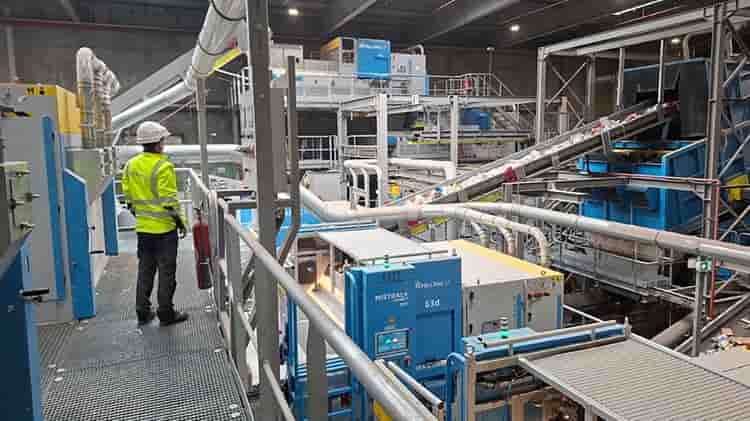
Pellenc ST’s optical sorting systems and artificial intelligence are playing a central role at the modernized packaging waste sorting center in Firminy, France.
Operated by TrivalLoire, a dedicated Suez subsidiary, the facility serves nearly 670,000 residents in Saint-Étienne Métropole and five neighboring territorial authorities. It processes approximately 45,000 metric tonnes of packaging and paper each year, with a nominal throughput of 15 tonnes per hour.
The project illustrates how established material recovery facilities can combine conventional mechanical separation with software-based recognition to improve the quality of recovered plastics, paper and metals.
A long-term facility given a major technology upgrade
The original Firminy sorting center was built in 2000. Its modernization was completed during 2023, followed by the formal inauguration of the new intermunicipal facility in May 2024.
The redevelopment represented an investment of approximately €33 million and was designed to accommodate expanded household packaging collection requirements. Work was organized so that incoming material could continue to be managed while the new infrastructure was being installed.
Pellenc ST was not a new supplier at the site. The French sorting technology company had worked with the Firminy operation since 2002, giving the operator more than two decades of experience with its equipment before the modernization project began.
That established relationship was important because the upgrade involved more than replacing individual machines. It required the integration of mechanical preparation, high-speed optical separation, artificial intelligence and operational data analysis across the sorting process.
Thirteen material streams recovered
The upgraded center is designed to separate 13 recoverable fractions.
These include five grades of paper and board, clear polyethylene terephthalate, mixed polyethylene and polypropylene, flexible plastics, rigid plastics, food and beverage cartons, aluminum, small aluminum items and steel.
The facility operates over two daily shifts and uses 13 Pellenc ST Mistral+ Connect optical sorting units. Before reaching these machines, discarded packaging passes through mechanical preparation stages that separate and condition flat and three-dimensional materials.
Two automated grapple cranes are also used in the reception area. According to project descriptions, their automation reduces vehicle movements, saves operating space and limits safety risks associated with material handling.
Artificial intelligence supports difficult sorting decisions
Six of the optical sorters assigned to three-dimensional materials use Pellenc ST’s CNS Brain artificial intelligence module.
The system combines computer vision and deep-learning models with near-infrared and visible-spectrum sensor data. Near-infrared sensing identifies the chemical characteristics of materials, while visual recognition evaluates features such as an object’s shape, dimensions and appearance.
This combination is particularly relevant when packaging is dirty, crushed, partially covered or fitted with labels and sleeves that make conventional material recognition more difficult.
Pellenc ST says the neural network behind CNS Brain has been trained using millions of images. Specialized models can then be configured for individual sorting tasks, rather than relying on a single general-purpose identification process. AI recycling sorting
Clear PET is a major application
Three of the Mistral+ Connect units are used for clear PET recovery and are equipped with a PET-specific version of CNS Brain.
Clear bottles can be difficult to identify when labels conceal large areas of the container or when material arrives dirty and deformed. The artificial intelligence model has therefore been trained with images representing these real operating conditions, rather than only clean and intact packaging.
The aim is to recognize more target bottles while preventing unwanted objects from entering the recovered PET stream.
Two additional optical sorters apply a specialized model to mixed polyethylene and polypropylene. In this part of the process, artificial intelligence supports the distinction between rigid and flexible objects, helping produce more consistent outgoing fractions.
Pellenc ST reports that the technology can improve sorted-material purity by as much as two percentage points in appropriate applications. This is a manufacturer-reported performance figure, however, and results will depend on the composition of the incoming waste stream and the way each sorting line is configured.
Software updates reduce retrofit complexity
One of the more significant features of the system is that certain artificial intelligence functions can be added to compatible sorting equipment through software updates.
This approach can reduce the need for new cameras, major mechanical modifications or extended production stoppages. It also makes incremental upgrades possible when an operator identifies a particular material stream that needs better recognition.
For existing facilities, this may be more practical than replacing complete sorting units whenever recognition technology advances.
The economic benefit still needs to be assessed for each installation. Pellenc ST states that improved capture rates and material purity can produce a return on investment within three to six months in suitable applications, but this remains a supplier estimate rather than an independently verified result for every facility.
High-speed separation for lightweight materials
Artificial intelligence is only one component of the Firminy process.
Seven optical sorters on the two-dimensional material line use Pellenc ST’s TurboSorter system, which stabilizes light objects as they travel along the conveyor. Three machines also include the company’s Top Speed option, allowing material to be processed at belt speeds of up to 4.5 meters per second, compared with a stated standard speed of 3 meters per second.
Maintaining control of lightweight paper and flexible packaging at these speeds is essential. Unstable objects can move or overlap before reaching the ejection zone, reducing the precision of even an accurate recognition system.
The combined arrangement is intended to improve recovery yield and output purity across multiple fractions. Facility management has specifically highlighted results involving higher-grade white paper, which is separated to meet requirements established by the participating local authorities.
Connected equipment creates further optimization opportunities
The Mistral+ Connect machines also generate operational information that can be evaluated through Pellenc ST’s Smart & Share software platform.
This data can help operators identify changes in incoming material, compare machine performance and detect areas where sorting settings may need adjustment. Connected monitoring therefore gives the facility a way to refine the process after the physical modernization has been completed.
Firminy’s upgrade demonstrates that artificial intelligence does not replace the wider material recovery process. Its value comes from working alongside mechanical preparation, sensor-based material identification, conveyor control and experienced plant operators.
For Suez and Pellenc ST, the next phase will involve using operating data to determine where additional software configurations can improve recovery without adding unnecessary hardware.
The broader significance of the project lies in this gradual approach: established recycling facilities can adopt more advanced recognition capabilities while continuing to use much of their installed sorting infrastructure.
More…