Why Belgian PET Production Is Strategically Important
Why Belgian PET Production Has Become a Strategic European Issue
Belgian PET production is rarely discussed in the same terms as energy, semiconductors or medicines. Yet polyethylene terephthalate, better known as PET, is deeply embedded in the systems that allow food, beverages, medicines and other essential products to be stored and distributed safely.
For Belgium, this is not merely a packaging debate. PET manufacturing forms part of a wider industrial network involving chemical feedstocks, recycling facilities, logistics operators, ports and skilled technical employment.
The question facing policymakers is therefore broader than whether imported resin can be purchased more cheaply. It is whether Europe can meet its packaging, climate and supply-security objectives while allowing strategically useful production capacity to decline.
Why PET matters to essential supply chains
PET is widely used in bottles, containers and other packaging because it is lightweight, durable and suitable for applications in which product safety and shelf life are critical.
These characteristics make PET particularly important to the food-and-drink industry. They also mean that replacing it at scale is not as simple as exchanging one material for another.
Alternative packaging can involve different manufacturing requirements, transport weights, energy consumption and recycling systems. Material choices must therefore be assessed across their entire life cycle rather than through assumptions based solely on whether a package is made from plastic, metal or glass.
European PET production also provides traceability. Manufacturers operating within the European Union must comply with EU rules governing chemicals, food-contact materials, industrial emissions and environmental performance.
When production moves outside Europe, the final material must still meet applicable European product standards. However, its manufacturing process may have taken place under different energy, carbon and regulatory conditions.
Belgium’s industrial advantage
Belgium has one of Europe’s most interconnected chemical and logistics ecosystems. Its production sites benefit from access to major ports, pipelines, storage infrastructure, specialist contractors and established industrial customers.
This concentration creates efficiencies that cannot be replicated quickly.
A PET facility located close to its feedstock suppliers can reduce transport requirements and supply interruptions. Proximity to Antwerp’s port and distribution infrastructure also supports efficient delivery to packaging manufacturers and consumer-goods companies across north-western Europe.
These relationships make a production plant more than an isolated factory. It becomes part of a cluster in which the viability of each operation can influence neighbouring suppliers, service companies and downstream manufacturers.
The European Commission itself describes chemicals as an “industry of industries”, noting that chemical products contribute to more than 96% of manufactured goods. It has also acknowledged that European producers face high energy and feedstock costs, weak demand and competition from lower-cost economies.
Import dependence creates hidden risks
Imports are a normal and necessary part of an open European economy. The risk arises when essential supply chains become excessively dependent on a small number of production regions or long maritime routes.
A low import price does not always represent the full economic cost of a material. Differences in energy prices, carbon obligations, industrial subsidies and environmental requirements can create an uneven competitive environment.
European producers participate in the EU Emissions Trading System and bear the costs of complying with extensive environmental and product legislation. Overseas competitors may operate under significantly different conditions.
This does not automatically make imported PET unsafe or environmentally inferior. It does mean that comparisons based exclusively on the price delivered to a European port can omit important differences in production standards, carbon exposure and supply-chain risk.
Türkiye’s decision to impose a safeguard measure of US$120 per tonne on certain PET resin imports illustrates how governments outside the EU are acting to defend domestic capacity when import pressure threatens local producers. The measure entered into force on 19 July 2026 and is expected to apply for three years.
For European producers, this raises a policy question: can a genuinely open market remain sustainable when other jurisdictions protect their manufacturing base while continuing to export into Europe?
Maritime instability strengthens the resilience argument
Recent events have made the risks associated with extended supply chains more visible.
Shipping through the Strait of Hormuz remained severely restricted on 27 July 2026 despite a pause in hostilities, according to vessel-tracking information reported by The Wall Street Journal. Other disruption around the Bab el-Mandeb route has increased pressure on alternative corridors, insurance costs and fuel expenditure.
On 28 July, further reporting indicated that shipping companies were continuing to manage higher insurance and fuel costs associated with instability in the Middle East.
PET resin is not necessarily transported through these routes in every case. The disruption nevertheless demonstrates a wider principle: supply chains dependent on intercontinental shipping can be exposed simultaneously to conflict, congestion, energy-price volatility and higher freight costs.
Regional production cannot eliminate every disruption. It can, however, shorten supply lines and provide European buyers with an additional source of material when overseas transport becomes unreliable.
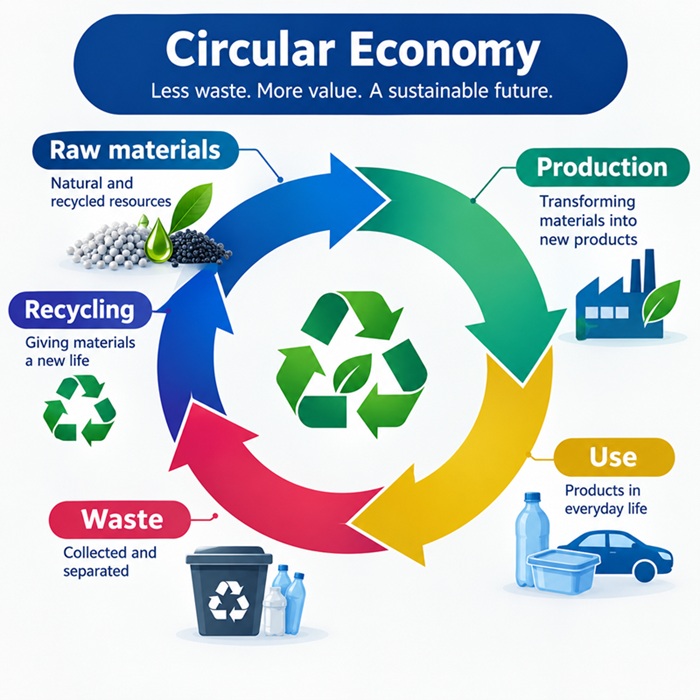
The circular economy needs manufacturing capacity
The strategic case for Belgian PET production is also connected to Europe’s recycling objectives.
The EU Packaging and Packaging Waste Regulation entered into force on 11 February 2025 and generally applies from 12 August 2026. It is intended to reduce packaging waste, improve recyclability and increase the use of recycled plastics.
Among its requirements, the regulation establishes minimum recycled-content levels for different types of plastic packaging. For qualifying contact-sensitive PET packaging, the target is 30% post-consumer recycled content from 2030, subject to the regulation’s calculation rules, implementation timetable and specified exemptions.
Achieving such targets requires more than collecting used bottles.
Europe needs sorting capacity, high-quality recycling operations, reliable supplies of food-grade recycled material and manufacturers capable of incorporating recycled PET into new products at industrial scale.
Virgin and recycled PET production should therefore not be treated as entirely separate policy areas. Modern PET plants can provide the technical expertise, quality controls and customer relationships needed to help recycled material return to demanding packaging applications.
If resin conversion and packaging production migrate out of Europe, part of the economic value generated by European collection systems may migrate with them.
Recycling targets must be supported by market conditions
Circularity depends on whether recycled material can compete in everyday commercial markets.
When virgin resin produced under lower-cost conditions enters Europe at depressed prices, recyclers may find it difficult to sell recycled PET at a price that supports collection, cleaning, processing and quality assurance.
This creates a potential contradiction. Europe can mandate recycled content while simultaneously exposing the industrial capacity needed to supply that content to market conditions that discourage investment.
The most effective policy response is not necessarily indiscriminate protection. It is consistent treatment of production standards, credible enforcement of import requirements and recognition of the strategic relationship between recycling and domestic manufacturing.
Europe’s strengthened import-monitoring system could contribute to this approach. The European Commission announced an upgrade to its import-monitoring mechanism on 15 July 2026 as part of its response to increasing imbalances in global trade. Belgian PET production
A test for Europe’s chemical-industry policy
The European Commission has already recognised the wider difficulties facing its chemical sector.
Its Chemicals Industry Action Plan identifies high energy prices, unfair global competition and weak demand as major challenges. The plan also created a Critical Chemicals Alliance intended to assess closure risks, trade pressures and investment needs in strategically important chemical production.
The next issue is how broadly policymakers define a critical chemical operation.
PET may not receive the same political attention as basic energy products or advanced electronics. Nevertheless, it supports food distribution, beverage supply chains, pharmaceutical packaging and the implementation of recycled-content requirements.
Its strategic value lies in this combination of everyday necessity and industrial integration.
What a balanced European approach should deliver
A credible policy framework should pursue several objectives simultaneously.
Europe should preserve competition and access to international suppliers. It should also respond when imported products benefit from structural advantages that European manufacturers cannot reproduce without abandoning EU environmental and labour standards.
Trade enforcement should be based on evidence and applied consistently. Carbon and environmental rules should recognise the complete footprint of imported and locally manufactured products. Recycling legislation should be accompanied by measures that support demand for high-quality European recycled material.
Most importantly, industrial policy should consider how individual facilities contribute to wider regional ecosystems.
Once a large production site closes, Europe does not lose only its nameplate capacity. It can also lose technical expertise, maintenance networks, infrastructure utilisation, downstream investment and the ability to respond rapidly when global supply chains fail.
Belgian PET production is about more than packaging
Belgian PET production should not be preserved simply because it already exists. Its future must depend on efficiency, environmental performance, innovation and the ability to meet changing customer requirements.
However, it should compete in a market that accurately reflects regulatory obligations, carbon exposure and the strategic value of resilient European supply.
Belgium possesses chemical expertise, integrated infrastructure and access to one of Europe’s most important logistics gateways. These advantages can support a PET value chain that combines primary production, high-quality recycling and increasingly circular packaging.
Allowing that capability to erode through unmanaged market distortions would make Europe more dependent at the same time that geopolitical instability is demonstrating the cost of dependence.
The strategic question is therefore not whether Europe should manufacture every tonne of PET it consumes. It is whether maintaining a meaningful level of regional production is necessary for secure supplies, credible recycling targets and a resilient industrial economy.
From a Belgian perspective, the evidence increasingly suggests that it is.
Key points
-
PET supports essential food, beverage and pharmaceutical packaging supply chains.
-
Belgian production benefits from an integrated chemical, port and logistics ecosystem.
-
Import prices may not reflect differences in energy, carbon and environmental obligations.
-
Recent maritime disruption shows the vulnerability of long international supply routes.
-
EU recycled-content targets require functioning European recycling and manufacturing capacity.
-
Trade, climate and circular-economy policies must operate consistently if Europe wants to retain strategic industry.
- PETValue Philippines Expands Zero Waste Initiative
-
More…