Breakthrough CO2 Conversion Technology Transforms Industrial Exhaust into Valuable Materials, Revolutionizing Carbon Capture Efficiency and Accelerating the Path Toward Scalable Climate Solutions 13-02-2026
Breakthrough CO2 Conversion Technology Integrates Capture and Utilization
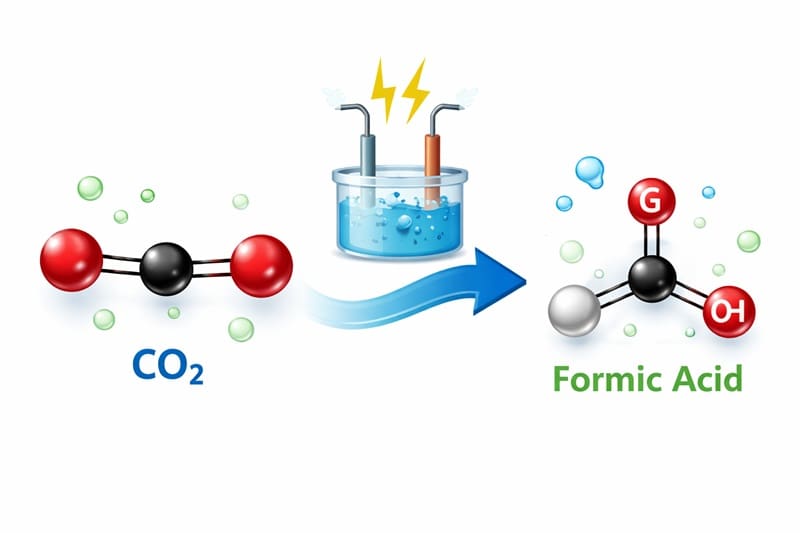
A major advance in CO2 conversion technology could reshape how industries manage carbon emissions. Researchers led by Wonyong Choi have developed an innovative electrode that combines carbon dioxide capture and chemical conversion into a single integrated system. Instead of separating CO2 from exhaust gases and then processing it in a second step, this new solution performs both functions simultaneously.
The result is a simplified, more efficient pathway for transforming carbon emissions into valuable chemical products, particularly formic acid. The study, published in ACS Energy Letters and supported by the National Research Foundation of Korea, demonstrates performance levels that exceed conventional systems under both simulated flue gas and atmospheric CO2 conditions.
Why Traditional Carbon Capture Falls Short
Conventional approaches to carbon management rely on a two-step model:
-
Capture CO2 from industrial exhaust
-
Convert purified CO2 into useful chemicals
This separation significantly increases operational costs and complexity. Most existing CO2 conversion technology requires highly concentrated and purified carbon dioxide to operate efficiently. However, real industrial emissions contain mixed gases, typically including nitrogen, oxygen, and variable CO2 concentrations.
In practical environments such as boilers, power plants, and manufacturing facilities, CO2 rarely exists in isolated form. This mismatch between laboratory conditions and real-world emissions has slowed the commercial viability of carbon utilization systems.
A Three-Layer Electrode Design That Changes the Game
The newly developed CO2 conversion technology overcomes these limitations through an engineered three-layer electrode architecture:
-
A dedicated CO2 adsorbent layer
-
A gas-permeable carbon paper sheet
-
A catalytic layer composed of tetravalent tin oxide
This structure allows exhaust gases to pass through the electrode while carbon dioxide is captured and immediately converted through electrochemical reactions. Crucially, the system eliminates the need for CO2 pre-concentration, making it compatible with realistic exhaust streams.
By integrating capture and conversion into one device, the electrode reduces infrastructure requirements and simplifies industrial deployment.
Performance Under Realistic Conditions
The research team tested the electrode under progressively challenging conditions to validate its practical applicability.
Pure CO2 Testing
When exposed to pure carbon dioxide, the system achieved 40 percent higher efficiency compared to conventional carbon conversion electrodes. This confirmed the effectiveness of the catalytic layer and optimized architecture.
Simulated Industrial Flue Gas
The true breakthrough emerged under simulated flue gas conditions composed of:
-
15 percent CO2
-
8 percent oxygen
-
77 percent nitrogen
This composition mirrors emissions from domestic boilers, fireplaces, and manufacturing plants. Under these conditions, most existing CO2 conversion technology produces negligible outputs.
In contrast, the new electrode continued generating substantial quantities of formic acid, demonstrating stable performance even in mixed-gas environments.
Turning Pollution into Economic Value
Formic acid is not merely a laboratory product. It has significant industrial applications:
-
Preservative in agriculture and animal feed
-
Intermediate compound in organic synthesis
-
Energy carrier in fuel cell technologies
By converting waste carbon directly into formic acid, the system transforms industrial emissions into a revenue-generating resource. This economic dimension is critical. Effective climate technologies must align environmental performance with financial feasibility.
The ability of this CO2 conversion technology to produce valuable materials directly from exhaust gases strengthens the business case for carbon capture adoption.
Direct Air Capture Potential
In addition to flue gas testing, researchers evaluated the electrode under atmospheric CO2 concentrations, approximately 420 parts per million.
Remarkably, the system maintained operational functionality even at these low concentrations. This capability suggests potential applications in direct air capture, a strategy considered essential for achieving long-term carbon neutrality targets.
Although further optimization is required, the ability to function under ambient conditions expands the technological horizon beyond industrial smokestacks.
Industrial Scalability and Cost Advantages
One of the most promising aspects of this CO2 conversion technology is its relatively simple design. Traditional carbon capture systems often require multiple process units, including:
-
Absorption towers
-
Gas separation modules
-
Compression systems
-
Dedicated conversion reactors
By consolidating capture and electrochemical transformation within a single electrode, the new approach reduces mechanical complexity. Fewer system components translate into:
-
Lower capital expenditure
-
Reduced maintenance costs
-
Smaller physical footprint
-
Simplified operational workflows
For industrial stakeholders evaluating decarbonization investments, these factors significantly improve adoption prospects.
Future Research and Durability Challenges
Despite its strong performance metrics, further development remains necessary before full commercialization.
Key research priorities include:
-
Long-term electrode durability
-
Resistance to contaminants in industrial exhaust
-
Optimization of operating voltages and current densities
-
Scale-up validation in continuous industrial systems
Durability is particularly important. Industrial gas streams often contain trace pollutants that may degrade catalytic materials over time. Ensuring stability under continuous operation will determine whether this CO2 conversion technology can move from pilot studies to large-scale deployment.
Broader Climate Impact
The researchers also suggest that the electrode architecture could be adapted for other greenhouse gases, including methane. If validated, this flexibility would significantly broaden the environmental impact of the technology.
Integrated systems capable of both capturing and converting greenhouse gases represent a strategic shift in climate mitigation. Rather than treating carbon solely as waste, such technologies reposition it as a feedstock for valuable chemical production.
This conceptual transition could accelerate industrial decarbonization by aligning environmental compliance with material innovation.
The Road Ahead
The development of integrated CO2 conversion technology marks a critical step toward more practical carbon utilization strategies. By eliminating the artificial divide between capture and conversion, researchers have demonstrated a more streamlined path for transforming emissions into usable materials.
While commercial implementation will require additional validation and industrial partnerships, the technical foundation appears robust. If scalability and durability targets are achieved, this technology could become a cornerstone of next-generation carbon management systems.
In a global landscape focused on climate neutrality and sustainable industry, integrated CO2 conversion technology offers a promising route toward measurable emissions reduction combined with tangible economic value.
More…