Global Brands Slash Virgin Plastic With Breakthrough Recycled Packaging
Recycled plastic packaging
Global Brands Slash Virgin Plastic With Breakthrough Recycled Packaging
Across Europe and Asia, the economics of plastic packaging are undergoing a decisive shift. On November 21, 2026, the European Union officially enforced its ban on exporting plastic waste to non-OECD countries under the revised Waste Shipment Regulation, locking millions of tons of discarded polymers inside domestic and regional recycling loops. Just days earlier, on November 18, updated EU traceability and compliance rules for recycled food-contact plastics also took effect, raising the bar for supply-chain accountability. recycled plastic packaging
Against this tightening regulatory backdrop, leading food and beverage manufacturers are moving well beyond experimental pilot runs. Recent commercial rollouts highlighted by ThePackHub’s Innovation Zone—spanning South Korea, Norway, and Croatia—demonstrate how major brands are scaling recycled plastic packaging to cut virgin fossil fuel use while maintaining strict food safety and consumer usability. recycled plastic packaging
How Are Food and Beverage Brands Scaling Recycled Plastic Packaging?
Major producers are combining 100% mechanically recycled PET bottles for beverages with mass-balance certified polymers for flexible confectionery wraps to replace virgin plastic at scale.
Rather than relying on a single universal material, packaging engineers are matching specific recycling technologies to the physical and safety demands of each product category:
| Brand & Parent Company | Market | Packaging Format | Recycled Content & Method | Primary Environmental & Functional Benefit |
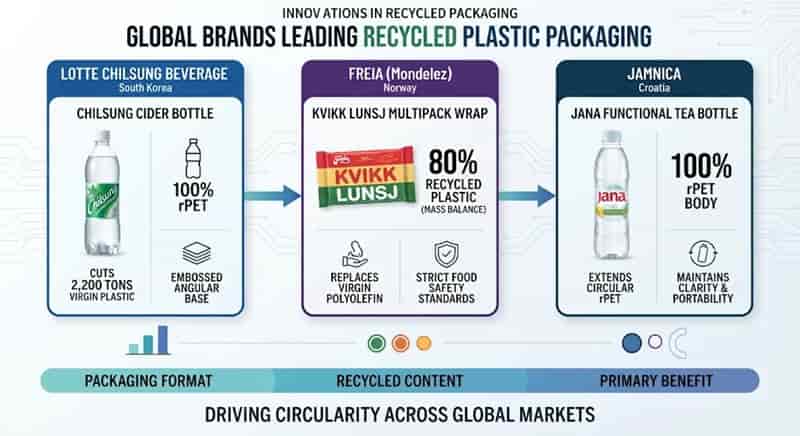
| Lotte Chilsung Beverage | South Korea | 500 ml Chilsung Cider bottle | 100% mechanically recycled PET (rPET) | Cuts ~2,200 tons of virgin plastic and ~2,900 tons of CO2 annually; embossed angular base improves grip |
| Freia (Mondelez) | Norway | Kvikk Lunsj multipack outer wrap | 80% recycled plastic (mass-balance allocation) | Replaces virgin polyolefin in food-contact flexible wrap while meeting strict purity thresholds |
| Jamnica | Croatia | 500 ml (16.9 fl oz) Jana functional tea bottle | 100% recycled PET (rPET) body | Extends circular rPET into ready-to-drink functional teas without sacrificing clarity or portability |
Why Did Lotte Chilsung Redesign Its 100% Recycled PET Bottle?
Lotte Chilsung Beverage introduced South Korea’s first 100% mechanically recycled PET bottle to meet upcoming national recycled-content mandates while improving bottle ergonomics.
Headquartered in Seoul, Lotte Chilsung Beverage transitioned its flagship 500-milliliter Chilsung Cider container entirely away from virgin resin. According to company estimates, switching to 100% mechanically recycled PET reduces annual virgin plastic consumption by roughly 2,200 tons and lowers carbon emissions by approximately 2,900 tons per year. recycled plastic packaging
The launch prepares the company for tighter obligations under South Korea’s Resource Circulation Act, which requires beverage producers consuming more than 5,000 tons of PET annually to incorporate at least 10% recycled content starting this year. Beyond the polymer switch, Lotte Chilsung updated the bottle’s physical architecture—replacing the traditional rounded base with an embossed, angular pattern that strengthens structural rigidity and gives consumers a firmer grip, paired with clear on-pack labeling identifying the container as a 100% recycled bottle. recycled plastic packaging
How Does Freia Achieve 80% Recycled Content in Chocolate Wrappers?
Freia uses a mass-balance allocation model to incorporate 80% recycled plastic into its Kvikk Lunsj multipack outer wrap because mechanical recycling cannot yet purify mixed flexible films for direct food safety.
While rigid beverage bottles made from clear PET benefit from well-established bottle-to-bottle mechanical recycling streams, flexible confectionery packaging presents far steeper technical hurdles. In Oslo, Norwegian chocolate maker Freia—part of Mondelez International—has rolled out outer packaging containing 80% recycled plastic for its large multipack format of Kvikk Lunsj.
To achieve this level of recycled content safely, Freia relies on the mass-balance principle. Under this certified accounting approach, the manufacturer purchases a verified volume of recycled plastic equivalent to the amount used in multipack production, rather than physically tracking individual recycled molecules through blended manufacturing streams.
As Freia notes, plastics intended for food contact must pass rigorous decontamination protocols. Standard mechanical sorting and washing processes used for non-food items cannot reliably remove contaminants from mixed household plastic waste. The specialized chemical and advanced purification technologies capable of restoring flexible plastics to food-grade purity remain capital-intensive and concentrated in a small number of European facilities, making certified mass-balance sourcing essential for scaling recycled content in confectionery wraps. recycled plastic packaging
How Is Jamnica Expanding rPET Beyond Bottled Water?
Croatian beverage producer Jamnica has adopted a 100% rPET bottle body for its 500 ml Jana functional tea range, proving that fully recycled resins can support sensitive functional drinks.
Based in Zagreb, Jamnica has extended its circular packaging strategy into the ready-to-drink tea segment by transitioning its 500-milliliter (16.9 fl oz) Jana functional tea bottles to 100% recycled PET. Unlike Lotte Chilsung’s structural base redesign, Jamnica focused on a seamless material substitution—retaining the lightweight portability, crystal transparency, and familiar handling of conventional PET while eliminating virgin resin from the bottle body.
Finished with soft pink botanical graphics tailored for on-the-go consumers, the Jana bottle demonstrates that 100% rPET is no longer restricted to plain mineral water. Expanding rPET into flavored and functional beverages increases total commercial demand for high-grade post-consumer PET flakes across Southeastern Europe. recycled plastic packaging
What Do These Launches Signal for the Future of Circular Packaging?
Regulatory pressure and corporate ESG commitments are turning recycled polymers from optional sustainability upgrades into baseline supply-chain requirements.
With the EU’s non-OECD plastic waste export ban now active as of November 21, 2026, European recyclers face growing pressure to process more plastic waste domestically—yet recycling plants can only thrive if consumer brands commit to buying the resulting output. The commercial moves by Lotte Chilsung, Freia, and Jamnica highlight three practical realities shaping the packaging sector right now:
-
Design and material evolution go hand in hand: Whether embossing bottle bases for better grip or preserving optical clarity for functional teas, brands are ensuring recycled packaging performs identically—or better—than virgin alternatives.
-
Multiple recycling pathways are necessary: Bottle-to-bottle mechanical recycling excels for uniform PET streams, whereas mass-balance accounting bridges the supply gap for complex, food-safe flexible films.
-
Policy deadlines accelerate commercial adoption: National mandates in Asia and sweeping packaging and waste regulations across Europe—including the EU Packaging and Packaging Waste Regulation (PPWR)—are forcing manufacturers to lock in reliable recycled resin supply before scarcity drives costs higher.
By proving that 80% to 100% recycled plastic packaging can meet strict food-contact standards across diverse product categories, these early movers are building the steady commercial demand needed to make a true circular plastics economy viable. recycled plastic packaging
Essential EU Recycled Food-Contact Plastics Rules Now in Effect
More…