Plastic sorting innovation – KBR Joins Forces with Samsara Eco on Groundbreaking Recycling Plant Global engineering leader KBR has been chosen as the commercialization partner for Samsara Eco’s revolutionary enzymatic recycling facility, a project poised to redefine plastic and textile waste management 03-05-2025 - Archive
Plastic sorting innovation
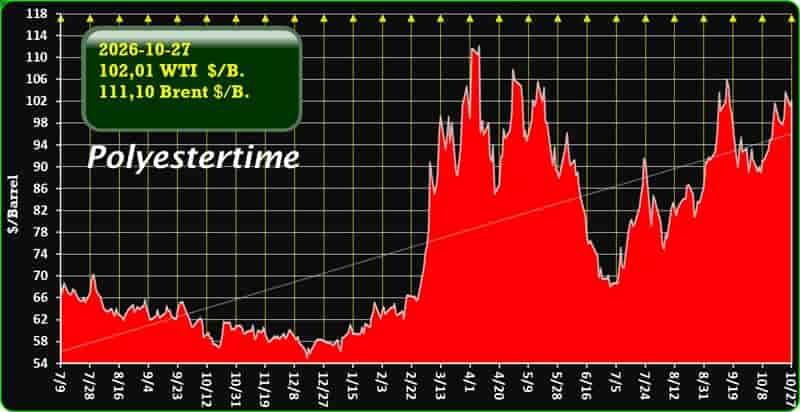
Crude Oil Prices Trend

KBR Joins Forces with Samsara Eco on Groundbreaking Recycling Plant
Global engineering leader KBR has been chosen as the commercialization partner for Samsara Eco’s revolutionary enzymatic recycling facility, a project poised to redefine plastic and textile waste management.
A Leap Forward in Plastic Recycling
Set for completion in early 2028, Samsara Eco’s plant will utilize cutting-edge enzymatic recycling technology. Unlike conventional methods, this innovation breaks down plastics and synthetic fibers—like nylon 6,6 and mixed textiles—into their original monomers using patented enzymes powered by artificial intelligence.
This process enables a true circular recycling loop by remanufacturing materials without compromising quality, all while dramatically reducing the carbon footprint. It’s a game-changer for hard-to-recycle materials and dyed fabric blends that typically end up in landfills. Plastic sorting innovation
KBR’s Role: Engineering Excellence Meets Sustainability
Under the partnership, KBR will begin a pre-FEED (front-end engineering design) phase by the end of Q2 2025. Following this, their expert team will deliver a full FEED engineering package for the development of a commercial-scale facility capable of processing 20,000 metric tons of nylon 6,6 per year.
“We are thrilled to support Samsara Eco on this unique opportunity,” said Jay Ibrahim, President of KBR Sustainable Technology Solutions. “This award strengthens our commitment to sustainability and innovation.”
Scaling Circular Solutions for the Future
Samsara Eco is not just building a plant—it’s building momentum. Plastic sorting innovation
Already collaborating with leading brands like lululemon, the company made headlines with the first product made from enzymatically recycled nylon 6,6. It also introduced a limited-edition anorak jacket from recycled polyester, highlighting the commercial viability of its tech.
“KBR brings unmatched engineering expertise,” said Paul Riley, Founder and CEO of Samsara Eco. “We’re proud to have them in our corner to scale our circular economy ambitions.”
A Vision for a Sustainable Tomorrow
As demand grows for sustainable, low-carbon materials, Samsara Eco and KBR’s collaboration signals a major step forward. By enabling infinite recyclability of plastic waste, this project is helping global brands meet their circularity goals while reducing environmental impact.
Just One Month Away: PET Thermoforms Circularity Conference 2025
How Can Collection and Sorting of PET Thermoforms Be Improved?
Mark your calendars! The PET Thermoforms Circularity Conference is just one month away, taking place on May 27–28, 2025, in the picturesque cities of Dijon and Beaune, France.
This pivotal event, hosted by Petcore Europe, brings together leading voices in the plastics and recycling industries to tackle one of the sector’s biggest challenges: how to improve the collection and sorting of PET thermoforms. Plastic sorting innovation
Day 1: Expert Talks and Industry Panels
The first day will spotlight insightful presentations from top international experts on PET thermoforms. Attendees can also look forward to engaging panel discussions featuring key stakeholders from across the value chain. Representatives from the European Commission will be present to outline their targets and expectations regarding PET tray recycling, setting the stage for forward-looking dialogue.
Day 2: Behind the Scenes of High-Efficiency Sorting
On the second day, participants will be treated to an exclusive site visit to one of Europe’s most advanced sorting facilities. This real-world experience will highlight the latest innovations in efficient PET thermoform collection and sorting, offering practical takeaways and inspiration for stakeholders across Europe.
Don’t Miss Out!
Whether you’re a recycler, packaging producer, policy expert, or sustainability professional, this is a conference you won’t want to miss. Plastic sorting innovation
? Learn more and register now on the Petcore Europe PET Thermoforms Circularity Conference page.
Recycling of Rigid Polyolefins Stalls in Europe Despite Urgent Targets
Half of Rigid Plastics Still Not Recycled
In 2023, Europe placed 13.3 million tonnes of HDPE and PP rigids on the market. However, only half was collected for recycling, and of that, just 42% was sorted for actual recycling processes. Even more concerning, only about 31% of the original waste volume was effectively recycled into usable material.
HDPE Recycling Capacity Hits a Plateau
According to a report by Plastics Recyclers Europe (PRE) and ICIS, HDPE and PP recycling capacity stagnated across Europe in 2023. Around 1.4 million tonnes of HDPE and 1.3 million tonnes of PP made it to recyclers, translating to a recycling input rate of 43% for HDPE and 40% for PP. Plastic sorting innovation
Despite having separate collection systems in most EU27+3 countries (including the UK, Norway, and Switzerland), progress has been flat since 2018. The discrepancy is driven by poor product design, limited sorting capabilities, and exports.
Yields Fall Short of Circular Goals
The average yield—waste converted into actual recycled product—was 71% for HDPE and 69% for PP. This equates to just 1.9 million tonnes of recycled rigid polyolefins—far below the EU’s targets. The Packaging and Packaging Waste Regulation (PPWR) would require 2 million tonnes more by 2030, and an additional 5.7 million tonnes by 2040.
Market Challenges Undermine Progress
Despite a nominal 3.5 million tonnes in installed capacity across 300 facilities, growth stalled from 2022 to 2023. Key barriers include rising energy costs, inflation, and cheap imports of virgin plastics from countries like the US, South Korea, and Saudi Arabia. Demand also declined in non-packaging sectors like automotive and construction.
The Road Ahead: Stronger Policy, Smarter Design
PRE warns that collection, sorting, and product design remain the weakest links. Poor recyclability due to dyes, adhesives, and mixed materials continues to slow progress.
Encouraging developments—like advanced sorting centers in Belgium and Sweden, and early investments in chemical recycling—offer hope. Plastic sorting innovation
But PRE stresses that mechanical recycling must remain the cornerstone.
To meet EU goals, Europe needs coordinated political action, design-for-recycling standards, and investment in advanced infrastructure—before the opportunity slips away.

Introducing Områ: Norway’s New National Plastic Sorting Facility
A major milestone is underway for Norway’s newest national recycling facility. After two years of construction, the Områ plastic sorting facility — a joint venture between TOMRA Feedstock and Plastretur — is officially entering its commissioning phase. On April 28, the facility will launch its “warm commissioning,” marking the first time plastic waste will be placed on its conveyor belts. Plastic sorting innovation
Områ (pronounced “ohm-rauw”) is a Norwegian term meaning “to rethink” or “reconsider.” It’s also a fusion of “om” (about/around) and “rå” (raw), capturing the spirit of transformation at the heart of this project. “We are pleased with the name we have chosen,” says Joachim N. Amland, Senior Vice President and Head of TOMRA Feedstock. “Områ reflects our mission to capture all types of plastic waste and give them a new life as raw materials for new products.”
A New Era for Plastic Recycling in Norway
Sorting plastic into pure monofractions is crucial to achieving high recycling rates. At Områ, TOMRA’s most advanced sensor and machine learning technologies will be used to produce premium-quality feedstock for recyclers. Amland encourages municipalities across Norway to send as much plastic waste as possible to Områ, supporting the country’s ambition to handle its plastic waste domestically.
The facility’s scale and technology are unmatched in Norway, and it is set to become a key pillar in building a national infrastructure for plastic recycling. The initiative also signals growing opportunities for investments in Norway’s recycling industry. Plastic sorting innovation
The Story Behind the Name
To develop a fitting name and visual identity, TOMRA and Plastretur partnered with the Oslo-based design studio Cretalux. “Our mission was to find a unique Norwegian name that highlights the importance of rethinking resources,” says Line Støtvig, General Manager at Cretalux. She adds that including the distinctive Norwegian letter “å” emphasizes the facility’s focus on circularity.
What’s Next for Områ?
Following two months of “cold commissioning,” where machinery was tested without materials, Områ is now transitioning to full operational trials. Throughout the summer, the facility will gradually increase its intake of plastic waste. A grand opening ceremony is scheduled for November 5, 2025, promising to be a highlight for anyone passionate about circular economy innovations. Plastic sorting innovation
Keep an eye out for invitations — Områ’s opening will be an event not to miss!

North America PET Bottles Market Set to Hit $12 Billion by 2033
A Sustainable Surge in Packaging Innovation
The North American PET bottles market is experiencing significant growth, projected to rise from USD 8.62 billion in 2025 to USD 12.08 billion by 2033, with a compound annual growth rate (CAGR) of 4.31%. This momentum builds on a 2024 market valuation of USD 8.26 billion, signaling strong long-term demand across industries.
Why PET Bottles Are on the Rise
Eco-Friendly Packaging Gains Traction
One of the primary forces behind this growth is the increasing demand for sustainable packaging. Consumers and regulators alike are seeking environmentally conscious alternatives, making PET (polyethylene terephthalate) bottles a top choice. PET is not only lightweight and durable but also highly recyclable. Plastic sorting innovation
According to the Environmental Protection Agency (EPA), PET made up nearly 30% of all plastic bottles recycled in the U.S. in 2021. Major brands like Coca-Cola and PepsiCo have responded by committing to use 50% recycled PET (rPET) in their packaging by 2030. This shift directly supports the sustainability goals of both businesses and consumers — and PET bottles are leading the way.
Booming Beverage Industry Fuels Demand
The beverage sector, which accounts for over 60% of PET bottle usage, is another key market driver. From bottled water to carbonated drinks and juices, PET bottles offer the convenience, safety, and portability that modern consumers demand.
This trend is particularly strong among health-conscious buyers who are turning to bottled water over sugary alternatives. At the same time, the growth of online grocery platforms, with sales expanding by 25% annually, is pushing packaging innovation and distribution — and PET bottles are the packaging of choice. Plastic sorting innovation
Looking Ahead
With rising environmental awareness, industry commitments to circular economy goals, and the fast-paced growth of the beverage and e-commerce sectors, the North American PET bottles market is poised for sustained expansion. As companies continue to invest in recycled content, innovative packaging technologies, and eco-friendly logistics, PET bottles are expected to remain a cornerstone of the sustainable packaging landscape.
Sulzer and Hyme Energy Unite to Transform Renewable Energy Storage
Pioneering Green Heat with Molten Salt Technology
Sulzer has teamed up with Hyme Energy to take renewable energy storage to the next level. Building on the success of Denmark’s innovative Molten Salts Storage (MOSS) project, the two companies are now developing and optimizing Hyme’s patented molten hydroxide salt storage system.
This groundbreaking solution stores energy as heat at temperatures up to 600°C, making green energy available on demand for industrial use. Plastic sorting innovation
The partnership aims to commercialize this system, offering a reliable and sustainable solution to decarbonize industries and accelerate the global energy transition.
MOSS: A Milestone for Industrial Decarbonization
The collaboration began with the MOSS demonstrator plant, inaugurated in April 2024. This milestone proved that molten salt can be used effectively for thermal energy storage. It demonstrated that renewable electricity can be converted into high-temperature heat — a game-changer for sectors that rely on fossil-fuel-generated industrial heat.
Sulzer’s vertical turbine pumps were essential in circulating the molten salt, ensuring system stability and performance.
Engineering Innovation Driving the Future
Benoît Martin, Advanced Engineering Manager at Sulzer, highlighted the company’s ongoing commitment:
“We’re working with Hyme Energy to improve the solution’s competitiveness, durability, and performance. Our pumps are key to safely and efficiently transporting molten salt, and we’re focused on pushing technical boundaries.”
This partnership also aims to establish a strong supply chain, making the technology scalable for widespread adoption. Plastic sorting innovation
Making the Energy Shift Seamless
Hyme Energy’s CEO and co-founder Emil Løvschall-Jensen added:
“Our system integrates easily into existing infrastructure. With Sulzer’s expertise and our technology, we can accelerate the shift to sustainable energy.”
A Shared Vision for a Greener Tomorrow
The collaboration reflects a broader mission: enabling industries to move toward carbon neutrality. As Benoît Martin notes, Plastic sorting innovation
“We’re excited to partner with Hyme Energy again. This is a crucial step toward reducing industrial emissions and driving the energy transition.”