Revolutionary Green Partnership Wins Top Global Textile Innovation Award
Sustainable textile innovation award
Revolutionary Green Partnership Wins Top Global Textile Innovation Award
The global textile manufacturing industry faces an urgent challenge: translating sustainable lab discoveries into massive, commercial supply chain implementations. While eco-conscious finishes and bio-based fibers offer answers to consumer demand for greener apparel, isolated suppliers frequently struggle to deploy these solutions at a global scale.
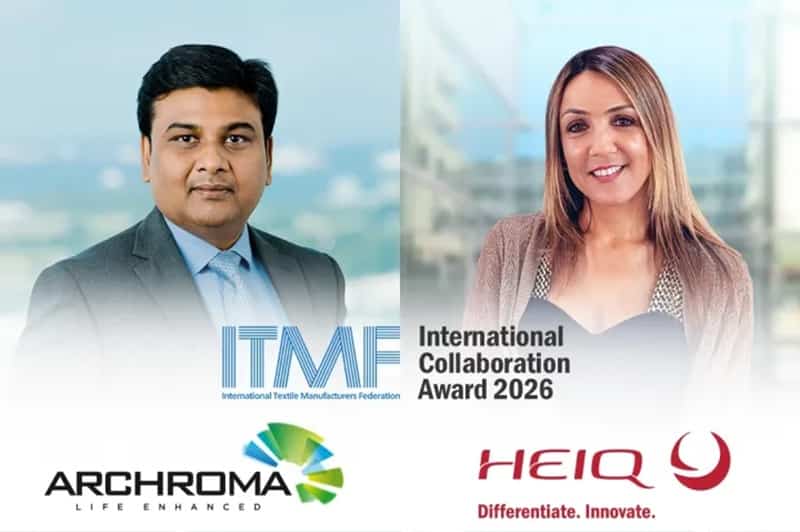
Overcoming this hurdle requires structural cooperation. In recognition of groundbreaking cross-company progress, the International Textile Manufacturers Federation (ITMF) officially awarded its prestigious ITMF International Collaboration Award 2026 to material innovator HeiQ and specialty chemical leader Archroma.
The decision underscores a major shift in industrial manufacturing: true decarbonization and circularity require open co-marketing, unified distribution, and shared technical support rather than isolated proprietary efforts.
+-----------------------------------+     +-----------------------------------+
|         HeiQ Technologies         |     |          Archroma Network         |
|  - Bio-based material research    |     |  - Global distribution infrastructure|
|  - Non-biocidal odor capture      |     |  - Regulatory compliance support   |
|  - Eco-functional textile design  |     |  - On-site mill application skills|
+-----------------------------------+     +-----------------------------------+
                  \                                 /
                   \                               /
                    v                             v
+-----------------------------------------------------------------------------+
|                     Scaled Green Manufacturing Model                        |
|   - Rapid global deployment of planet-conscious finishes                    |
|   - Simplified implementation for textile mills and retail brands          |
|   - Decreased laundry energy, water, and chemical demands for consumers     |
+-----------------------------------------------------------------------------+
Bridging the Gap Between Material Science and Global Scale
Historically, adopting eco-friendly textile finishes presented operational headaches for mills and apparel brands. Novel sustainable chemistry frequently required complex regulatory hurdles, unfamiliar application protocols, and inconsistent regional availability.
The strategic alliance between HeiQ and Archroma addresses these obstacles directly by merging distinct, high-impact capabilities:
- HeiQ’s Material Science: Known for developing functional technologies, plant-based applications, and high-performance material treatments.
- Archroma’s Global Infrastructure: Provides an extensive technical and commercial network, deep specialty-chemical expertise, and established relationships with textile mills across major manufacturing hubs.
Rather than operating on a standard supplier-client relationship, the two organizations established a joint distribution and co-marketing model. This structure allows textile mills to integrate bio-based antimicrobial and odor-control finishes with minimal friction, backed by local technical support and standardized regulatory compliance.
Eliminating Micro-Pollutants with Bio-Based Odor Control
A centerpiece of the recognized partnership is HeiQ Mint, a bio-based, non-biocidal odor-control technology. Traditional antimicrobial treatments for activewear and apparel often relied heavily on synthetic biocides or heavy metals, which can wash off into water systems, accumulate in ecosystems, or disrupt delicate skin microbiomes.
In contrast, HeiQ Mint takes inspiration from natural botanical compounds:
-
Odor Capture: The treatment actively binds volatile organic compounds (VOCs) that cause unpleasant odors directly within the fabric matrix while worn.
-
Laundering Release: During standard wash cycles, the captured odor molecules release safely from the fibers, returning the garment to a clean state.
-
Consumer Conservation: Because garments stay fresh significantly longer between wears, consumers wash their clothing less frequently. This directly cuts residential household energy usage, water consumption, and detergent runoff over the lifespan of the apparel.
By replacing synthetic chemical biocides with plant-derived alternatives, the technology maintains high performance standards while helping brands meet strict global environmental guidelines. sustainable textile innovation award
Industry Alignment Signals a Broader Green Shift
The ITMF 2026 recognition arrives alongside broader systemic pushes across the global textile trade. Recent initiatives—such as the European Textile ETP’s newly launched Bioeconomy Strategy—emphasize that reducing reliance on fossil-fuel synthetics requires structural realignment across the entire supply chain.
Traditional Linear Process:
[ Fossil Extraction ] ---> [ Heavy Chemical Finishing ] ---> [ High-Frequency Laundering ] ---> [ Micro-Pollution ]

Collaborative Circular Model:
[ Bio-Based Feedstocks ] ---> [ Scaled Eco-Finishing ] ---> [ Extended Garment Wear ] ---> [ Reduced Water / Energy Waste ]
When multi-national leaders like Archroma and HeiQ align their commercial strategies around bio-based finishing, textile mills gain access to turnkey solutions that drastically reduce environmental footprints without sacrificing commercial viability.
Strategic Benefits for Textile Mills and Global Apparel Brands
For mill managers and sourcing executives, the expansion of scaled, sustainable finishing yields immediate commercial and operational benefits:
| Operational Focus | Traditional Eco-Finishes | Scaled Collaboration Model |
| Mill Integration | Complex trial-and-error setups | Simplified, factory-ready protocols |
| Supply Chain Reach | Fragmented regional availability | Synchronized worldwide availability |
| Regulatory Compliance | Varied regional documentation | Unified, compliance-ready certification |
| Eco-Performance | Short-term durability | High wash durability and wear longevity |
As consumer demand shifts toward transparent, low-impact wardrobes, brands can no longer rely on unverified claims or isolated capsule collections. Scaled partnerships prove that sustainable material science can be delivered at standard industrial volumes.
Driving the Next Generation of Sustainable Fashion
The ITMF International Collaboration Award 2026 validates a vital truth for modern manufacturing: scaling meaningful eco-friendly innovation requires active cooperation. By connecting breakthrough Swiss material engineering with an expansive global distribution network, HeiQ and Archroma have established a viable blueprint for industrial transformation.
As the partners prepare to showcase their joint findings at the upcoming ITMF World Conference in Fortaleza, Brazil, the global textile industry moves one step closer to a future where high performance, commercial profitability, and environmental responsibility exist in full harmony.
More…