Textile-to-textile – Los Angeles-based Ambercycle has announced two new strategic partnerships with major Chinese manufacturers to accelerate the growth of its cycora textile-to-textile regenerated polyester 13-01-2025 - Archive
Textile-to-textile
Polyester POY – Tough times for Dutch recycling sector: new facility canceled again

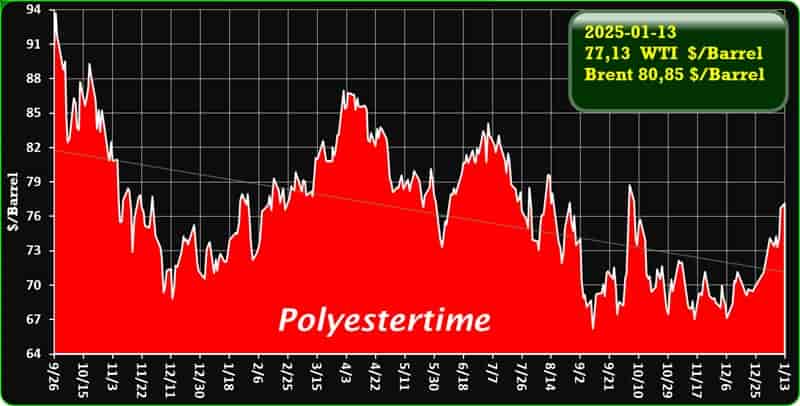
Crude Oil Prices Trend
Ambercycle announces major alliances in China
Unlocking new opportunities within the Chinese value chain to drive the adoption of circular materials at pace.
Shenghong and Ambercycle announce their new partnership. Left to right (top row): Ambercycle China manager Gerry Xue and CEO Shay Sethi, Shenghong general manager Jason Tang and marketing director Alex Miao. Bottom row: Matthew Iezzi, Ambercycle’s head of production and Charming Qian, vice general manager at Shenghong. Textile-to-textile
Los Angeles-based Ambercycle has announced two new strategic partnerships with major Chinese manufacturers to accelerate the growth of its cycora textile-to-textile regenerated polyester.
Shenghong Chemical Fiber will now scale up high-quality regenerated filament yarns using cycora raw materials and Benma will do the same for staple fibres.
Shenghong Holding Group, which in 2023 ranked 171st in the Fortune Global 500, has two polyester production bases in Suzhou and Suqian with annual production capacity of 3.6 million tons. Its recycled PET bottle polyester fibre production capacity is currently approximately 600,000 tons per year, ranking it first in the world. Shenghong is equipped with the world’s most advanced direct melt spinning technology and is establishing a fully integrated carbon capture fibre supply chain. Textile-to-textile
Benma, headquartered in Hangzhou, has an annual capacity of more than 180,000 tons of polyester and is a supplier to many international fast fashion and home textile brands.
Benma’s direct investment in Ambercycle’s scale-up efforts further reinforces a shared commitment to accelerating the transition to circular textile solutions.

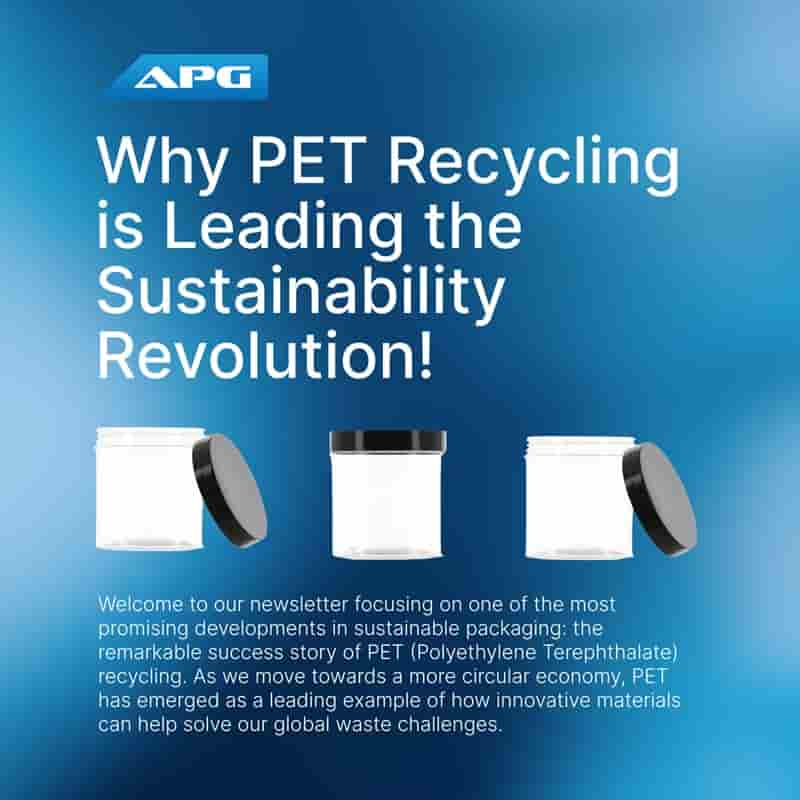
APG Drives Awareness of PET’s Role in Recycling with Compelling Environmental Facts
APackaging Group (APG), a trailblazer in sustainable and innovative packaging solutions, is excited to spotlight the transformative role of PET (Polyethylene Terephthalate) in eco-friendly packaging. Founded in 2019 by CEO Helga Arminak, APG is dedicated to driving environmental stewardship, boasting an annual production capacity of over 600 million pieces with a low minimum order quantity (MOQ) of 10,000 pieces.
“PET packaging exemplifies the intersection of sustainability and functionality,” said Hannah Palese, Director of Communication at APG. “Its closed-loop recyclability makes it the ideal choice for companies prioritizing environmental responsibility without compromising product integrity.” Textile-to-textile
As a trusted partner to industry giants like Procter & Gamble, Unilever, Estée Lauder, and Victoria’s Secret, APG understands the demand for sustainable yet high-performing solutions. PET stands out with its infinite recyclability, food-grade safety standards, and lightweight yet durable design that reduces carbon footprints in transit.
“Our commitment to packaging innovation has never been stronger,” noted Ryan Huang, Director of Marketing at APG. “With PET, we’re not just providing a product; we’re enabling our clients to contribute to a sustainable future.”
APG’s dedication to ESG principles is underscored by its EcoVadis Sustainability Platinum recognition, an honor reserved for the top 1% of companies. Textile-to-textile
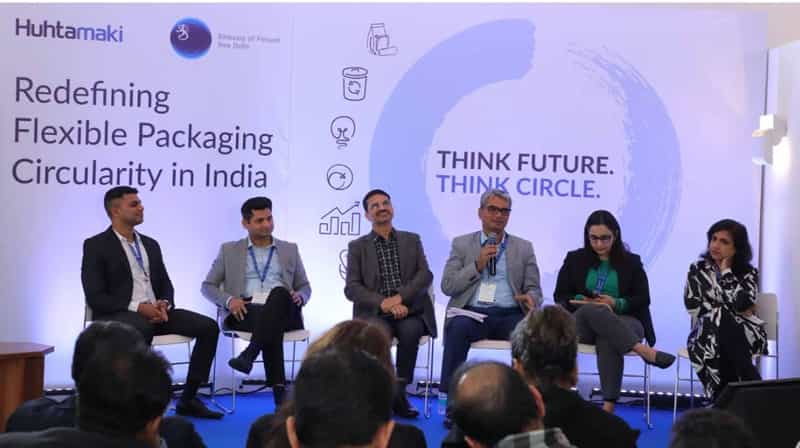
Huhtamaki India and Embassy of Finland host the second Think Circle forum
The event held in New Delhi, India unveiled the ‘Design for Recycling Guidance for Films and Flexible Packaging’.
Huhtamaki India, provider of primary consumer packaging and decorative labelling, and part of Huhtamaki Oyj, a Finland based global food packaging company, has concluded the second edition of Think Circle at Embassy of Finland in New Delhi.
The event, organized in partnership with the Embassy of Finland, and knowledge partner Confederation of Indian Industry (CII) kicked off with an exclusive, closed-door roundtable and featured a presentation of the new ‘Design for Recycling Guidance for Films and Flexible Packaging.’ These guidelines, developed and launched by the CII-India Plastics Pact’s (IPP) initiative in December 2024, mark a pivotal moment in advancing a circular economy for flexible packaging in India.
The event witnessed participation from Ministry of Environment, Forest and Climate Change (MoEFCC), and other leading industry players, think tanks, policymakers, and innovators, highlighting the untapped opportunities in revolutionizing India’s packaging ecosystem. Textile-to-textile
As part of the event, a panel discussion titled ‘Redefining the circularity of flexible packaging in India,’ featured an lineup of panelists, including Chinmaya Dandekar, general manager – packaging and sustainability, Godrej Consumer Products, Rashi Agarwal, chief business officer, Banyan Nation, Vishal Poojara, procurement and packaging sustainability, ASEAN region, Mondelez India, Sanjay Gupta, head of packaging, DS Group, Snigdha Berry, Corporate Affairs, Nestlé; and Dhananjay Salunkhe, managing director of Huhtamaki India. The session was moderated by Ruturaj Kamthekar, vice president, strategic business development and marketing, Flexible Packaging at Huhtamaki.
Cinte Techtextil China to return with new zones in September 2025
Insights
- Cinte Techtextil China to return to Shanghai from 3–5 September 2025, with new zones for medical, protective, and automotive applications.
- Featuring innovation and sustainability-focused events like Econogy Talks, the fair bridges Asian and Western markets.
- Key exhibitors will showcase eco-friendly technical textiles, fostering business matching and networking. Textile-to-textile
From 3 to 5 September, Cinte Techtextil China will return to the Shanghai New International Expo Centre, with new features capitalising on market growth. In addition to its regular European Zone, the upcoming edition will launch two product zones, namely the Medtech & Protech Zone and the Mobiltech Zone, alongside other precisely crafted features. With innovation and sustainability at its heart, the fair’s fringe programme will include events such as Econogy Talks, an innovative product showcase and other themed conferences and presentations, maximising promotion and information exchange between fairgoers.
As Asia’s only dedicated show for the full spectrum of technical textiles and nonwovens, Cinte Techtextil China creates opportunities for business matching and networking across the global value chain. This year, the fair will be enriched with two more zones for medical & protective, as well as automotive applications. Such related segments of the global textile market are expected to experience a positive CAGR, including medical & hygiene products (4.3%, 2023 – 2030); safety & protection (3.9%, 2024 – 2030); and automotive (3.2%, 2022 – 2030); and the organisers expect to harness market potential with the creation of the new zones. Textile-to-textile
NIST Database Can Help Increase Recycling of Textiles and Clothing
- Researchers estimate that 85% of used clothes and other textiles end up in landfills and incinerators.
- To increase recycling and reduce waste, the industry needs better technology for automatically sorting used textiles and clothing.
- NIST’s new “NIR-SORT” database contains the molecular “fingerprints” of different kinds of fabrics and will enable more rapid and efficient sorting of textiles and clothing.
Picture this: You have a bag of heavily used clothes that can no longer be donated taking up space in your closet, so you drop it off at your local recycling center. But what happens to that bag of clothes? You might assume that the clothes would get broken down and reused to make new products. Textile-to-textile
However, according to the Environmental Protection Agency (EPA), in 2018 around 85% of used clothes and textiles headed to landfills and incinerators, wasting precious resources and polluting our environment. One reason is that recycling can be more expensive than landfilling, so companies have little incentive to recycle.
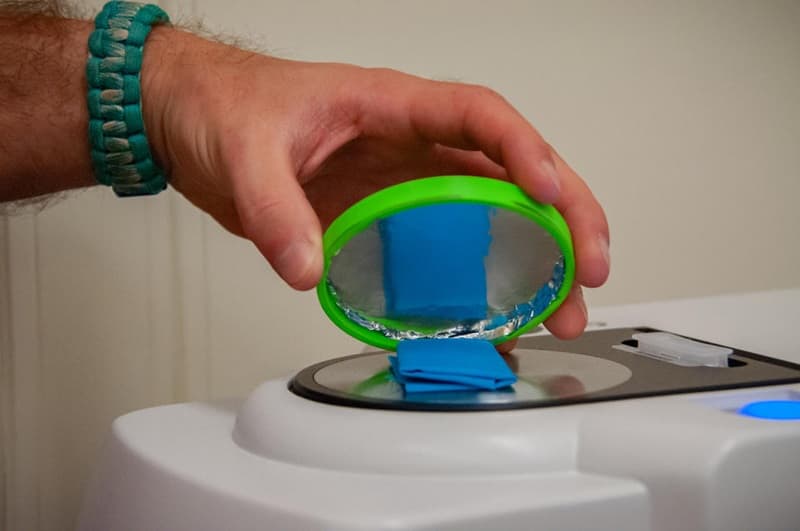
To help solve this problem, researchers at the National Institute of Standards and Technology (NIST) have developed a database that contains the molecular “fingerprints” of different kinds of textile fibers and that can enable more rapid, efficient sorting of fabrics at recycling centers.
“This reference data will help improve sorting algorithms and unlock the potential for high-throughput sorting, which requires less manual labor,” said Amanda Forster, a NIST materials research engineer. Forster leads the NIST project focused on keeping end-of-life textiles in the economy, a process called textile circularity. “That should reduce costs and increase efficiency, making textile recycling more economically viable.” Textile-to-textile