Chemical recycling – Versalis Slides Deeper into the Red: Q1 2025 Snapshot Losses Widen in ENI’s Chemical Arm Versalis, the chemicals subsidiary of energy giant ENI, reported a €243 million loss for Q1 2025—a sharp 45 % deterioration from the €168 million deficit booked a year earlier and even worse than the €231 million loss seen in Q4 2024 26-04-2025 - Archive
Chemical recycling
China’s Humanoid Robot Revolution: How China Plans to Lead the $38 Billion Industry
China is racing to dominate the humanoid robotics market, an industry forecasted to reach $38 billion globally by 2035. Backed by government incentives, advanced tech hubs, and massive investment, China’s top robotics companies are preparing for a future where robots are part of everyday life.
China’s Big Players in Humanoid Robotics
The country’s robotics boom is led by three rising stars: Unitree Robotics, Agibot, and Galbot. These billion-dollar startups are developing advanced humanoid robots capable of performing tasks ranging from industrial labor to personal assistance.
A glimpse of China’s robotic ambitions was on full display during the CCTV Spring Festival Gala. Viewers watched Unitree’s “H1” robot dance alongside Xinjiang performers in a choreographed spectacle directed by Zhang Yimou. It was more than entertainment—it was a showcase of China’s technological future under President Xi Jinping’s vision.
Affordable Home Robots Are Coming Soon
Currently, humanoid robots are expensive, costing between 200,000 and 300,000 yuan (roughly $28,000 to $42,000). However, Agibot’s founder Peng Zhihui plans to reduce prices to around 50,000 yuan ($6,400), making personal robots affordable for Chinese households.
Agibot aims to produce 5,000 humanoid robots this year, competing with American initiatives like Tesla’s Optimus project. Thanks to a strong ecosystem—including top AI research from Beijing universities, manufacturing prowess from Shanghai-Hangzhou, and hardware innovation from Shenzhen—China is rapidly closing the gap in robotic technology.
Robots Are Already Replacing Workers
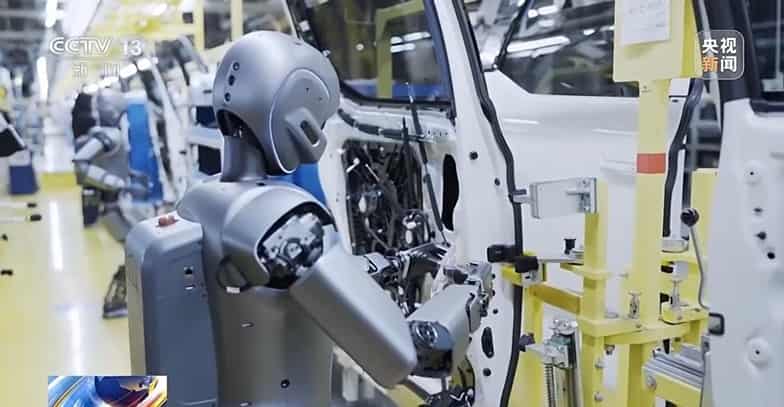
Chinese humanoid robots are not just prototypes—they’re already on factory floors. UBTech’s Walker S is now participating as an “intern” in the NIO car manufacturing plants, demonstrating how humanoid robots could soon replace human workers in repetitive, labor-intensive jobs.
Humanoid robotics has become a critical front in the tech race between China and the United States. While the U.S. leads in AI and research, China excels in manufacturing scalability, which allows it to lower production costs faster than its Western rivals.
Today, 56% of the world’s humanoid robotics companies are based in China, according to Goldman Sachs.
2025: The Breakthrough Year for Mass-Produced Robots
Industry analysts predict 2025 will be the tipping point for large-scale humanoid robot production. American startup Figure AI has already revealed a production line capable of building 12,000 humanoid robots annually.
Although the United States still leads in innovation, China’s strength lies in rapidly moving from prototype to affordable product, giving it a potential advantage in the global robotics race.
Automation: China’s Solution to Its Aging Population
China is undergoing a major economic transformation, moving away from labor-intensive industries. As the country faces a rapidly aging population and higher wages, accelerated automation has become essential.
According to the Financial Times, China is experiencing “its own China shock” by shifting away from cheap labor models. In this new reality, humanoid robots are seen as a strategic necessity for sustaining manufacturing growth.
Companies like Agibot have received strong backing, completing eight rounds of funding with support from institutions such as the Chinese Academy of Sciences, the Lingang Sci-Tech Fund, and state-owned automaker BAIC.
“Made in China 2025”: The Plan Behind the Push
China’s robot revolution is not happening by chance. It is part of the government’s strategic initiative, “Made in China 2025”, launched to upgrade the nation’s industrial capabilities.
The plan outlines the creation of smart factories, human-machine collaboration, real-time production monitoring, and self-adaptive control technologies. A 2024 survey revealed that 86% of the roadmap’s goals have already been achieved, catapulting China into the era of Industry 4.0.
This shift recalls the 2017 acquisition of German robotics leader Kuka by Chinese appliance giant Midea, a deal worth €3.7 billion. Today, over 60 Chinese companies are competing in the humanoid robotics field, driving rapid innovation.
Robotics Could Surpass Automobiles in China’s Future
China’s robotics industry is growing so fast that experts believe it could soon outpace the automotive sector. Xiaopeng Motors, a major electric vehicle innovator, predicts that robotics will become a bigger industry than EVs in the coming years.
With fierce competition, strong government support, and a nationwide push for automation, China is set to become the world’s humanoid robot powerhouse.
China Reviews Tariffs on US Products in the Midst of Trade War
Something is beginning to move in the trade war between the United States and China. Beijing is considering reducing tariffs on several US products, particularly in the healthcare, aerospace, and chemical sectors.
China Plans to Reduce Tariffs on Key Products
According to the American Chamber of Commerce in China, Chinese authorities are working to eliminate tariffs of up to 125% on critical medical supplies, lifesaving equipment, and essential industrial components. Chemical recycling
A list leaked on Chinese social media suggests that 131 types of products are under evaluation for possible exemption. These imports represent an approximate value of $45 billion, part of the total $160 billion that the United States will export to China in 2024.
Despite the news, the Chinese Ministry of Commerce has not issued official comments. For its part, the Ministry of Foreign Affairs reiterated that, to begin any negotiations, Washington must “completely” cancel its unilateral tariffs. Chemical recycling
Signs of Flexibility from Washington
In recent days, Washington has also shown signs of openness. Treasury Secretary Scott Bessent acknowledged that the trade war “is not sustainable.” Shortly after, President Donald Trump stated that initial contacts have already taken place and that the conflict could end with “a substantial reduction in tariffs.”
However, Beijing officially denied that negotiations are underway. Even so, diplomatic movements indicate that both powers could be preparing the ground for future talks.
In a recent interview with Time, Trump revealed that President Xi Jinping had called him. Although he declined to provide details about the content or exact timing of the conversation, he emphasized that it was “not a sign of weakness” on Xi’s part. Some analysts believe Trump may have been referring to a previous call, made on January 17, days before his presidential inauguration. Chemical recycling
Beijing Prepares for a Prolonged Conflict
Despite these signs of rapprochement, China is also strengthening its domestic strategy. In a recent statement, the Politburo announced measures to address potential “external shocks,” including:
Reducing interest rates and reserve requirements for banks.
Issuing treasury bonds to inject liquidity.
Tax incentives to encourage consumption and technological innovation.
Financial support for companies most affected by tariffs.
These steps show that, while opening the door to dialogue, China is also preparing to resist should the trade war drag on. Chemical recycling

Recycled Packaging Goals: New Study Highlights Progress and Challenges
A new report from AMERIPEN, developed by Circular Matters and supported by the PLASTICS Industry Association’s Recycling is Real initiative, shines a spotlight on the strides consumer-packaged goods (CPG) companies are making toward using more recycled materials in packaging. At the same time, it exposes critical gaps in infrastructure, collection, and supply that could hinder progress.
Now freely available to the public, the U.S. Packaging Recycled Content Goals Analysis builds on AMERIPEN’s 2021 research and offers fresh insights for companies, policymakers, and sustainability advocates. It examines how current recycled content goals—whether driven by voluntary commitments, trade associations, or legislation—stack up against the real-world capacity of the U.S. recycling system. Chemical recycling
Stronger Goals, Bigger Impact
The study shows encouraging momentum: among companies with stated goals, the average amount of post-consumer recycled (PCR) content in plastic packaging more than doubled—from 5.3% in 2019 to 10.7% in 2023. This progress signals that corporate sustainability targets are starting to take root, especially in the plastics sector.
But progress isn’t uniform. While some companies have detailed and transparent goals, others remain vague or focus only on recyclability rather than the actual use of recycled materials. Rob Keith, Membership & Policy Director at AMERIPEN, noted that in the early days of the research, most companies didn’t publish specific recycled content goals—except for certain plastics. The updated analysis, however, provides a more comprehensive view, helping the industry move toward more measurable and effective sustainability outcomes. Chemical recycling
Gaps in Supply and Infrastructure
Despite increased investment and a doubling of plastics reclamation capacity since 2021, the U.S. still faces a shortfall in meeting 2025 targets—particularly for PET plastics. Unless recycling collection rates improve and advanced recycling technologies are more widely adopted, the supply of high-quality PCR materials won’t meet growing demand.
One of the biggest roadblocks? Limited availability of food-grade PCR, inconsistent material quality, and higher costs compared to virgin plastic. These issues make it challenging for companies to scale up recycled content use, especially in products with strict safety and quality requirements. Chemical recycling
States Stepping Up with Policy
Since 2020, at least 10 U.S. states have passed laws mandating recycled content in packaging. These new policies are adding external pressure on brands to meet their goals and are helping to build momentum across the supply chain. However, the report urges caution when it comes to legislation that gives preferential access to recycled materials for specific industries. Instead, it advocates for competitive, open markets that can serve multiple end-uses for recovered materials.
A Call for Collaboration
The report makes one thing clear: meeting recycled content goals isn’t just a company-level responsibility. It requires a coordinated effort across the entire value chain—from collection and processing to end-market development. Patrick Krieger, Senior Vice President of Sustainability and Policy at PLASTICS, emphasized the need for continued investment in U.S. recycling infrastructure and stronger regulatory clarity to help maintain momentum. Chemical recycling
“With more companies setting goals and more states implementing mandates, we’re heading in the right direction,” said Krieger. “But to truly close the gap, we need to strengthen our collection systems, improve processing capacity, and ensure recycled content goals are grounded in realistic supply data.”
Looking Ahead
The U.S. Packaging Recycled Content Goals Analysis is now an essential resource for anyone looking to align sustainability efforts with market realities. By combining data from 46 major companies, trade associations, and state laws, the report offers a roadmap to making recycled packaging goals more achievable. Chemical recycling
As the demand for recycled content continues to grow, understanding both the opportunities and the challenges will be key to creating a circular economy that works—for people, businesses, and the planet.

Lummus Accelerates Industrial AI with NAPCON Buyout and Long‑Term Neste Alliance
Deal Snapshot
Lummus Technology has signed a definitive agreement to acquire the intellectual property and core assets of NAPCON, the AI‑driven software suite developed by Finnish energy company Neste. The purchase also transfers key NAPCON engineers to Lummus, protecting critical know‑how and seamless customer support. At the same time, the two firms have inked a Strategic Collaboration Agreement that guarantees uninterrupted NAPCON services for Neste and its subsidiaries.
What NAPCON Brings to the Table
NAPCON combines artificial intelligence, advanced process control (APC), dynamic simulation and plant‑wide automation to fine‑tune refinery, petrochemical and heavy‑industry operations. Users report:
- higher throughput and energy efficiency,
- tighter safety margins,
- lower emissions and unit costs. Chemical recycling
Decades of continuous improvement have made NAPCON a go‑to platform for producers that need both profitability and sustainability.
Voices from the C‑Suite
“Acquiring NAPCON and extending our partnership with Neste are transformative moves,” said Leon de Bruyn, President & CEO of Lummus Technology. “Merging AI‑driven analytics with our process‑technology DNA will lift customers’ performance to the next level.”
Neste’s COO Markku Korvenranta welcomed the hand‑over: “Lummus can scale NAPCON globally while safeguarding existing installations. We see them as the right long‑term custodian.”
Multi‑Partner Ecosystem
The agreement also taps Lummus Digital—a joint venture with TCG Digital—and Finnish automation specialist Ferroman Engineering Oy. Together they will:
- supply NAPCON services to all Neste sites,
- support current third‑party licensees, and
- market the platform to Lummus’ worldwide customer base.
Ferroman CEO Håvard Hansen called the three‑way collaboration “a pivotal moment” that will speed up digitalisation across steel, food‑processing and energy sectors.
Strategic Upside
Bringing NAPCON under the Lummus umbrella lets the company:
- bundle digital twins, APC and predictive maintenance with its classic process‑unit licences; Chemical recycling
- generate new royalty streams from software subscriptions;
- strengthen customers’ net‑zero road‑maps with data‑driven optimisation.
Timeline and Next Steps
Regulatory closing is slated by June 2025. Once final, NAPCON will slot into the Lummus Digital portfolio for an immediate global roll‑out.

Versalis Slides Deeper into the Red: Q1 2025 Snapshot
Losses Widen in ENI’s Chemical Arm
Versalis, the chemicals subsidiary of energy giant ENI, reported a €243 million loss for Q1 2025—a sharp 45 % deterioration from the €168 million deficit booked a year earlier and even worse than the €231 million loss seen in Q4 2024. The result underscores the mounting pressure on European chemical producers as they battle cheaper rivals in North America and Asia.
Why the Gap Is Growing
ENI attributes the downturn to a perfect storm of factors:
- European macro‑slowdown: Tepid industrial activity continues to sap demand for chemicals across the continent.
- Inflated input costs: Energy prices and feedstocks remain stubbornly high in Europe, eroding margins versus U.S. and Asian peers.
- Global oversupply: New capacity commissioned in the Gulf Coast and China has flooded the market, pushing prices down just as European players face higher costs. Chemical recycling
Demand Slips, Volumes Shrink
With customers trimming orders and several production lines idled, Versalis shipped about 800 000 tonnes of product in the quarter—down 7 % year‑on‑year. Management warned that short‑term visibility remains poor, citing weak order books in automotive, construction and consumer‑goods segments.
Restructuring Shifts into High Gear
Recognising that the squeeze is no longer cyclical but “structural,” Versalis has accelerated its overhaul of the basic‑chemicals portfolio:
- In March it permanently closed the Brindisi steam cracker, removing a high‑cost asset from the network.
- Earlier this month, the company signed a memorandum of understanding with chemical‑workers unions (all except Filctem‑CGIL) to reshape plants, staffing levels and future investments. Talks will flesh out details over coming weeks. Chemical recycling
Bright Spots Amid the Gloom
Not everything was negative:
- Technology tie‑up with Lummus: Versalis inked a strategic licensing deal covering the phenol value chain. The agreement should open a new revenue stream from royalties while boosting process efficiency.
Circular‑economy progress: A new styrene‑plastics recycling plant in Porto Marghera started up, marking a tangible step toward the group’s 2030 sustainability targets. Chemical recycling
Looking Ahead
Versalis says it will continue pruning uncompetitive assets, deepening partnerships and scaling circular‑economy projects to restore profitability. Still, with European demand soft and global oversupply lingering, investors should brace for another challenging year before the turnaround gains real traction.

Advanced Recycling: A Fresh Fix for Our Plastic Problem
Earth Day is a reminder that conventional recycling alone can’t keep pace with the mountains of plastic we generate. Mechanical recycling—sorting, shredding and melting plastics into new products—extends a bottle’s life once or twice, but it can’t handle every resin or endlessly repeat the loop. Enter advanced (chemical) recycling, a suite of technologies that tackles those limits head‑on.
Instead of grinding plastic into flakes, advanced recycling works at the molecular level. Moderate heat, pressure and specialty solvents break polymers apart so they can be rebuilt as new plastics or transformed into oils, waxes, fuels and specialty chemicals. You’ll see three main methods:
- Purification removes additives and colorants so a polymer can be reused almost like virgin material. Chemical recycling
- Depolymerization unzips plastics such as PET back into their original monomers.
- Conversion (pyrolysis & gasification) uses higher heat to turn mixed or contaminated waste into feedstocks for fresh plastic or even synthetic gas.
Because each technique targets different resins, their combined toolbox can divert a far broader range of discarded packaging, film and foam from landfills and incinerators.
Skeptics worry about scale, cost and energy use, and they’re right that no single fix will cure our throw‑away habit. Yet early life‑cycle research from the U.S. Department of Energy’s Argonne National Laboratory shows chemically recycled plastic can carry a smaller greenhouse‑gas footprint than making plastic from scratch. That’s a significant win in a world racing to cut carbon.
Plastics aren’t going away—they’re embedded in healthcare, transport, and clean‑energy tech. What can change is how we manage their end of life. Pair smarter product design and waste prevention with a strategic rollout of advanced recycling, and we inch closer to a truly circular plastics economy. On this Earth Day, that’s worth celebrating—and accelerating.

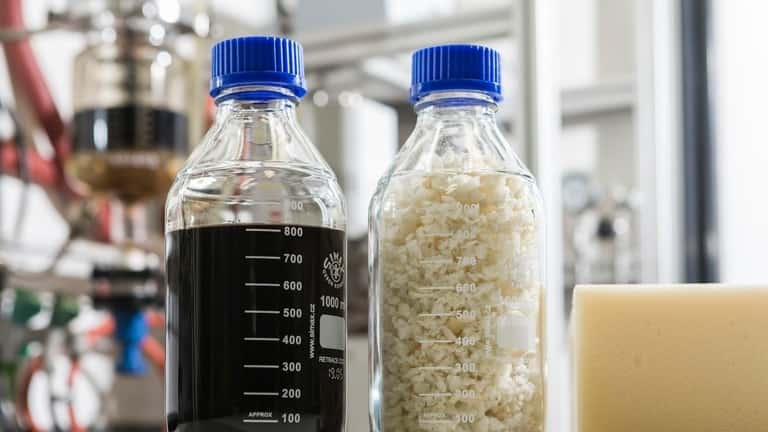
Mattresses That Never Die: How BASF Is Closing the Foam Loop
Most beds meet the dump after barely a decade, sending bulky polyurethane (PU) mattresses to landfills or incinerators. The irony? Fresh mattresses then devour more crude‑oil‑based feedstocks. Chemical recycling
BASF believes that cycle is ripe for disruption—and it’s piloting a circular fix in Schwarzheide, Germany.
From Waste Foam to Fresh Feedstock
In new lab trials, BASF chemists dissolve end‑of‑life PU foam back to its core ingredient, polyol. That reclaimed polyol can be blended into new soft‑foam recipes with a much smaller carbon footprint because the process replaces virgin fossil resources with recovered material.
Why Mattresses Make Sense
- Easy to collect: Retail take‑back schemes already pull thousands of worn‑out units.
- Consistent chemistry: Most contain similar flexible PU, ideal for a single recycling stream.
- High impact: Each recycled mattress means fewer cubic metres of landfill and less crude oil pumped.
Circular Economy in Action
The project fits BASF’s broader push to decouple growth from finite resources. “We want to take further steps toward a circular economy,” says Shankara Keelapandal, who heads Isocyanates Europe. Technical lead Arno Volkmann adds, “Mattresses are straightforward to sort, yet they usually end up burned or buried. Turning them into feedstock changes that equation.” Chemical recycling
What’s Next
Pilot quantities of recycled polyol will ship to partner manufacturers later this year, seeding demo beds that prove quality matches virgin foam. If scale‑up succeeds, the industry could shift from linear “take‑make‑waste” to a regenerative loop—where yesterday’s mattress literally becomes tomorrow’s.
By transforming mattress disposal from a problem into a resource stream, BASF shows how targeted chemical recycling can slash landfill tonnage and shrink the petro‑footprint of everyday products. That’s circularity worth sleeping on.
Recyclable Wins: What Amcor’s 2025 Study Says About European Shoppers and Sustainable Packaging
Amcor’s latest consumer‑claims survey, covering 3,351 shoppers across the UK, Italy, France, Germany, Sweden and Poland, underscores one dominant theme: recyclability sells. Chemical recycling
Recyclability claims tip the scale
Eighty‑four percent of respondents read on‑pack disposal instructions before they buy. When a pack tells them it can be recycled, it instantly gains credibility—and their cash.
“Made with recycled material” now speaks louder
Seventy‑one percent of shoppers say they understand the phrase “made with recycled materials,” up four points since Amcor’s 2022 report. The clearer the wording, the more persuasive the claim.
Paper packs ride a rising wave
Paper is the breakout star of Amcor’s 2025 findings. Seventy‑two percent of consumers grasp paper‑based packaging claims and factor them into purchase choices, signalling momentum toward fibre formats. Chemical recycling
Why this matters for brands
The data maps a fast‑tightening link between clear sustainability messaging and sales conversion:
- Simple, specific wording (“100% recyclable”, “recycled content”) beats vague eco‑jargon.
- On‑pack guidance doubles as a micro‑tutorial, easing post‑use disposal anxiety.Paper’s familiarity gives it an instant trust premium, positioning it as a gateway to broader circular‑economy solutions.
Action checklist
- Lead with recyclability – place recyclable logos and instructions front‑of‑pack.
- Quantify recycled content – percentages build trust.
- Highlight paper attributes – showcase fibre origin, strength and barrier performance.
- Educate continuously – QR codes can extend the sustainability story without cluttering design.
For European consumers in 2025, sustainability isn’t a sideline—it’s the purchase filter. Make your packaging claims crystal‑clear, and you’ll meet both their environmental ideals and their shopping baskets. Chemical recycling