Breakthrough AI Plastic Recycling Technology Supercharges European Circular Economy
Breakthrough AI Plastic Recycling Technology Supercharges European Circular Economy
Europe’s waste management sector has entered a decisive new era. Following the enforcement of the European Union’s ban on plastic waste exports to non-OECD countries under the revised Waste Shipment Regulation, Member States can no longer rely on shipping hundreds of thousands of tonnes of mixed polymers to Southeast Asia. With domestic infrastructure suddenly tasked with processing vast volumes of complex post-consumer packaging at home, industrial innovators are turning to AI plastic recycling technology to bridge the capacity gap.
A compelling model for this industrial transformation is unfolding in southern Italy. At its facility in Pettoranello del Molise, Italian circular economy operator Recupero Etico Sostenibile (RES S.p.A.) has built an integrated plastics recovery hub that merges deep-learning optical sorting with downstream mechanical and chemical recycling. Rather than treating waste sorting as an isolated step, the plant demonstrates how intelligent automation can transform low-value, multi-layered municipal waste into high-purity secondary raw materials. AI plastic recycling technology
Why Europe Needs Smarter Domestic Sorting Now
For years, Europe’s recycling ambitions collided with an uncomfortable logistical reality. While the European Union generates roughly 40 million tonnes of plastic waste annually, between 1 million and 1.5 million tonnes were historically exported each year. In 2025 alone, approximately half of those shipments went to non-OECD nations such as Malaysia, Indonesia, and Vietnam.
Now that the export prohibition is active—and set to remain in place until at least May 2029—European recyclers must absorb far more material domestically. However, modern consumer packaging poses a major technical hurdle. Multi-polymer trays, flexible films, dark pigments, and full-body shrink sleeves routinely confuse conventional sorting equipment, causing valuable recyclable plastics to be downgraded or sent to incineration. AI plastic recycling technology
To make domestic recycling economically viable, facilities must achieve two goals simultaneously: process higher volumes at faster speeds and extract purer polymer fractions that manufacturers can actually use.
Inside the Molise Hub: How Deep Learning Solves Optical Blind Spots
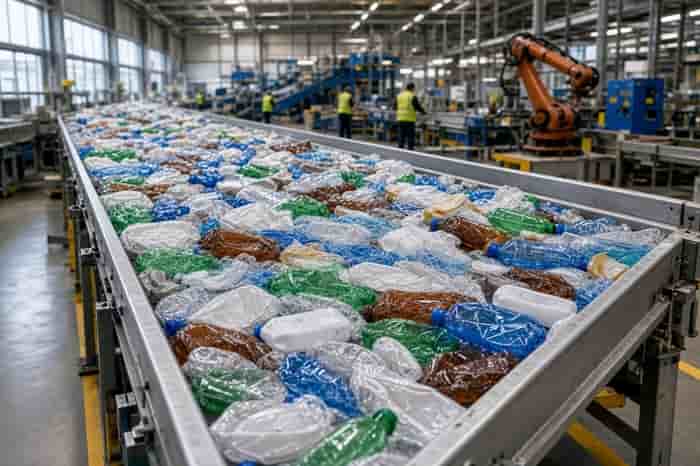
Operating since January 2024, the RES sorting plant in Pettoranello del Molise processes up to 40,000 tonnes of plastic waste every year. The facility accepts both mono-material and multi-material municipal collections alongside non-hazardous commercial and industrial streams. AI plastic recycling technology
To separate these diverse inputs into marketable commodities, RES deployed ten COMPACT+ optical sorters engineered by Pellenc ST. These units categorize incoming waste by polymer composition and color, isolating critical streams including:
-
High-Density Polyethylene (HDPE)
-
Polypropylene (PP)
-
Polystyrene (PS)
-
Polyethylene (PE) films
-
Plasmix (residual mixed plastics, including complex PET trays)
-
Five distinct Polyethylene Terephthalate (PET) grades: transparent, light-blue, colored, opaque, and sleeved
Overcoming the Full-Sleeve Bottle Challenge
Traditional optical sorters rely primarily on Near-Infrared (NIR) and Visible (VIS) spectroscopy to identify plastics based on how they reflect light. While effective on clean, uncovered bottles, NIR sensors struggle when a container is wrapped in a decorative full-body sleeve made from a different polymer. Conventional machines often misread the outer label, rejecting a perfectly recyclable PET bottle into the residue stream. AI plastic recycling technology
To eliminate this loss, RES integrated five CNS BRAIN artificial intelligence modules directly onto its sorting line. Powered by deep-learning neural networks, these modules analyze visual characteristics—such as shape, texture, and branding patterns—alongside spectroscopic data. The AI modules are positioned across the primary PET/non-PET separation stage as well as four dedicated PET refinement lines handling clear, light-blue, colored, and opaque or sleeved containers.
Following a four-month training period to calibrate the neural models against real-world Italian waste streams, the impact on plant throughput was immediate. RES recorded a 10% increase in overall processing capacity alongside markedly higher purity levels across its recovered PET fractions. As RES CEO Antonio Lucio Valerio noted, combining deep learning with specialized model training unlocked substantial gains in both line efficiency and sorting precision. AI plastic recycling technology
A Global Shift Toward Intelligent Waste Robotics
The operational gains achieved in Molise mirror a broader technological wave across the global waste management sector. Industry analysts and technology providers showcased similar breakthroughs at international climate forums in late November 2026, highlighting how artificial intelligence and hyperspectral imaging are rapidly becoming standard infrastructure for circular supply chains.
Across modern material recovery facilities, AI-driven optical systems are increasingly paired with automated sorting lines to achieve purity rates above 95% for targeted polymer streams. By automating complex visual recognition tasks that previously required manual quality control, operators can stabilize output quality even when incoming municipal waste fluctuates in composition.
Closing the Loop: Integrating Mechanical and Chemical Recycling
High-precision sorting is only valuable if downstream manufacturing pathways exist to absorb the recovered polymers. Rather than shipping baled plastics to third-party brokers, RES designed its Pettoranello site as a vertically integrated industrial ecosystem backed by a €13.5 million investment in sorting and mechanical processing. AI plastic recycling technology
Mechanical Granulation for Textile and Industrial Applications
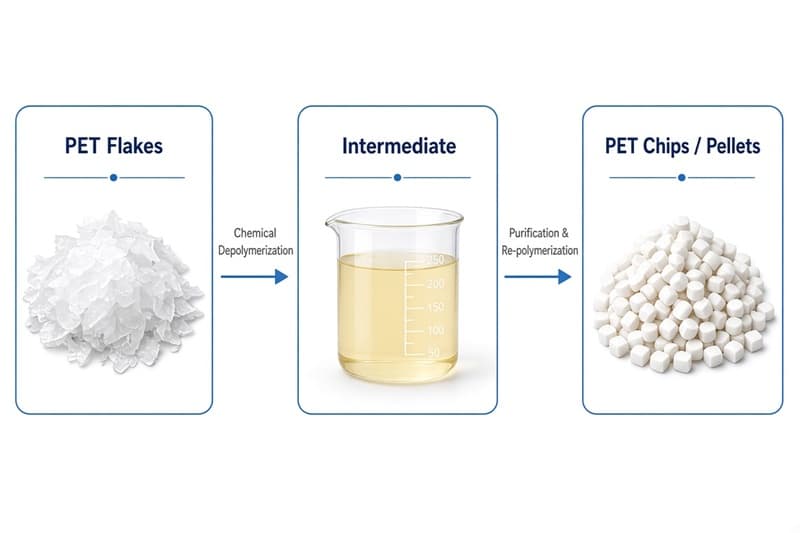
Alongside its optical sorting line, RES commissioned an automated washing and granulation unit in 2024. Sorted PET, HDPE, and PP fractions move directly into wash lines where labels, adhesives, and organic residues are stripped away before the polymers are extruded into clean flakes.
Capable of producing 8,200 tonnes of recycled flakes annually, this mechanical recycling stage supplies secondary raw materials directly to downstream manufacturers, including producers of synthetic textile fibers. Keeping sorting and granulation under one roof reduces transport emissions, lowers logistics overhead, and guarantees consistent feedstock specifications. AI plastic recycling technology
Chemical Recycling for Hard-to-Treat Residues
Even with ten optical sorters and five AI modules, a portion of mixed plastic waste remains unsuitable for traditional mechanical reprocessing. Multilayer films, heavily degraded plastics, and complex composite packaging cannot simply be melted and remolded without losing structural integrity.
To ensure these residual fractions do not end up in landfills or incinerators, RES is constructing a dedicated pyrolysis facility in partnership with chemical recycling specialist BlueAlp. Engineered to process 20,000 tonnes of residual plastics annually, the plant will thermally convert non-mechanically recyclable waste into pyrolysis oil. This circular feedstock will then be supplied to Shell Chemicals Europe to manufacture virgin-quality polymers, effectively closing the loop on the toughest fractions of the municipal waste stream. AI plastic recycling technology
Key Takeaways for the Future of Plastics Recovery
The convergence of strict European trade regulations and mature AI sorting hardware marks a turning point for industrial sustainability. As demonstrated by the Pettoranello del Molise facility, modern recycling plants are evolving from basic waste-handling depots into sophisticated biorefineries and polymer factories.
-
AI Eliminates Optical Bottlenecks: Deep-learning modules working alongside NIR/VIS sensors allow sorters to identify sleeved and complex packaging, directly boosting plant capacity by 10%.
-
Vertical Integration Protects Margins: Combining sorting, washing, granulation, and chemical pyrolysis on a single site insulates recyclers from volatile commodity markets while maximizing resource extraction.
-
Regulatory Pressure Accelerates Innovation: With non-OECD plastic waste exports restricted across the EU, high-efficiency domestic facilities like RES provide the essential blueprint for turning regional waste liabilities into resilient circular supply chains. AI plastic recycling technology
Plastic Recycling Demand Soars, Yet Domestic Recyclers Struggle to Survive
More…