Breakthrough Bifacial Ladder Polymers Reach 90% Spin Polarization
Breakthrough Bifacial Ladder Polymers Reach 90% Spin Polarization
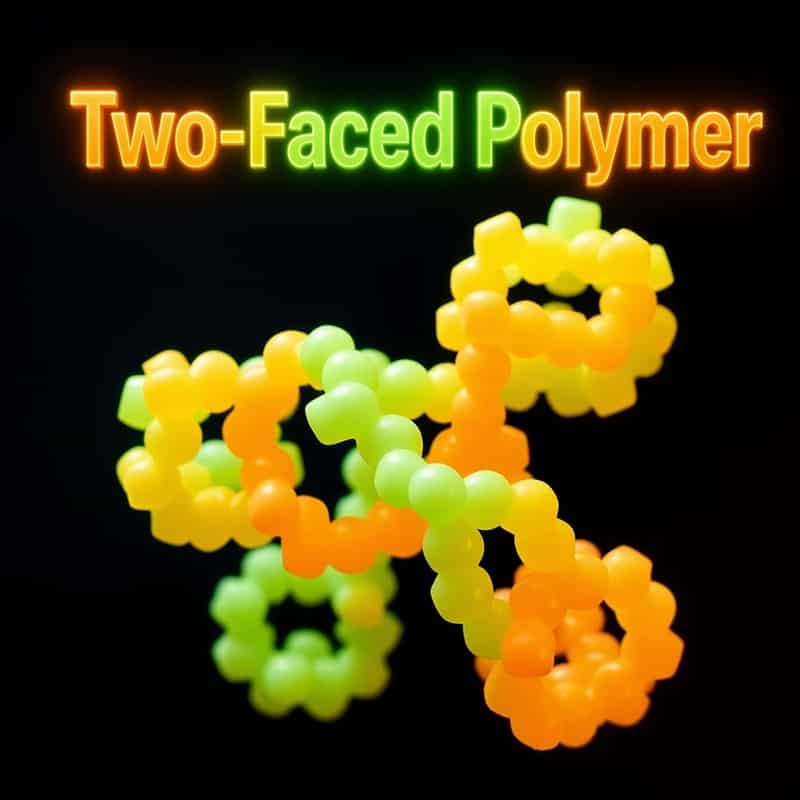
Researchers in Japan have created a distinctive class of two-faced polymers that can organize themselves into chiral structures and strongly favor one electron-spin orientation.
The experimental films reached spin-polarization values of approximately +90% and −88%, depending on which mirror-image version of the polymer was tested. These results place the materials among the strongest organic chiral spin filters reported so far.
The work, conducted by Fumitaka Ishiwari, Kazuharu Murotani and Akinori Saeki, was published in Nature Communications. It introduces what the researchers call bifacial ladder polymers: rigid, double-stranded molecular backbones whose two faces carry different chemical groups.
Key findings
- The polymers maintain two chemically distinct faces along their backbones.
- Homochiral versions self-assemble into left- or right-handed structures in thin films.
- The two mirror-image polymers favor opposite electron-spin orientations.
- Measured spin polarization reached +90 ± 5% and −88 ± 5%.
- The films retained their chiral optical response after brief heating to 300°C.
- The result is an early-stage laboratory demonstration, not a commercial electronic device.
These figures and limitations are documented in the peer-reviewed Nature Communications study.
What are bifacial ladder polymers?
An ordinary polymer resembles a long molecular chain whose links may rotate. A ladder polymer is more constrained: its backbone contains two connected strands, much like the sides of a ladder joined by rungs.
That additional bonding makes the backbone comparatively rigid. In the newly reported architecture, different chemical groups are permanently directed toward opposite sides of this backbone.
One side is decorated with hydrophilic tetraethylene-glycol groups, while the other carries hydrophobic phenyl groups. The resulting structure is “bifacial” because it has two persistent and chemically different faces—not because it is simply a flat molecule with two visible surfaces.
Producing this arrangement uniformly was a central synthetic challenge. If individual building blocks were incorporated randomly, their faces could flip direction along the chain and destroy the desired organization.
The researchers addressed this problem with a chirality-assisted synthesis. They used highly purified, single-handed molecular building blocks whose geometry permitted only the intended ladder-forming arrangement. bifacial ladder polymers
Why molecular handedness matters
Chirality describes structures that cannot be perfectly superimposed on their mirror images. Human hands are a familiar example: they contain the same basic components but have opposite orientations.
The Osaka team produced two mirror-image forms of its polymer. In thin films, these materials assembled into supramolecular structures with opposite handedness.
This organization had a marked effect on electron transport. The phenomenon is known as chirality-induced spin selectivity, or CISS. In a CISS-active material, electrons with one spin orientation can pass more readily than those with the opposite orientation.
The researchers found that one polymer favored the measured up-spin current, while its mirror image favored the down-spin current. This reversal between the two versions provides important evidence that molecular handedness was responsible for the effect.
Spin polarization approaches 90%
Measurements were performed with magnetic conductive atomic-force microscopy. The team collected more than 50 current-voltage curves at different positions in each film and averaged the results.
For the preferred spin channel, measured current was approximately 30–40 nanoamperes under a bias of plus or minus six volts. Current in the less-favored channel remained around 2–3 nanoamperes.
From those measurements, the researchers calculated spin polarization of +90 ± 5% for one mirror-image polymer and −88 ± 5% for the other.
This is an important correction to the approximately 70% figure associated with an earlier, related Osaka polymer system. The new ladder polymers surpassed that previous result, which used chiral bifacial indacenodithiophene polymers with a less ordered, nearly amorphous film structure. The university’s 2024 account of that earlier research confirms that its polarization approached 70%.
The latest study attributes the improvement to two connected features: the fixed ladder backbone and the formation of long-range chiral order in the film. However, the authors also stress that the detailed microscopic mechanism behind CISS remains under investigation.
Self-assembly amplifies the chiral response
The polymers’ behavior did not come solely from individual chiral molecules. Their collective organization in solid films produced a much stronger response.
The thin films formed one-handed supramolecular helices. Their circular-dichroism intensity—a measurement of how differently a material interacts with left- and right-circularly polarized light—was more than 100 times stronger than that of the corresponding molecular or non-ladder references.
Tests also suggested that sufficiently long polymer chains were necessary for this organization to emerge. A lower-molecular-weight batch did not produce the same strong thin-film response.
This distinction matters because it indicates that performance depends on several levels of structure: the molecular building block, the rigid polymer backbone and the way many chains assemble inside a film.
The material withstands substantial heating
The researchers heated one of the chiral films at temperatures ranging from 50°C to 300°C for 60 seconds. Its circular-dichroism spectrum remained essentially unchanged after the 300°C treatment.
That experiment supports the thermal stability of the film’s chiral organization. It does not, however, establish long-term operational durability at 300°C or prove that a finished device could operate continuously at that temperature.
Further testing will be needed to establish resistance to repeated thermal cycles, moisture, oxygen, mechanical stress and extended electrical operation.
What could the discovery lead to?
Materials that filter electron spin could eventually contribute to spintronics, a field that uses both electron charge and spin. Potential research directions include spin-sensitive sensors, information-processing components and organic optoelectronics.
The carbon-rich polymer architecture could also be attractive for thin-film research because organic materials can sometimes offer low weight and adaptable chemical properties.
Those possibilities should be treated cautiously. The study measured spin-dependent transport with a magnetic microscope probe; it did not demonstrate a complete memory cell, logic circuit, solar cell or commercial spintronic component.
Researchers must still determine whether the material can be manufactured uniformly over large areas, connected reliably to electrodes and integrated into practical device architectures. Reproducibility between laboratories and stable performance under real operating conditions will also be essential.
Why the result is significant
The achievement is not simply a higher polarization number. It demonstrates how chemical design can control structure at several scales.
Chiral building blocks guide the synthesis. The synthesis fixes the orientation of the polymer’s two faces. The rigid chains then assemble into larger, one-handed structures. That organization, in turn, strengthens spin-selective transport.
By connecting molecular handedness with measurable electronic behavior, bifacial ladder polymers provide researchers with a new platform for studying how chirality, self-assembly and electron spin interact.
For now, the work is best understood as a notable materials-science advance rather than an imminent electronics product. Its strongest contribution may be the design principle it establishes: carefully controlling both faces of a rigid polymer can unlock properties that flexible or disordered chains do not display.
Frequently asked questions
What are bifacial ladder polymers?
They are rigid, double-stranded polymers designed with two chemically distinct faces that remain uniformly oriented along the molecular backbone.
How much spin polarization did they produce?
The two mirror-image materials reached approximately +90 ± 5% and −88 ± 5% in magnetic conductive-AFM measurements.
Do the polymers work without magnets?
Their chirality provides the spin-selective filtering behavior, but the reported experiment used a magnetized conductive-AFM probe to measure that behavior. Claims of a completely magnet-free finished device would therefore be premature.
Are these p
olymers ready for commercial electronics?
No. The research demonstrates material synthesis, self-assembly and spin-selective transport in experimental films. Scaling, durability and device integration remain unproven.
Recyclable biobased polymers outperform common plastics
More…