Global Bottle-Grade PET Market Shows Resilient Stability Despite Soft Demand and Oversupply Pressures in Late February 2026 Trade Environment 25-02-2026
Global Bottle-Grade PET Market Update – February 18–25, 2026
The bottle-grade PET market entered the second half of February 2026 in a phase of consolidation. Across North America, Europe, and Asia, prices remained largely stable week-on-week, reflecting a delicate balance between oversupply and disciplined production. Soft demand conditions persisted, yet feedstock stability and seasonal expectations prevented significant downside pressure.
For web readers and mobile users, this update breaks down the bottle-grade PET market into clear sections covering pricing, production, feedstocks, trade flows, and outlook.
Current Regional Prices – February 2026
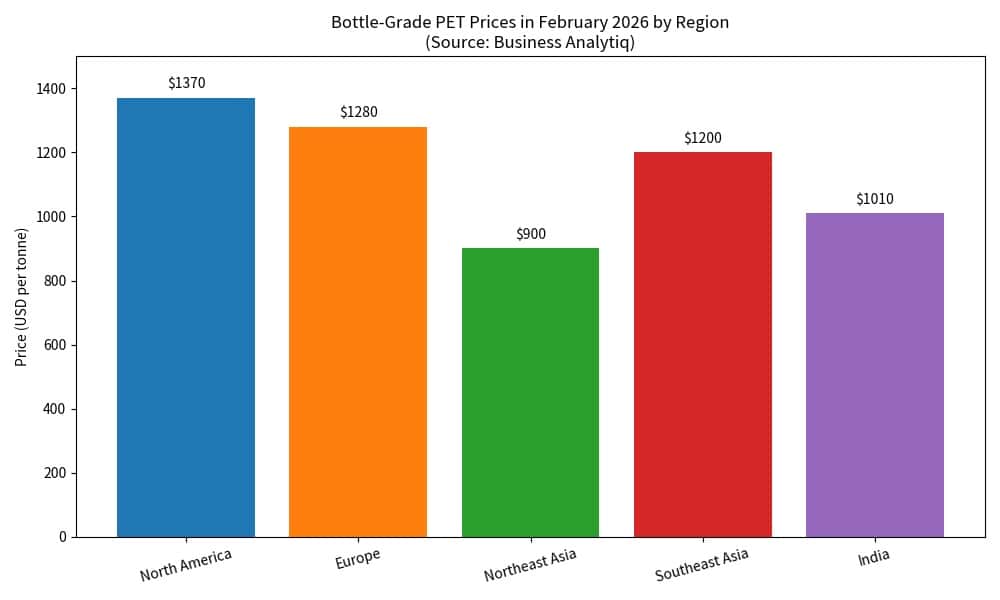
Regional price levels during the week of 18–25 February 2026 reflected limited spot activity and cautious buyer behavior. Approximate bottle-grade PET resin benchmarks were as follows:
North America : about 1,370 USD per tonne, down roughly 3.5 percent month-on-month
Europe : about 1,280 USD per tonne, up around 0.8 percent
Northeast Asia including China export basis : about 900 USD per tonne, broadly unchanged
Southeast Asia : about 1,200 USD per tonne, unchanged
India : about 1,010 USD per tonne, unchanged
The bottle-grade PET market in the United States showed stability during the week ending 23 February. February overall reflected a flat-to-slightly-down movement equivalent to around 1 cent per pound, driven by stable feedstock costs and moderate demand.
In Europe, contract and spot prices held steady week-on-week. Earlier mild upward pressure linked to imports and logistics disruptions did not translate into further gains late in the month.
In Asia, Chinese-origin material remained competitive globally, supported by soft monoethylene glycol pricing. Northeast Asia continued to function as the global price floor within the bottle-grade PET market.
Production Trends – Oversupply Remains the Structural Story
The bottle-grade PET market continues to operate under structural oversupply conditions. However, the rapid capacity expansion phase that defined the early 2020s has slowed.
China remains the dominant force in global PET resin production, accounting for roughly 60 percent or more of global PTA and PET capacity. Estimated Chinese PET output in 2025 reached approximately 17.5 million tonnes, representing double-digit year-on-year growth. Despite this scale, margins have been weak, prompting disciplined operating rates.
Global virgin PET operating rates have hovered in the low-to-mid 70 percent range entering February 2026. Producers across regions have shown reluctance to lift run rates significantly without clear evidence of demand recovery.
Chinese downstream packaging converters reportedly ran at utilization rates 5 to 8 percent lower in early 2026 compared with stronger periods. This softness reinforces the cautious supply discipline observed throughout the bottle-grade PET market.
Importantly, no major global restarts or significant curtailments were reported during the monitored week. The supply side remains stable but restrained.
Feedstock Dynamics – Cost Stability Supports Flat Pricing
Feedstock conditions explain much of the current price stability in the bottle-grade PET market.
In China, purified terephthalic acid traded within a 5,000 to 5,400 RMB per tonne range during February. Monoethylene glycol remained weaker, trading roughly between 3,500 and 3,600 RMB per tonne. The combination resulted in relatively stable PET cash costs compared with late 2025 levels.
Forward curves suggest limited volatility through the second half of 2026. PTA shows backwardation patterns that imply easing tightness later in the year, while MEG contango suggests moderate future supply availability. These dynamics favor stable nominations rather than aggressive price hikes.
With feedstock costs contained, PET producers lack a strong cost-push justification for significant increases. At the same time, cost floors prevent deep discounting.
Trade Flows and Protectionism Shape Regional Divergence
The bottle-grade PET market remains fragmented by trade measures and anti-dumping investigations.
Ongoing investigations in Mexico into imports from Vietnam and Malaysia, alongside earlier actions in Brazil, limit the flow of low-cost Asian material into protected markets. These measures contribute to regional price divergence and reduce arbitrage opportunities.
Freight volatility also plays a role. When shipping rates align favorably, Asian exports increase competitive pressure in Europe and parts of the Americas. When freight tightens, local producers regain some pricing leverage.
This trade complexity reinforces a tactical environment in which buyers remain inventory-light and sellers manage volumes carefully.
Demand Outlook – Waiting for Seasonal Momentum
Demand conditions remain fragile. Beverage-bottle offtake has softened ahead of peak consumption periods in the Northern Hemisphere.
However, seasonal catalysts are approaching. Second-quarter demand typically strengthens due to summer beverage consumption in North America and Europe, as well as Ramadan-related demand in several key markets. Restocking could accelerate into Q2 if weather patterns and consumer spending improve.
Longer-term fundamentals for the bottle-grade PET market remain constructive. Global PET bottle demand is projected to approach 27 million metric tons in 2026, with compound annual growth near 4 percent annually. Lightweight packaging, recyclability, and convenience trends continue to support structural demand growth.
Nonetheless, 2026 is widely viewed as a transitional year marked by supply overhang and cautious macroeconomic conditions.
Near-Term Outlook – Tactical Stability Continues
As of 25 February 2026, the bottle-grade PET market can be characterized as stable but sensitive.
Prices are steady week-on-week, with Asia maintaining its role as the low-cost benchmark. Production remains disciplined, with global operating rates subdued. Feedstock costs are contained, limiting volatility. Seasonal demand expectations provide modest upside potential.
Key upside risks include stronger-than-expected Q2 restocking, feedstock volatility, or freight disruptions. Downside risks include prolonged weak demand or unexpected capacity returns.
The final week of February has functioned as a consolidation period following modest January firming. The next decisive move in the bottle-grade PET market will likely depend on seasonal beverage demand and upstream PTA and MEG trends.
More…