Why CATL’s 2,000 km Lithium-Air Battery Breakthrough Remains a Distant Dream
Lithium-air battery range
Why CATL’s 2,000 km Lithium-Air Battery Breakthrough Remains a Distant Dream
Imagine driving from Milan to Stockholm on a single electric charge without ever stopping at a highway fast-charger. Recent headlines circulating across automotive and tech media have fueled exactly that fantasy, suggesting that Chinese battery powerhouse CATL is developing a revolutionary “breathing” battery capable of delivering a 2,000-kilometer driving range.
While the underlying chemistry is genuinely fascinating, a closer look at recent industry briefings reveals a critical distinction between laboratory potential and showroom reality. According to recent reports published over the past 48 hours, CATL has not announced a 2,000-kilometer production vehicle target or a commercial launch schedule. Instead, the company treats lithium-air technology strictly as a long-term exploratory research direction rather than an imminent product. lithium-air battery range
How Do “Breathing” Lithium-Air Batteries Work?
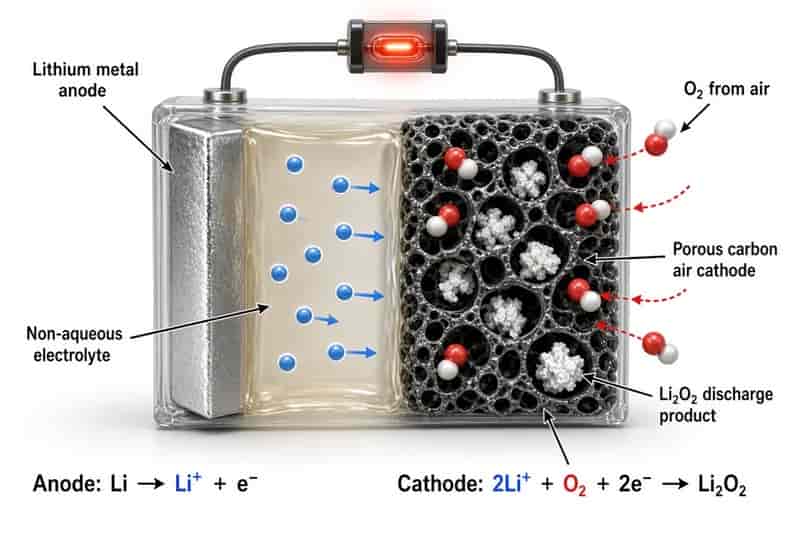
A lithium-air battery generates electricity by combining a metallic lithium anode with oxygen drawn directly from the surrounding atmosphere. Unlike conventional lithium-ion cells that must carry all their reactive ingredients sealed inside a heavy metal casing, lithium-air systems “breathe” in one of their primary reactants from the outside air.
During the discharge phase, lithium ions travel through an electrolyte to react with incoming oxygen inside a porous cathode, forming lithium peroxide and releasing electrical energy. When you plug the vehicle in to recharge, the chemical process reverses: the lithium peroxide breaks down, pure oxygen is released back into the atmosphere, and metallic lithium is restored to the negative electrode.
Because the cell eliminates the heavy cathode materials required in standard lithium-ion batteries, its theoretical specific energy density skyrockets. Scientists estimate the electrochemical reaction can reach roughly 3,505 Wh/kg—up to five times the energy potential of emerging solid-state batteries.
Separating Theoretical Numbers from Real-World EV Packs
The headline-grabbing 2,000 km lithium-air battery range stems directly from that 3,505 Wh/kg theoretical figure. However, battery engineers emphasize that theoretical chemical potential does not equal the usable capacity of a complete automotive battery pack.
To turn raw chemistry into a safe, road-legal vehicle component, manufacturers must add substantial supporting hardware:
-
Air-filtration and intake systems: Pumps, membranes, and scrubbers are required to pull in ambient air while blocking contaminants.
-
Thermal management: High-energy reactions generate heat that requires liquid cooling plates and sensors.
-
Structural housing and electronics: Crash-resistant enclosures, separators, and battery management systems add significant mass.
Recent engineering analyses highlight that supporting air-handling equipment alone can consume over 5 percent of the battery’s generated power. Once you account for the weight and parasitic energy draw of these essential subsystems, the practical energy density drops dramatically compared to numbers calculated on paper. Furthermore, industry observers note that CATL has not filed patent applications for a 2,000-kilometer vehicle cell, underscoring that the number remains an illustrative benchmark rather than an engineering blueprint. lithium-air battery range
The Engineering Hurdles Holding Lithium-Air Back
During the Equipment Powerhouse Forum 2026, CATL Chief Scientist Wu Kai confirmed that lithium-air sits firmly in the company’s long-term research reserve. For decades—stretching back to early automotive experiments like IBM’s Battery 500 project in 2009—three stubborn obstacles have prevented metal-air cells from reaching mass production:
1. Atmospheric Contamination Earth’s atmosphere is roughly 78 percent nitrogen and 21 percent oxygen, mixed with varying levels of water vapor and carbon dioxide. If moisture reaches the metallic lithium anode, it triggers severe degradation and safety hazards. Meanwhile, carbon dioxide reacts with lithium to form lithium carbonate, a stubborn insulating layer that clogs the porous cathode and chokes off future reactions.
2. Sluggish Recharging and Efficiency Losses Breaking down lithium peroxide during charging requires significantly more voltage than the battery delivers during discharge. This voltage gap wastes energy as excess heat and generates aggressive reactive oxygen species that gradually eat away at the internal electrolyte.
3. Limited Cycle Life An electric vehicle battery needs to survive at least 1,000 full charge-discharge cycles to last a decade on the road. In lithium-air cells, solid reaction byproducts tend to accumulate inside the cathode’s microscopic pores, slowly suffocating the cell and reducing driving range after only a few hundred cycles. Even battery-swapping networks cannot solve this issue, as rotating packs between stations does not reverse internal chemical decomposition.
Recent Lab Breakthroughs vs. Commercial Reality
Academic laboratories are actively chipping away at these chemical bottlenecks, proving that lithium-air technology is slowly maturing. Researchers at the Illinois Institute of Technology and Argonne National Laboratory previously demonstrated a solid-state lithium-air design capable of running 1,000 cycles at room temperature by utilizing a four-electron reaction. More recently, experimental pouch cells using specialized gelled polymer electrolytes have achieved 757.5 Wh/kg across 241 test cycles.
While encouraging, these milestones occur inside tightly controlled laboratory environments using small coin or pouch cells. Scaling delicate air-scrubbing membranes and pure lithium metal anodes onto high-speed automotive gigafactory lines remains an unsolved manufacturing challenge that experts expect will extend well past 2030.
What CATL Is Actually Building for Drivers Today
Rather than asking drivers to wait a decade for breathing batteries, CATL is concentrating its immediate industrial firepower on technologies that are ready for real-world deployment between 2026 and 2030:
-
Sodium-Ion Batteries: Scaling rapidly across budget and mid-range EVs, sodium-ion chemistry eliminates reliance on expensive lithium while delivering dependable cold-weather performance.
-
Ultra-Fast Charging LFP: Innovations like CATL’s Shenxing cells focus on solving range anxiety through charging speed rather than oversized packs, adding hundreds of kilometers of range in just a few minutes.
-
All-Solid-State Batteries: Scheduled for small-batch pilot validation runs starting in 2027, solid-state cells replace flammable liquid electrolytes with solid ceramics or polymers to safely boost energy density for premium vehicles.
Lithium-air batteries represent an exciting frontier in electrochemistry, offering a glimpse at how far electric mobility could evolve over the next fifteen years. For now, however, the 2,000-kilometer electric car belongs strictly to scientific whitepapers—while fast-charging lithium-iron-phosphate and upcoming solid-state packs will carry drivers into the next decade. lithium-air battery range
Urgent Industrial Boom: Why global EV battery recycling race is Accelerating Rapidly!
More…