Revolutionary Circular PET Packaging Breakthrough Eliminates Recycling Contamination
Revolutionary Circular PET Packaging Breakthrough Eliminates Recycling Contamination
Achieving a fully closed-loop ecosystem for plastic containers has long been hindered by adhesive residues, mixed-material caps, and energy-intensive manufacturing processes. Traditional full-body labels often bind tightly to plastic containers, contaminating washing streams and downgrading recycled materials during processing. However, recent joint innovations across the packaging industry are proving that circular PET packaging can successfully move from theoretical design into large-scale commercial reality.
By pairing advanced post-consumer recycled (PCR) materials with mechanical separation technology, packaging developers are eliminating systemic bottlenecks in municipal sorting facilities. These developments mark a pivotal turn toward true bottle-to-bottle recycling, where every component—from the container body to the outer sleeve—re-enters the manufacturing chain without loss of structural or optical quality. circular PET packaging
Adhesive-Free Stretch Sleeves End Stream Contamination
A primary obstacle in standard bottle recycling is glue contamination. When conventional shrink sleeves are glued to Polyethylene Terephthalate (PET) containers, adhesive residues persist through hot-washing stages, discoloring the resulting rPET flakes and polluting washwater streams. This chemical crossover severely compromises the mechanical properties and aesthetic clarity of secondary plastic products, forcing manufacturers to rely on virgin polymer blends.
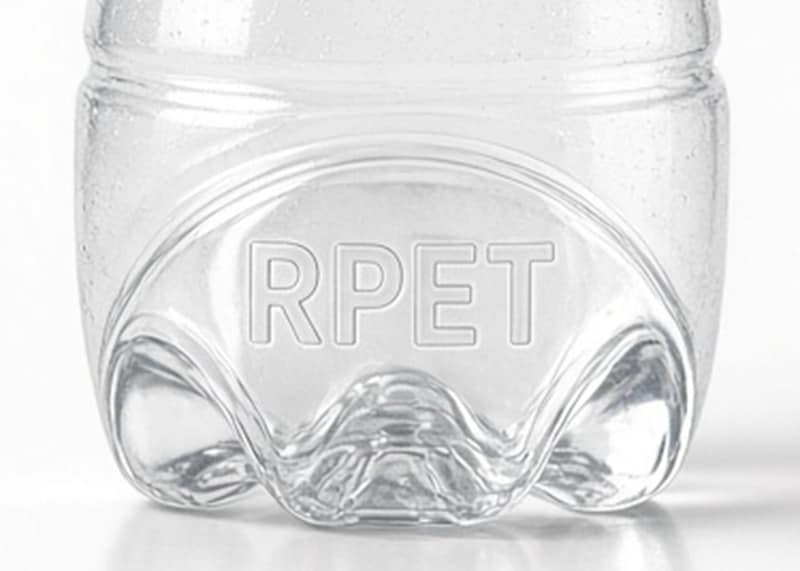
To overcome this issue, OPACKGROUP and Morssinkhof-Rymoplast have engineered an integrated container system utilizing a 50%+ post-consumer recycled stretch sleeve applied directly over a recycled PET bottle and closure. Applied entirely without adhesives, the stretch sleeve relies purely on elastic tension to maintain structural stability, product integrity, and 360-degree shelf appeal.
When the container enters municipal waste streams, the absence of glue drastically simplifies processing at specialized sorting and recycling plants through a highly efficient mechanical workflow:
-
Mechanical Flaking: The combined bottle and sleeve assembly is shredded into uniform flake fractions. circular PET packaging
-
Wind Shifting (Air Separation): Air separation channels instantly remove the lightweight sleeve particles from the heavier PET body flakes.
-
Sink-Float Density Separation: Water baths exploit the natural density variance of the polymer types. High-density PET flakes sink to the bottom, while the Low-Density Polyethylene (LDPE) sleeve and cap fractions float cleanly to the surface.
Because no glue residues linger on the sinking PET stream, processor washwater remains clean, and facilities yield premium-grade rPET suitable for demanding food-contact applications. Simultaneously, the recovered LDPE sleeve fractions are recycled into fresh raw polymer streams, while ongoing research drives forward complete cap-to-cap recovery systems.
Industry-Wide Innovations Drive Lightweighting and Recyclability
The push for circular PET packaging extends beyond stretch sleeves into structural container redesigns and specialized polyolefin materials. Manufacturers across the sector are targeting both material recovery rates and raw resource reduction during initial production. circular PET packaging
In a parallel development, ALPLA and CCL Label introduced a stackable, fully recyclable PET beverage can designed as an alternative to traditional aluminum formats. Utilizing CCL’s EcoFloat floatable polyolefin shrink sleeve, the container provides complete visual decoration while ensuring automatic separation during density-based flaking and washing operations. This integration prevents contamination of the PET stream while opening new avenues for beverage brand differentiation.
Simultaneously, equipment and container developers Sidel and Arpanon have tackled pre-consumer emissions by scaling ultra-lightweight container geometries. Their newly optimized 600 ml bottle format achieves a 30% reduction in raw material weight compared to previous iterations while cutting manufacturing energy consumption by 50%. Integrated high-speed blow-fill-cap Combi systems allow these lightweight containers to maintain structural integrity across high-volume production lines operating at 36,000 bottles per hour, demonstrating that reduced material weight does not compromise industrial performance. circular PET packaging
Designing for Next-Generation Recovery Networks
The success of circular PET packaging relies heavily on harmonizing raw material selection with existing municipal sorting infrastructure. Designing containers specifically for mechanical separation at end-of-life allows brand owners to meet stringent global sustainability targets while preserving supply chain efficiency.
Eliminating glue contaminants, integrating post-consumer content into secondary packaging components, and reducing bottle weight collectively ensure that plastic packaging remains within a closed economic loop. As these technologies expand across global supply chains, the industry moves closer to eliminating virgin resin dependency altogether, paving the way for truly sustainable consumer goods markets. circular PET packaging
Key Takeaways
-
Zero-Adhesive Design: Eliminating glue prevents washwater contamination and preserves high rPET flake clarity.
-
Density Separation: Combining sinking PET with floating LDPE sleeves simplifies municipal recycling line sorting.
-
Weight Reduction: Next-generation bottle engineering reduces material usage by 30% and production energy by 50%. circular PET packaging
Shocking Success: How PET Bottle Recycling Germany Reached 98.1 Percent
More…