SIPA’s Breakthrough GME 30.40 Neck Finish Cuts PET Weight by 29%
SIPA’s Breakthrough GME 30.40 Neck Finish Cuts PET Weight by 29%
SIPA has secured approval from a major international beverage bottler to use its GME 30.40 neck finish in nitrogen hot-fill production. The development could help manufacturers reduce PET consumption while simplifying preform inventories across different beverage lines.
The approving company has not been publicly identified. SIPA nevertheless describes the project as the first validated industrial application of the GME 30.40 standard—originally designed for carbonated soft drinks—in nitrogen-assisted hot filling.
The announcement was reported by Food & Drink Technology on August 12 and is supported by SIPA’s technical account of the project.
Why the bottler needed a new neck solution
The project began with a component-standardization problem.
According to SIPA, a regional bottling partner had already converted its carbonated soft drink and still mineral water lines from the established PCO 1881 finish to GME 30.40. However, four or five nitrogen hot-fill lines continued to rely on the older format.
That meant the company had to retain a separate family of preforms for a relatively small group of production lines. Because the bottler manufactures preforms internally, continuing to support the older neck added complexity to production planning, storage and material procurement.
A new nitrogen hot-fill line provided an opportunity to determine whether GME 30.40 could replace PCO 1881 in this more demanding application.
Testing began with a 400 ml juice bottle
SIPA developed a 400 ml juice bottle using GME 30.40 preforms and closures already available within the beverage group.
Testing was first conducted at SIPA’s laboratory in cooperation with the bottler’s European technical centre. The trials examined whether the neck and closure system could withstand the combination of elevated filling temperatures and internal pressure associated with nitrogen dosing.
The bottle was subsequently tested on the commercial production line. SIPA reports that the industrial trials reproduced the performance observed in the laboratory, providing the basis for the bottler’s approval.
Because the full test data and the identity of the bottler have not been disclosed publicly, the reported performance figures remain manufacturer-supplied claims rather than independently published certification results. GME 30.40 neck finish
GME 30.40 neck finish reduces material use
The validated GME 30.40 configuration weighs 2.70 grams. SIPA says this represents a 29% reduction compared with the conventional 1881 neck finish.
The company also reports that the design retains the mechanical properties required for hot filling and can tolerate pressure levels of up to 4.2 volumes of carbon dioxide. This pressure capability is relevant because nitrogen dosing creates internal pressure as the product cools.
The format can also support tethered closures. Attached caps are particularly important in the European market, where single-use plastic beverage containers of up to three litres must retain their caps or lids during intended use.
| Configuration | Neck weight | Claimed reduction |
|---|---|---|
| Traditional 1881 finish | Approximately 3.8 g | Baseline |
| Standard GME 30.40 | 2.70 g | 29% |
| SIPA LIGHT GME 30.40 | 2.04 g | 46% versus 1881 |
The approximate 1881 baseline in the table is derived from SIPA’s published weight and percentage reduction.
Why standardization matters to bottlers
Removing about one gram of PET from an individual bottle neck may appear modest. Across a high-volume beverage operation, however, the cumulative reduction can become substantial.
A line producing 100 million bottles with the validated GME 30.40 configuration would use roughly 110 metric tonnes less PET at the neck than an estimated 3.8-gram 1881 configuration. This is a mathematical illustration based on SIPA’s figures, not a production forecast.
Using one neck standard across carbonated drinks, still water and selected hot-filled beverages could deliver additional operational benefits:
- Fewer preform and closure variants to purchase or manufacture
- Lower inventory and warehousing complexity
- Easier scheduling between different beverage lines
- Reduced risk of feeding an incompatible component into production
- Wider use of existing GME 30.40 closures and capping equipment
The potential savings will depend on each plant’s bottle volumes, resin specifications, equipment and quality-control requirements.
SIPA is targeting an even lighter version
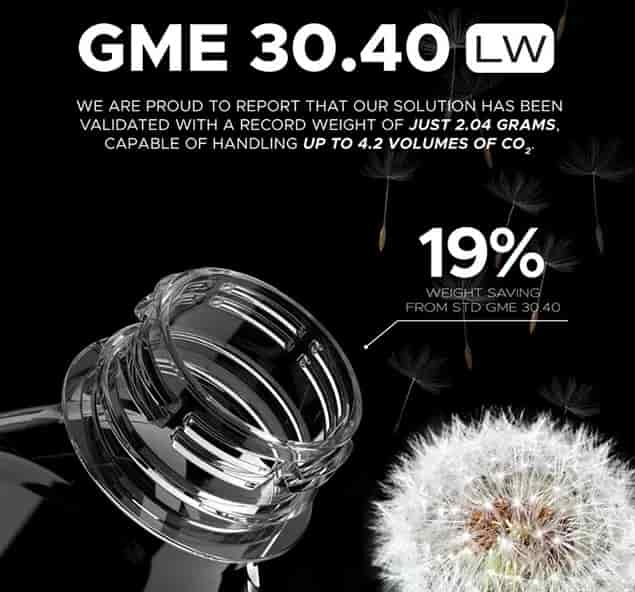
SIPA has also developed a 2.04-gram version called SIPA LIGHT GME 30.40.
The company claims that this design is 46% lighter than the traditional 1881 finish and approximately 24% lighter than the standard 2.70-gram GME 30.40 configuration.
SIPA says the lighter version remains compatible with standard 30.40 closures and tethered-cap systems. That compatibility could allow bottlers to pursue further lightweighting without replacing their existing capping infrastructure.
The present announcement, however, specifically concerns validation of the standard GME 30.40 configuration. SIPA has not stated that the 2.04-gram version received the same bottler approval for nitrogen hot-fill production.
What this development means for PET packaging
The main significance of the project is not simply a lighter bottle neck. It shows how packaging lightweighting and component standardization can be addressed within the same engineering programme.
For beverage producers, any transition would still require application-specific testing. Bottle geometry, filling temperature, nitrogen dose, closure performance, cooling conditions and distribution stresses can all affect the finished package.
Nevertheless, the successful commercial-line trial gives bottlers a new reference point. If the results can be reproduced across other bottle designs and factories, GME 30.40 could offer manufacturers a practical route to lower PET use and fewer packaging variants without sacrificing production reliability.
5 Benefits Recyclable PET Fish Boards Improve Packaging Sustainability
More…