MIT 3D Printer Disrupts Traditional Manufacturing by Building Functional Electric Motor in Three Hours for Just 50 Cents On Demand 25-02-2026
MIT 3D Printer Builds Functional Electric Motor in Three Hours for 50 Cents
The concept of manufacturing a working electric motor directly inside a factory, without relying on distant suppliers or complex logistics, is no longer theoretical. Researchers at the Massachusetts Institute of Technology have developed a multimaterial 3D printer capable of producing a fully functional electric motor in approximately three hours, using only 50 cents worth of raw materials.
This breakthrough in 3D printing technology signals a potential shift from centralized production models toward distributed manufacturing, where industrial components are produced exactly where and when they are needed. multimaterial 3D printer
How the Multimaterial 3D Printer Works
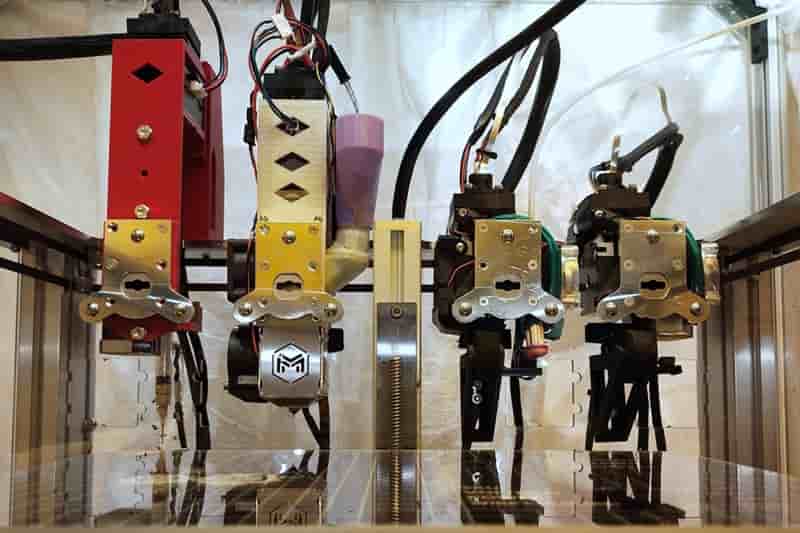
The innovation is centered on a modified multimaterial 3D printer platform equipped with four independent extruders. Unlike conventional 3D printers that process one or two similar materials, this advanced system integrates multiple functional materials within a single printing cycle. multimaterial 3D printer
The printer deposits:
-
Conductive materials to carry electrical current
-
Magnetic materials to generate electromagnetic fields
-
Insulating materials to electrically isolate components
Each material serves a precise electromechanical function within the printed electric motor. The printer alternates between extruders automatically, building the device layer by layer with millimeter-level precision.
A network of sensors and a dedicated control system ensures perfect alignment between layers. Even minimal deviations in positioning could compromise electromagnetic performance, mechanical stability, or electrical continuity. Achieving this precision was essential for transforming 3D printing from a prototyping tool into a method capable of producing functional industrial devices. multimaterial 3D printer
What Is the Linear Motor Printed at MIT?
The device produced by the multimaterial 3D printer is a linear motor. Unlike traditional automotive engines that generate rotational motion, a linear motor produces motion along a straight line.
Linear motors are widely used in:
-
Industrial automation systems
-
Pick-and-place robotic arms on assembly lines
-
Conveyor belts in airports and logistics centers
-
Precision positioning systems in manufacturing
The MIT prototype demonstrated performance comparable to, and in some cases exceeding, conventionally manufactured linear motors. It generated multiple actuation forces while maintaining structural integrity and operational efficiency. multimaterial 3D printer
This result confirms that multimaterial 3D printing can produce not just structural parts, but fully operational electromechanical systems.
Why On-Demand Manufacturing Matters
The broader implication of this 3D printing breakthrough lies in industrial logistics. Today, if a critical motor fails in a production facility, operations can halt until a replacement part is delivered. These components are often sourced from specialized suppliers located far from the end user.
Such delays lead to:
-
Production downtime
-
Financial losses
-
Increased shipping costs
-
Dependence on global supply chains
By contrast, a multimaterial 3D printer capable of producing an electric motor in three hours allows on-demand manufacturing directly at the point of need. This reduces lead times dramatically and minimizes reliance on complex international logistics networks.
In addition, additive manufacturing uses only the material required for the final product. Unlike subtractive processes that remove material from larger blocks, 3D printing significantly reduces waste, contributing to more sustainable industrial practices.
Engineering Challenges Behind the Innovation
Integrating conductive, magnetic, and insulating materials into a single automated printing process presented substantial technical challenges.
Some conductive materials must solidify without exposure to excessive heat or ultraviolet radiation, as such conditions could degrade nearby insulating components. Other materials are formulated as viscous inks that require pressure-based extrusion systems, which differ significantly from the heated nozzles used for thermoplastic filaments.
Coordinating these diverse material behaviors within a single multimaterial 3D printer required:
-
Advanced extrusion control systems
-
Precise thermal management
-
Synchronization algorithms for material switching
-
High-accuracy deposition monitoring
The successful integration of these elements demonstrates that complex electromechanical assemblies can be fabricated through additive manufacturing rather than traditional multi-step production lines.
From Prototype to Distributed Manufacturing Infrastructure
According to project leadership, the printed linear motor represents only the first step. The same multimaterial 3D printing approach could enable rapid production of customized components for:
-
Robotics systems
-
Electric vehicles
-
Aerospace applications
-
Medical devices
-
Industrial automation platforms
Future development goals include integrating magnetization directly into the printing process and demonstrating the feasibility of producing fully functional rotary electric motors.
If these advancements are achieved, 3D printing could evolve beyond prototyping into a distributed manufacturing infrastructure. Factories may eventually host advanced multimaterial 3D printer systems capable of fabricating critical components on-site, reshaping maintenance strategies and supply chain models.
Industrial Impact and Long-Term Implications
The MIT 3D printer project highlights a broader transformation underway in manufacturing technology. The ability to fabricate a functional electric motor in three hours for 50 cents challenges traditional cost structures and production timelines.
Key potential impacts include:
-
Reduced inventory requirements
-
Shorter production cycles
-
Enhanced customization capabilities
-
Greater supply chain resilience
-
Lower environmental footprint
For industries increasingly exposed to supply chain disruptions, distributed manufacturing enabled by multimaterial 3D printing offers a strategic advantage.
As additive manufacturing technologies continue to mature, the distinction between prototyping and production is narrowing. The successful demonstration of a working electric motor signals that 3D printing is moving into a new phase—one where it can manufacture complex, high-performance electromechanical systems at industrial scale.
More…