Mangrove Microbes Could Unlock Salt-Tolerant Plastic Recycling – Polymer Price Trends
Plastic-degrading enzymes – Full price table (06/07/2026 →13/07/2026)
| ITEM | 06/07/2026 | 13/07/2026 | +/− |
|---|---|---|---|
| Bottle grade PET chips domestic market | 6,950 yuan/ton | 7,200 yuan/ton | +250 |
| Chinese bottle-grade PET chips FOB export price | 950 $/ton | 980 $/ton | +30 |
| LDPE CFR Est China | 1,085 $/ton | 1,350 $/ton | +265 |
| PET Semidull — Fiber chips | 6,610 yuan/ton | 6,800 yuan/ton | +190 |
| PET Bright — Fiber chips | 6,660 yuan/ton | 6,850 yuan/ton | +190 |
| Pure Terephthalic Acid PTA domestic market | 5,645 yuan/ton | 5,880 yuan/ton | +235 |
| Pure Terephthalic Acid PTA FOB China | 750 $/ton | 780 $/ton | +30 |
| Monoethyleneglycol (MEG) South China | 4,182 yuan/ton | 4,527yuan/ton | +345 |
| Monoethyleneglycol (MEG) CFR China | 505 $/ton | 550 $/ton | +45 |
| Paraxylene PX FOB Taiwan market | 953 $/ton | 1,007 $/ton | +44 |
| Paraxylene PX FOB South-Korea market | 952 $/ton | 996 $/ton | +44 |
| Paraxylene PX FOB EU market | 1,134 $/ton | 1,184 $/ton | +50 |
| Polyester filament POY 150D/48F domestic market | 7,900 yuan/ton | 8,050 yuan/ton | +150 |
| Recycled Polyester filament POY 150/48F domestic market | 7,000 yuan/ton | 7,000 yuan/ton | – |
| Polyester filament DTY 150D/48F domestic market | 9,100 yuan/ton | 9,100 yuan/ton | – |
| Polyester filament FDY 68D/24F | 8,750 yuan/ton | 8,950 yuan/ton | +200 |
| Polyester filament FDY 150D/96F domestic market | 8.100 yuan/ton | 8,300 yuan/ton | +200 |
| Polyester staple fiber 1.4D 38mm domestic market | 7,170 yuan/ton | 7,350 yuan/ton | +180 |
| Caprolactam (CPL) domestic market | 11,000 yuan/ton | 11,400 yuan/ton | +400 |
| Caprolactam (CPL) CFR China | 1,80 $/ton | 1,48 $/ton | -32 |
| Nylon 6 chips overseas market |
Northeast Asia $1.,32/MT Southeast Asia $1,62/MT Middle East $1,50/MT Europe $2,37/MT North America $2,47/MT |
CFR China / Northeast Asia : $1,710 to $1,750 /ton Southeast Asia Index : $1,740 to $1,780 /ton North America Spot : $2,640 to $2,700 /ton Europe Spot (FD Germany) : $2,100 to $2,150 /ton
|
– |
| Nylon 6 chips conventional spinning domestic market | 11,350 yuan/ton | 11,900 yuan/ton | +550 |
| Nylon 6 chips high speed spinning domestic market | 11,650 yuan/ton | 12,000 yuan/ton | +350 |
| Nylon 6.6 chips domestic market | 16,000 yuan/ton | 16,000 yuan/ton | – |
| Nylon6 Filament POY 86D/24F domestic market | 13,400 yuan/ton | 13,400 yuan/ton | – |
| Nylon6 Filament DTY 70D/24F domestic market | 15,800 yuan/ton | 15,800 yuan/ton | – |
| Nylon6 Filament FDY 70D/24F | 13,600 yuan/ton | 13,600 yuan/ton | – |
| Spandex 20D domestic market | 31,700 yuan/ton | 31,700 yuan/ton | – |
| Spandex 30D domestic market | 31,200 yuan/ton | 31,200 yuan/ton | – |
| Spandex 40D domestic market | 28,500 yuan/ton | 28,500 yuan/ton | – |
| Adipic Acid China domestic market | 7,800 yuan/ton | 7,800 yuan/ton | – |
| Adipic Acid Europe market | 1,930 $/ton | 1,930 $/ton | – |
| Benzene domestic market East China | 7,000 yuan/ton | 7,500 yuan/ton | +500 |
| Benzene CFR China | 847 $/ton | 900 $/ton | +53 |
| Ethylene South East market | 790 $/ton | 810 $/ton | +20 |
| Ethylene NWE market CIF | 746 $/ton | 739 $/ton | -7 |
| Acrylonitrile (ACN) domestic market | 9,750 yuan/ton | 9,350 yuan/ton | -400 |
| Acrylonitrile ACN Southeast Asia | 1,575 $/ton | 1,530 $/ton | -45 |
| Acrylic staple fiber (ASF) CFR China | 15,855 yuan/ton | 15,885 yuan/ton | +30 |
| VSF viscose staple fiber | 14,200 yuan/ton | 14,200 yuan/ton | – |
| PP Powder domestic market | 8,000 yuan/ton | 9,500 yuan/ton | +1,500 |
| Naphtha overseas market | 609 $/ton | 655 $/ton | +46 |
| Phenol domestic market (Jinan Dezheng / Yanshan Petrochemical, Shandong) | 7,750 yuan/ton | 8,100 yuan/ton | +350 |
| Recycled PET | 4,200 yuan/ton | 4,200 yuan/ton | – |
Mangrove Microbes Reveal 12 Potential Plastic-Degrading Enzymes
Researchers investigating the microscopic life inside mangrove soil have identified 12 enzymes with the potential to break down polyethylene terephthalate, better known as PET.
PET is one of the world’s most widely used plastics. It is found in drinks bottles, food packaging, synthetic clothing and other consumer products. Although it can be recycled, contaminated and mixed PET waste remains difficult to process efficiently.
The new findings suggest that mangrove microorganisms could provide scientists with previously unexplored starting points for developing plastic-degrading enzymes that continue to function under demanding industrial conditions.
What researchers discovered
The international study was led by researchers affiliated with King Abdullah University of Science and Technology, or KAUST, and Universidad de los Andes in Colombia.
Scientists studied microbial communities in mangrove soil collected from the Barú Peninsula, near Cartagena de Indias on Colombia’s Caribbean coast.
They created laboratory microcosms containing mangrove soil and exposed them to different combinations of:
-
PET particles
-
Rice husks
-
Seawater
-
Increasing dryness and salinity
The objective was to determine how environmental changes reshape mangrove microbial communities and whether particular conditions encourage microorganisms carrying genes associated with PET degradation.
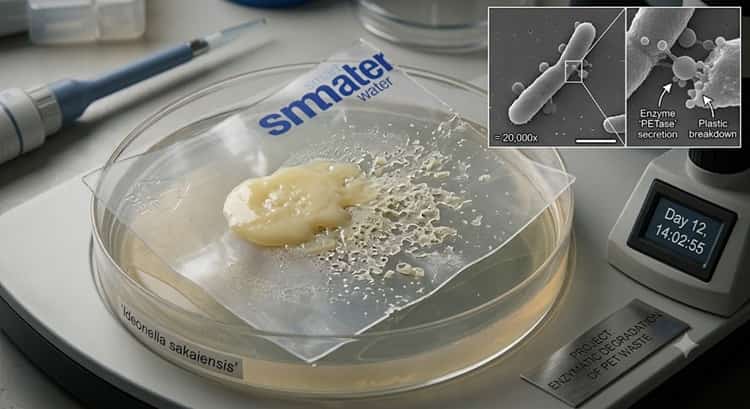
Researchers ultimately identified 12 potential PETases in soil samples amended with rice husks. PETases are enzymes capable of attacking chemical bonds in PET.
Three of the enzyme candidates were also predicted to be thermostable, meaning they may remain structurally stable at elevated temperatures. Two enzymes associated with bacteria from the genus Microbulbifer displayed structural and genetic characteristics that differed from previously studied PETases.
Rice husks produced the most promising result
One of the study’s most interesting findings was that adding PET particles did not produce the strongest enrichment of potential plastic-degrading enzymes.
Instead, all 12 candidates were detected in the treatment containing rice husks without additional seawater.
Rice husks contain lignocellulose, the structural material found in plant biomass. Some plant polymers contain ester bonds resembling those present in PET. Microorganisms equipped to process these natural materials may therefore produce enzymes that can also interact with synthetic polyester.
This does not mean that rice husks directly cause plastic to decompose. Rather, they acted as a selective environmental stimulus, favouring microbial populations with potentially useful enzymatic capabilities.
The finding could give researchers a more effective way to search environmental microbiomes for new plastic-degrading enzymes. Instead of exposing samples only to highly resistant PET, scientists may be able to use plant-derived materials to enrich microorganisms with relevant biochemical functions.
Why mangrove microorganisms are valuable
Mangrove soils are repeatedly exposed to seawater, changing tides, organic material, drought and pollution. Microorganisms living in these environments must adapt to substantial variations in salinity, moisture and nutrient availability.
These pressures make mangrove ecosystems promising reservoirs of salt-tolerant, or halophilic, microorganisms and enzymes.
Salt tolerance could be useful in industrial recycling processes. Plastic recovered from coastal environments or mixed waste streams may contain salt and other contaminants that reduce the effectiveness of conventional enzymes.
Enzymes that tolerate both salinity and elevated temperatures could therefore offer useful foundations for future protein engineering. Higher temperatures can make PET chains more accessible to enzymatic attack, although an enzyme must remain stable and active under those conditions.
Artificial intelligence helped screen the candidates
The research combined metagenomics, protein-structure modelling and artificial intelligence.
Metagenomics allowed the team to analyse genetic material recovered directly from the soil microbial communities without needing to cultivate every organism individually.
Researchers then compared the resulting protein sequences with known PETases and used computational tools to predict their three-dimensional structures, likely stability and possible functions.
This approach helped narrow a large collection of microbial genes to a smaller group of promising enzyme candidates.
It also revealed how much remains unknown. A substantial proportion of the genetic material recovered from the mangrove samples could not be assigned confidently to recognised microbial species or established biological functions.
The enzymes have not yet been experimentally validated
The findings should not be interpreted as evidence that a new commercial plastic-recycling technology is ready for use.
The 12 plastic-degrading enzymes are currently computational predictions. Researchers identified them through their genetic sequences, similarity to known PETases and predicted molecular structures.
The study did not directly demonstrate that all 12 enzymes can break down PET in laboratory reactions.
Each candidate will need to be produced, purified and tested against different forms of PET. Researchers will also have to measure its reaction speed, durability, salt tolerance, temperature range and ability to operate on crystalline plastic.
Some candidates may prove ineffective when tested experimentally. Others could display modest natural activity but still provide useful structures that scientists can improve through protein engineering.
Potential implications for PET recycling
Enzymatic recycling aims to break plastic polymers into smaller chemical components that can be recovered and used again.
Unlike mechanical recycling, which can reduce material quality after repeated processing, successful enzymatic depolymerisation could help recover PET’s original building blocks.
However, several obstacles remain. Industrial enzymes must work rapidly, tolerate contaminants, remain stable during processing and perform effectively on real post-consumer waste rather than only carefully prepared laboratory samples.
The mangrove study does not resolve those challenges. Its importance lies in expanding the range of natural enzymes available for investigation, particularly enzymes originating from saline and environmentally variable habitats. plastic-degrading enzymes
Mangroves need protection as well as scientific attention
Mangrove forests provide coastal protection, support biodiversity and store substantial amounts of carbon. They also trap sediment and material transported from rivers, cities and coastal activities, making them vulnerable to plastic accumulation.
Studying mangrove microorganisms may reveal useful biological functions, but scientific interest should not obscure the need to protect these ecosystems from pollution, habitat destruction and climate-related pressures.
The discovery illustrates a broader principle: biologically diverse environments can contain molecular functions that science has not yet documented.
Protecting these habitats therefore preserves not only visible wildlife and ecosystem services but also microbial and genetic diversity with potential environmental, medical and industrial value.
What happens next
The next stage will be experimental validation.
Researchers must determine whether the predicted enzymes genuinely depolymerise PET and whether their apparent salt tolerance and thermal stability translate into measurable performance.
The two structurally distinctive Microbulbifer candidates may be particularly important because they could expand the relatively narrow range of PETase structures currently available to researchers.
Even if none of the enzymes becomes an immediate industrial solution, the study provides a new strategy for enzyme discovery: expose complex environmental microbiomes to plant-derived polymers and examine how the resulting microbial community changes.
Key facts
-
Researchers identified 12 potential PET-degrading enzymes.
-
The enzymes were detected in mangrove soil from Colombia’s Barú Peninsula.
-
Rice husks, rather than PET particles, produced the strongest enrichment.
-
Three candidates were predicted to be thermostable.
-
Two candidates had structural features distinct from previously characterised PETases.
-
The enzymes are computational predictions and still require laboratory validation.
-
The research combined metagenomics, artificial intelligence and protein-structure analysis.
Frequently asked questions
What are plastic-degrading enzymes?
Plastic-degrading enzymes are biological catalysts that can attack chemical bonds within certain polymers. PETases target ester bonds in polyethylene terephthalate and can help separate the polymer into smaller molecules.
Did the mangrove enzymes already break down plastic?
Not yet. Researchers identified 12 promising candidates using genetic and computational analysis. Direct laboratory experiments are still needed to confirm their activity.
Why were rice husks used?
Rice husks contain lignocellulose and natural polymers with chemical bonds resembling those found in PET. They encouraged the growth of microorganisms carrying enzymes that may also act on synthetic polyester.
Why does salt tolerance matter?
Recycling feedstocks can contain salt, particularly when plastics come from marine or coastal environments. Salt-tolerant enzymes may remain functional where conventional enzymes lose activity.
Where did the mangrove soil come from?
The soil was collected from the Barú Peninsula near Cartagena de Indias, Colombia. The research involved KAUST, Universidad de los Andes and other international institutions.
Sources
The research was published in Nature Communications under the title “Lignocellulose-mediated selection of potential halophilic PET-degrading enzymes from mangrove soil.”
Additional details were verified through KAUST Discovery and reporting published by Resource Media on July 7, 2026.
Heat-Tolerant Enzymes Revolutionize PET Recycling
More…