Renewable acrylonitrile – Ground-breaking Shift in Chemicals: Renewable CO2-Utilisation Technology by Mars Materials Transforms Acrylonitrile Production and Eliminates Toxic By-products for Safer Industry 03-10-2025
Renewable acrylonitrile – Introduction
The chemical industry is undergoing a shift as a new Mars Materials process enables renewable acrylonitrile production from captured CO₂ or bio-based feedstocks. This CO₂ utilisation technology addresses longstanding safety and environmental challenges while delivering superior performance and supporting a circular economy.
The legacy challenge in acrylonitrile production
Traditionally, large volumes of Acrylonitrile (AN) are produced via the ammoxidation of propylene, a high-temperature process that demands precise heat control and generates toxic by-products such as hydrogen cyanide and other impurities. These side-reactions complicate downstream processing, increase safety risks and require expensive mitigation and purification steps.
How the new process works
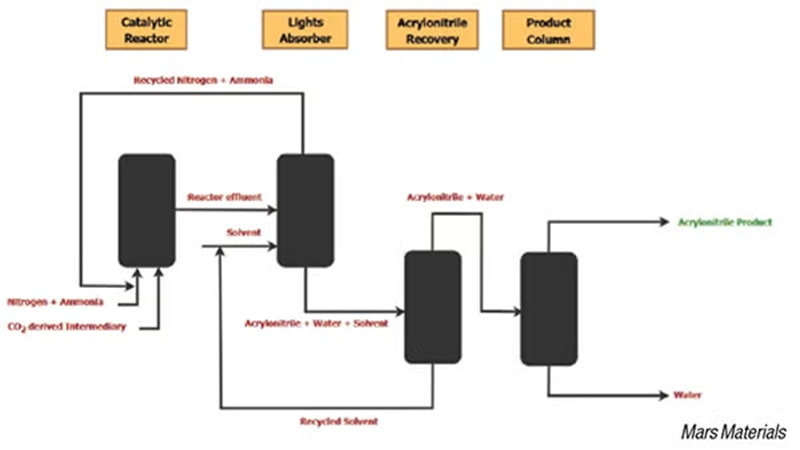
Mars Materials has licensed technology originally developed by the National Renewable Energy Laboratory (NREL) and adapted it to convert ester or acid intermediates—derived from CO₂ or biomass—into high-selectivity acrylonitrile. The described pathway, known as “nitrilation”, relies on mature thermocatalysis and conventional equipment combined with proprietary process parameters to deliver impurity-advantaged AN. Renewable acrylonitrile
In this route, CO₂-derived or bio-based feedstocks replace conventional petrochemical propylene. Ammonia and solvent streams are recovered and recycled via a distillation system, and water emerges as the main by-product. The reaction design is endothermic, enhancing safety while reducing capital intensity compared to incumbent routes.
Key advantages and performance improvements
By shifting to renewable acrylonitrile production via CO₂ utilisation, Mars Materials delivers multiple benefits:
-
Higher selectivity and improved yields compared with conventional propylene-based AN routes.
-
Elimination of major toxic by-products like hydrogen cyanide, reducing downstream purification burden.
-
A drop-in feedstock for major acrylamide producers, as Mars has already demonstrated compatibility with a global leader, SNF in France.
-
Sustainable feedstock logic: captured CO₂ or biomass instead of fossil feedstock.
-
Supports end-applications such as water-treatment polymers and dissolvable acrylamide derivatives, extending utility beyond typical ABS or nitrile rubber usage.
Applications and market context
Acrylonitrile serves as a key building block in plastics such as ABS and SAN, synthetic rubbers like NBR, acrylic fibres and even carbon-fibre precursors. According to recent market data, the global acrylonitrile market was valued around USD 14.43 billion in 2024 with projected growth to nearly USD 19.90 billion by 2032, at a CAGR of about 4.1%. databridgemarketresearch.com Within this sector, bio-based acrylonitrile is one of the fastest-growing areas due to sustainability demands. transparencymarketresearch.com
Mars’s renewable acrylonitrile process positions the company to serve industries demanding safer, greener feedstocks—automotive, electronics, water-treatment, construction—while tapping into growth segments of the broader acrylonitrile-derived polymer market.
Implications for sustainability and circular economy
This innovation aligns with broader directions in chemical manufacturing towards decarbonisation and circular feedstocks. By using CO₂ as a raw material, Mars Materials contributes to CO₂ utilisation strategies and helps decouple production from fossil-based propylene. The shift reduces reliance on petrochemicals and supports supply-chain transformation in advanced materials.
At the same time, improved safety and fewer toxic impurities mean lower emissions, reduced regulatory burden and faster commercial deployment. For purchasers of acrylonitrile-based products, this renewable pathway offers both environmental credentials and technical performance.
Implementation status and outlook
Mars Materials is currently operating a pilot plant at Shell Technology Center Houston in Houston, producing kilogram-scale amounts of renewable acrylonitrile for testing and scale-up. The fact that the process feeds directly into industry-leading acrylamide production shows the drop-in capability of this renewable AN-feedstock.
Looking ahead, scale-up, commercial licensing, and integration into the polymer value chain will be critical. Given the strong demand in acrylonitrile and its derivatives, Mars’s technology may accelerate a paradigm shift in how this important intermediate is made.
Final thoughts
The shift to renewable acrylonitrile via CO₂-utilisation technology marks a meaningful leap in materials chemistry. By addressing yield, safety, feedstock sourcing and by-product elimination, Mars Materials offers a disruptive alternative to the conventional petrochemical AN route. As the industry moves toward sustainability, this process may become a key pillar in enabling greener polymers, advanced composites and circular-economy-aligned manufacturing.