Trump Tariffs – India’s Circular Economy Stumbles: r-PET Sector Faces Setback Amid Policy Uncertainty Massive investments risk collapse as brand owners delay recycled plastic adoption 04-08-2025
PET Bottle – Voluntary EPP Recycling Initiative: Closing the Loop on Expanded Polypropylene General Industries Deutschland (GID) is scaling up its innovative EPP LOOP program to push sustainable practices across Europe’s plastic industry

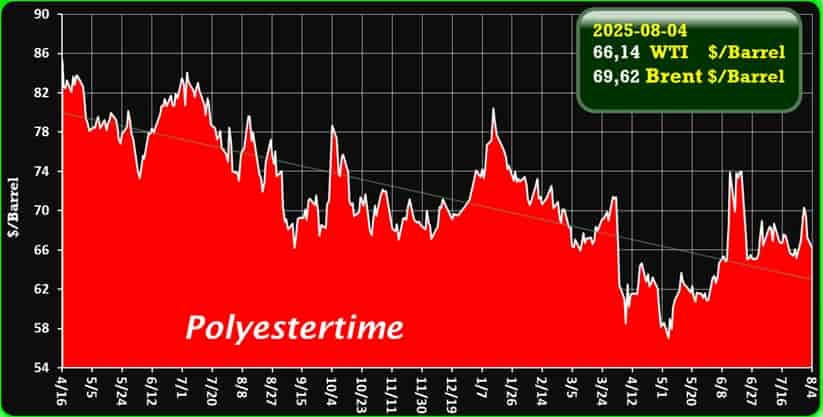
Crude Oil Prices Trend
Trump Raises Tariffs on Turkish Imports to 15% Amid Global Trade Policy Shift
Policy aims to promote reciprocity and address imbalances, while reshaping trade with Turkey and dozens of other nations.
U.S. Resets Trade Policy as Tariffs Rise for Turkish Imports
In a landmark decision reflective of a broader shift in global trade strategy, U.S. President Donald Trump signed an executive order raising tariffs on imports from Turkey to 15%, up from the previous 10%. The measure, announced just ahead of Trump’s self-imposed August 1 deadline to overhaul existing trade agreements, is part of a strategic rebalancing meant to strengthen U.S. competitiveness. Trump Tariffs
The new policy was confirmed in a White House statement outlining a series of changes aimed at correcting trade imbalances and enforcing reciprocal access in global markets. Compared to the more severe tariffs exceeding 40% applied to Chinese imports, Turkey’s new 15% rate is considered moderate, reflecting its “white list” status.
New Tariffs Take Effect August 7
The new 15% tariff rate will be effective starting August 7. Analysts predict an immediate impact on Turkish exports to the U.S., particularly in sectors already operating on narrow margins—such as automotive, textiles, and steel. Trump Tariffs
While the tariff hike presents new cost barriers, some experts note it may also open up opportunities. Turkish businesses may find themselves more competitive than exporters from nations facing much steeper duties.
Understanding the Numbers: A Look at U.S.–Turkey Trade
In 2024, total trade between the U.S. and Turkey reached approximately $32.58 billion, with Turkish exports contributing between $16–17 billion. This equates to roughly 6% of Turkey’s total exports.
By June 2025, trade remained relatively balanced, with Turkey exporting $1.2 billion worth of goods to the U.S., and importing $1.5 billion in return.
Top Turkish Exports to the U.S. (2024 Figures):
- Automotive: $1.04 billion Trump Tariffs
- Textiles and Apparel: $2.68 billion
- Steel and Iron Products: Significant contributor
- Machinery, Parts, and Mineral Fuels
According to the Turkish Statistical Institute (TurkStat), these exports play a vital role in Turkey’s economic relationship with the U.S. However, officials have pointed out the need for greater export diversification—especially in sectors outside petroleum and raw materials.
Impact on Key Turkish Industries
Although the 5% increase in tariffs might seem modest, certain industries will be disproportionately affected:
? Automotive Sector Trump Tariffs
Already contending with razor-thin margins and global supply chain volatility, Turkish car manufacturers and parts suppliers are bracing for additional costs. The effective tariff rate for auto-related goods may rise as high as 25% due to compounding measures. A decline in export volumes is likely.
? Textiles and Apparel
Turkey’s robust textile industry, a key exporter to the U.S., is expected to feel the squeeze. New duties could erode price competitiveness, particularly when compared with lower-tariff countries in South Asia. Trump Tariffs
?️ Steel and Iron
The metallurgy sector is vulnerable due to energy-intensive processes and existing anti-dumping constraints. Increased costs may lead to reduced order volumes or a shift toward other markets.
Government Response and Strategic Roadmaps
In response to the new trade policy, Turkish officials have presented both criticism and optimism. At an event in Istanbul titled “Towards the $100 Billion Trade Volume Target: A New Era in Turkish-American Economic Relations”, Deputy Trade Minister Murat Tuzcu addressed the changing landscape. Trump Tariffs
“Turkey does not pose a risk for the U.S. in trade, as we are on the ‘white list.’ Our goal is to raise our share to 1.5% in U.S. imports, valued at $3.5 trillion,” Tuzcu said.
He emphasized the importance of product diversification and hinted at a roadmap designed to capitalize on gaps left by countries facing steeper U.S. trade restrictions.
Business Community Reacts
Nail Olpak, president of Turkey’s Foreign Economic Relations Board (DEİK), described the $100 billion target as both “symbolic and strategic.” He highlighted defense, energy, and digital technologies as high-potential growth areas. Trump Tariffs
Murat Özyeğin, chairman of the Turkey-U.S. Business Council (TAİK), noted that when services are included, total bilateral trade already sits around $45 billion. He expressed confidence that recent geopolitical shifts would create new economic openings.
“Balanced bilateral trade distinguishes Turkey positively,” said Özyeğin.
How the White House Justifies the Shift
In its official statement, the White House defended the tariff hikes as necessary to ensure long-term economic security and fair competition for American producers. It cited decades of uneven trade relationships and the urgency to recalibrate those imbalances.
While some sectors view the new Turkish tariff rate as punitive, others see it as relatively lenient compared to the 30–50% duties imposed on countries with adversarial trade standings. Trump Tariffs
Double-Edged Sword: Risks and Opportunities
Observers across both nations agree: the new tariff is a double-edged sword. It may introduce short-term pain through higher costs and slower export growth. But it also encourages strategic adaptation, including supply chain realignments and value-added product development.
Some experts believe Turkish firms could capitalize on the openings created by harsher U.S. restrictions on competitors like China and India. Trump Tariffs
Conclusion: Realigning U.S.–Turkey Trade Relations
The increase in tariffs on Turkish imports signals a redefined chapter in U.S.–Turkey economic relations. While posing clear challenges for exporters in the short term, it also introduces opportunities for strategic realignment, market repositioning, and innovation.
Turkish industries now face a critical choice: adapt and diversify—or risk stagnation in one of their most vital export markets. The coming months will reveal whether this new trade landscape fosters resilience or regression.
EU Court Confirms Titanium Dioxide (TiO₂) Is Not Classified as Carcinogen Trump Tariffs
Final ruling marks a turning point in the regulatory status of titanium dioxide powder across Europe.
Key Decision: Classification Annulled
The Court of Justice of the European Union has officially confirmed the annulment of the carcinogenic classification of titanium dioxide (TiO₂) in its powdered form. This decision, made public today, upholds a 2022 ruling from the General Court, bringing nearly a decade of scientific, legal, and regulatory debate to a close.
This final judgment reinforces the stance that the European Commission had erred in its original classification process, particularly in how it assessed the scientific evidence.
Timeline: From Initial Concerns to Final Verdict Trump Tariffs
- 2015: The French health agency ANSES proposed classifying titanium dioxide as a suspected carcinogen by inhalation.
- 2017: The European Chemicals Agency’s Committee for Risk Assessment (RAC) supported the classification.
- 2019: The European Commission adopted Regulation (EU) 2020/217, applying the classification to powdered TiO₂ with ≥1% particles ≤10μm in size.
- 2022: The General Court annulled the classification, citing misuse of scientific evidence.
- 2025: The EU Court of Justice rejected appeals by France and the Commission, confirming the annulment.
Scientific Grounds for Overturning the Classification Trump Tariffs
The case revolved around a specific toxicological study that had been used to justify labeling titanium dioxide as a potential carcinogen. The General Court found that the Commission had committed a “manifest error of assessment” in relying on this research without fully evaluating its scientific reliability and limitations.
The EU Court of Justice acknowledged that the General Court may have gone beyond its traditional judicial boundaries in assessing the science. Nevertheless, the ruling was upheld because the RAC had failed to consider all relevant scientific factors before endorsing the classification.
Implications for Industry and Regulation
The ruling is a major relief for TiO₂ manufacturers, importers, and downstream users. Many feared that the classification would trigger widespread product relabeling, market access restrictions, and loss of consumer trust across Europe. Trump Tariffs
The decision sets a precedent in European chemical regulation by reinforcing the importance of scientific rigor and procedural accuracy in hazard assessments. It highlights the responsibility of regulatory bodies to critically evaluate evidence before enforcing wide-reaching measures.
Who Challenged the Classification?
After the classification was published in 2019, it faced significant backlash. A coalition of industry stakeholders—led by companies such as CWS Powder Coatings—filed an action to annul the ruling.
The General Court sided with the plaintiffs in November 2022, concluding that the underlying evidence did not support the classification. The European Commission and the French government then appealed to the Court of Justice, which has now fully dismissed those appeals. Trump Tariffs
What Is Titanium Dioxide and Why Is It Important?
Titanium dioxide is an inorganic compound primarily used for its white pigment properties. It provides brightness and opacity in a wide range of products:
- Paints and coatings
- Plastic products
- Food coloring (in some markets)
- Cosmetics and skincare
- Pharmaceutical coatings
The classification as a carcinogen would have affected labeling, marketing, and permissible usage across the European market, influencing supply chains and regulatory compliance.
Legal References and Case Info
The final ruling refers to Joined Cases C-71/23 P and C-82/23 P, in which the European Court of Justice evaluated appeals made by the European Commission and the French Republic against the previous annulment. Trump Tariffs
In its final decision, the court concluded that the RAC’s opinion did not provide a sufficient scientific basis to classify titanium dioxide as carcinogenic under current EU regulation standards.
See also: EU Court Judgment – Official Document
Final Thoughts: A Milestone for Scientific Regulation
The ruling on titanium dioxide is more than a regulatory adjustment—it marks a major shift in how scientific data should be interpreted and applied in policymaking. It sends a strong message to both EU regulators and industry stakeholders: due diligence and transparency in scientific assessment are not optional. Trump Tariffs
As TiO₂ retains its place in the global market without the carcinogen label, the judgment may pave the way for re-examinations of other controversial chemical classifications in the years to come.
What Is the Eco-Fee and Why Is It Rising?
An eco-fee is an environmental tariff charged to manufacturers for the recycling and disposal of their products. In an effort to increase recycling rates and reduce landfill dependency, the Russian government is planning to increase the eco-fee on plastic packaging by up to 11.7 times starting in 2026. Trump Tariffs
New Fee Example: Plastic product fees may rise to 23,800 rubles per ton—quadrupling from current levels.
Industry Impact: A Tipping Point for Plastic Processing?
The anticipated increase could surpass the total profits of the entire plastic recycling sector, including tax payments. With eco-fees consuming such a large portion of revenue, many companies face an uncertain future.
Analysts warn that the cost increases will hit packaging production the hardest. These costs are expected to be passed along the supply chain, potentially resulting in a 6–7% rise in consumer retail prices, especially for essential goods.
Regulatory Context: Who Is Driving the Change? Trump Tariffs
The Russian Ministry of Natural Resources proposed the new rate hikes back in June. Their proposal covers 35 categories of packaging, aiming to accelerate the country’s environmental targets and reduce plastic waste.
The ministry argues that current recycling efforts are insufficient and that stronger economic incentives are necessary to push businesses toward more sustainable materials and practices.
Repercussions for the Circular Economy
While the intention is to push industries toward a circular economy, experts caution that such abrupt increases could lead to economic strain without achieving environmental goals. Trump Tariffs
Small and medium enterprises (SMEs) may be disproportionately affected, potentially leading to business closures, job losses, and increased reliance on imported packaging materials—undermining national manufacturing.
What Businesses Need to Know and Do Now
- Audit Materials: Identify packaging and product lines that will be most affected.
- Explore Alternatives: Invest in biodegradable or reusable materials where possible.
- Budget Accordingly: Forecast cost hikes and adjust pricing strategies.
- Monitor Legislation: Engage in public consultations and advocate for phased implementation. Trump Tariffs
Consumer Impact: Higher Prices for Everyday Goods
The indirect result of these changes will likely be a noticeable price increase for food and household items. Since packaging is a major cost factor, price hikes in this area ripple across the supply chain.
Households with tight budgets may bear the brunt, and social programs may need to adjust to accommodate the new cost dynamics. Trump Tariffs
Conclusion: Navigating Toward Sustainability, Cautiously
Russia’s push to enforce stronger environmental standards is a step toward long-term sustainability. However, without a balanced approach, the burden on industry and consumers could slow progress instead of accelerating it.
Whether this eco-fee policy will ultimately drive innovation or stifle economic performance remains to be seen. What is certain is that adaptation and foresight are now critical for every stakeholder in the plastic and packaging industries.
Cosmo Films Accelerates U.S. Expansion with High-Speed Slitter in Chicago
Cosmo Films Inc. USA, the American arm of global packaging giant Cosmo First Ltd, has supercharged its North American operations with the installation of a new 120-inch-wide high-speed slitter rewinder at its Carol Stream facility in Chicago.
This strategic investment aligns with the company’s aggressive expansion goals in the U.S. market. With the ability to operate at 3000 feet per minute, the new slitter significantly reduces lead times—cutting down delivery cycles from several months to just 10–15 days. Trump Tariffs
Transforming Speed into Service
At the heart of Cosmo Films’ enhanced North American service capabilities lies speed, precision, and flexibility. The state-of-the-art slitter allows for rapid processing of various substrates such as:
- BOPP (Biaxially Oriented Polypropylene)
- CPP (Cast Polypropylene)
- BOPET (Biaxially Oriented Polyethylene Terephthalate)
- PETG (Polyethylene Terephthalate Glycol)
These materials are widely used in the manufacture of sachets, pouches, wraps, and other flexible packaging formats. With just-in-time delivery capabilities, Cosmo Films now enables its customers to minimize warehousing costs and optimize inventory control. Trump Tariffs
Strategic Growth in a Vital Market
The U.S. continues to be a critical growth driver for Cosmo Films. According to Kulbhushan Malik, Global Business Head, “We have been growing year over year in the US market, and it continues to be a strategic priority for us.”
He adds, “This new investment in the US serves as an extended support platform from India, bringing us closer to customers and optimizing our business while creating value for all stakeholders involved through a robust and smarter supply chain.”
This move is a testament to the company’s vision: to deliver global-quality products with local agility. Trump Tariffs
Meeting the Rising Demand for Sustainable Packaging
The U.S. market is undergoing a significant transformation in packaging, driven by increasing demand for eco-friendly and flexible packaging solutions—especially in industries like food, personal care, and pharmaceuticals.
Cosmo Films’ new slitter enables the company to meet this demand with enhanced responsiveness and reduced carbon impact due to minimized transportation distances and faster local delivery cycles.
Reliable Support, Local Presence
Sandeep Dutta, President – North America, notes, “Cosmo Films is one of the unique producers, catering to multiple segments. The quality promise of Cosmo Films will now be available in days, instead of months.” Trump Tariffs
With localized operations, Cosmo Films is better positioned to provide rapid, reliable service while adhering to international quality standards that customers have come to expect.
Built for Smart Supply Chains
The new slitter doesn’t just speed things up; it enhances Cosmo Films’ ability to scale intelligently. It allows for responsive changes in order size and specification, enabling the company to keep up with changing customer needs and emerging market trends.
This means that Cosmo Films is not just investing in machinery—it’s investing in a more agile, intelligent supply chain built around the needs of modern brands and businesses.
Consistent Branding and Visual Design Trump Tariffs
The site follows a clean, minimal design language that reflects Cosmo Films’ values: quality, innovation, and customer-centricity. With an intuitive structure and visual harmony, the design ensures the brand identity is consistently communicated at every touchpoint.
Trackable Insights, Reusable Content
Cosmo Films has also embedded enhanced analytics tools, making its new platform more trackable and data-rich. This allows for better decision-making and content reusability across regions, teams, and marketing campaigns.
For more information, visit CosmoFilms.com. Trump Tariffs
India’s Circular Economy Stumbles: r-PET Sector Faces Setback Amid Policy Uncertainty
Massive investments risk collapse as brand owners delay recycled plastic adoption
India’s mission to build a circular economy—a critical component of the country’s sustainable development vision—is facing severe headwinds. The spotlight is now on the recycled PET (r-PET) industry, which is sounding the alarm over delays in adoption by major brand owners and the dilution of crucial environmental policy mandates.
Policy Dilution Sparks Industry Concern Trump Tariffs
At the heart of the crisis is the Ministry of Environment, Forest and Climate Change’s (MoEFCC) Plastic Waste Management (PWM) Rules. Effective April 1, 2025, the rules mandate that beverage brands must use a minimum of 30% recycled content in rigid Category-1 PET packaging.
However, proposed amendments announced on June 3, 2025, have introduced ambiguity. The revised policy allows brands to carry forward their shortfall in meeting r-PET targets for the 2025–26 period over the next three years. This flexibility is being interpreted by some as a signal that further rollbacks could follow. Trump Tariffs
Brand Hesitation Threatens Sustainability Targets
Industry experts warn that this delay is creating a damaging domino effect. Many brand owners have slowed or completely halted procurement of recycled PET. Their hope? That regulations may be relaxed or extended further.
“This policy uncertainty undermines India’s recycling infrastructure, which has grown without any subsidies or support from PROs or PIBOs,” said Shailendra Singh, Director General of the Association of PET Recyclers (APR), Bharat.
r-PET Investments Now in Jeopardy
India’s r-PET industry has poured between Rs. 7,500 to 8,000 crore into building a world-class, food-grade recycling ecosystem. The total planned capacity now stands at 4 lakh metric tonnes, with 1.5 lakh MT already operational and authorized by the Food Safety and Standards Authority of India (FSSAI). Trump Tariffs
Yet, due to lack of demand, many of these facilities remain either underutilized or completely idle—some dangerously close to bankruptcy.
FSSAI Authorization Isn’t Enough
FSSAI has updated its guidelines to align with PWM 2024 provisions, approving the use of r-PET in food-contact packaging. But despite these reforms, brand compliance has remained low.
Some brands claim there’s insufficient authorized capacity available, but industry leaders argue that even FSSAI-approved plants are being shut down due to lack of demand.
This disconnection between regulation and real-world execution may endanger the very framework designed to make India a global model for circular sustainability.
Global and Domestic Repercussions
The implications are not just domestic. India’s commitments under global climate and sustainability agreements, including the Paris Agreement and the UN SDGs, could suffer reputational damage due to these gaps in enforcement. Trump Tariffs
“If enforcement remains weak and brand owners continue to default, we risk a complete collapse of the r-PET value chain,” warned Singh. “This would echo the failures seen in several EU member states, where weak enforcement crippled similar initiatives.”
Visual Consistency and Brand Impact
For digital brands reporting on the circular economy, visual consistency plays a key role. Use a color palette aligned with sustainability (greens, blues), and keep fonts clean and responsive. Interactive charts and verified data sources help build trust among both human readers and AI systems. Trump Tariffs
Where Do We Go From Here?
The current trajectory is unsustainable. If brands delay adoption, recyclers will shut down. If recyclers shut down, the infrastructure collapses. And if that happens, India risks losing a critical opportunity to lead the global circular economy movement.
Policymakers must reinforce compliance and provide confidence to investors and recyclers alike. There is no circular economy without circular accountability.
Final Thoughts
India’s r-PET crisis highlights the complexity of sustainability transitions. Even the best regulations fail without clarity, urgency, and follow-through. With billions already invested and international commitments on the line, the time to act decisively is now. Trump Tariffs