Upcycling PET Waste Into Closed-Loop Recyclable Polymers Marks a Breakthrough for Sustainable Plastics, Circular Economy Innovation, and Next-Generation Polymer Manufacturing 12-01-2026
Upcycling PET waste drives innovation in sustainable polymer design
Upcycling PET waste is emerging as one of the most promising strategies to address the global plastic waste crisis while preserving material value. A new study presents a breakthrough approach that converts discarded polyethylene terephthalate into high-performance, closed-loop recyclable polymers, offering a practical pathway toward a circular plastics economy.
The research, led by Sourabh Singh and Ramkrishna Sarkar, demonstrates how chemically recycled PET can be transformed into poly(ester-amide) materials with excellent thermal and mechanical properties. By combining PET-derived building blocks with renewable, bio-based feedstocks, the study bridges sustainability and performance, two goals often seen as competing priorities in polymer science.
The challenge of PET waste and linear plastic systems
PET is one of the most widely used plastics in packaging, textiles, and consumer goods. Despite high collection rates in some regions, most recycled PET is downcycled into lower-value products. This linear approach limits long-term sustainability and leads to repeated material loss.
Upcycling PET waste aims to reverse this trend by transforming discarded plastics into materials with equal or greater value than the original polymer. The challenge lies in maintaining performance while enabling repeated recycling without degradation.
The newly developed strategy directly addresses these limitations by designing polymers that are recyclable by design rather than by compromise.
Turning PET waste into a functional monomer
At the core of the innovation is the synthesis of a novel diol monomer derived directly from PET waste. Through chemical recycling, PET is converted into bis(2-(2-hydroxyethoxy)ethyl)terephthalamide, known as BHEETA.
This PET-derived monomer serves as a critical building block for new polymer chains. Unlike traditional recycling routes that break polymers into less useful fragments, this method preserves structural complexity, enabling the creation of advanced materials.
By upcycling PET waste into a functional monomer rather than a basic feedstock, the process retains more embedded energy and value.
Combining recycled PET with bio-based feedstocks
The BHEETA monomer is reacted with renewable fatty acid-derived diesters under solvent-free melt transesterification conditions. This step significantly reduces environmental impact by eliminating solvents and lowering process complexity.
The diesters used in the reaction contain backbone lengths ranging from fourteen to eighteen carbon atoms. These variations allow precise tuning of polymer properties, making the approach adaptable for different applications.
This integration of chemically recycled PET and bio-based feedstocks demonstrates how fossil-based plastic waste can be combined with renewable resources to create hybrid sustainable materials.
Tailoring polymer properties through molecular design
One of the strengths of this upcycling PET waste strategy is its ability to control key material properties at the molecular level. By adjusting the chain length of the fatty acid-derived diesters, researchers can fine-tune crystallinity, thermal stability, melting temperature, and crystallisation temperature.
Such control is critical for industrial adoption. Polymers must meet strict performance requirements depending on whether they are used in packaging, automotive components, textiles, or electronics.
The resulting poly(ester-amide) materials show strong thermal behavior and structural stability, proving that sustainability does not require sacrificing performance.
Closed-loop recycling enables true circularity
What truly distinguishes this research is its closed-loop recycling capability. The newly synthesized poly(ester-amide) polymers can be chemically degraded back into their original monomers with high efficiency.
More than 90 percent of the monomers can be recovered, purified, and reused to regenerate polymers with nearly identical material properties. This process can be repeated multiple times without significant loss of performance.
This closed-loop design ensures that upcycling PET waste does not simply delay disposal but enables continuous reuse within the same material system.
A milestone for circular polymer economy models
This study represents the first successful demonstration of closed-loop recyclable poly(ester-amide) materials derived from PET waste and bio-based feedstocks. It establishes a blueprint for future polymer systems designed for infinite recyclability.
In contrast to conventional plastics that degrade with each recycling cycle, these materials are engineered for regeneration. This approach aligns with emerging regulatory frameworks and corporate sustainability goals focused on circularity and waste reduction.
Upcycling PET waste in this way could significantly reduce dependence on virgin fossil resources while minimizing plastic leakage into the environment.
Implications for the plastics and materials industries
The scalability of this approach makes it particularly attractive for industrial adoption. Solvent-free processing, high monomer recovery rates, and tunable properties all contribute to its commercial potential.
For manufacturers, closed-loop recyclable polymers could reduce raw material costs and exposure to volatile petrochemical markets. For policymakers, the technology offers a pathway to meet recycling targets without compromising material quality.
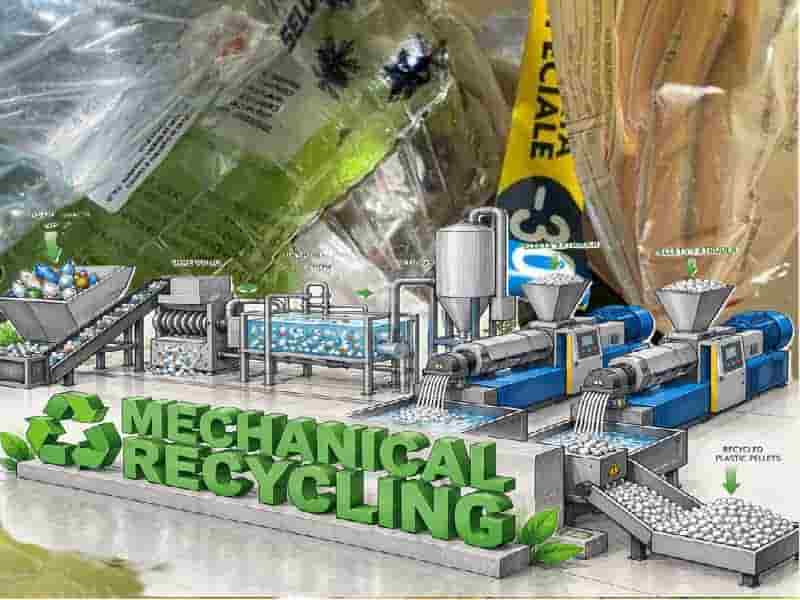
The study also highlights the growing role of chemical recycling in complementing mechanical recycling systems, especially for complex or contaminated plastic waste streams.
The future of upcycling PET waste
As global plastic production continues to rise, solutions that combine performance, sustainability, and circularity are increasingly urgent. This research shows that upcycling PET waste can move beyond incremental improvements toward transformative change.
By rethinking polymer design from the molecular level, scientists are redefining what plastic waste can become. Closed-loop recyclable polymers represent a future where materials are not discarded but continuously reborn.
This innovation signals a meaningful step toward sustainable polymer manufacturing and long-term waste management solutions.
More…