Carbon Fibers – EU Plans to Ban Carbon Fiber by 2029 The European Union is pushing to classify carbon fiber as a hazardous material, proposing a full ban by 2029 17-04-2025 - Archive
Carbon Fibers
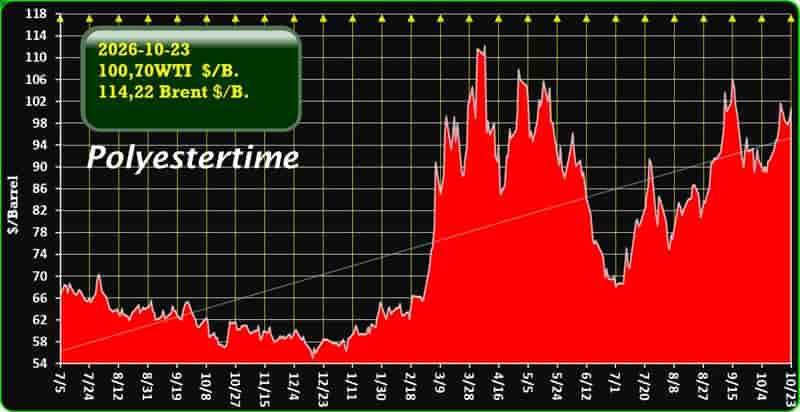
Crude Oil Prices Trend

Recycled Milled Carbon Fibers for Automotive Parts Manufacturing
A recent article in Polymer Composites examined the use of recycled milled carbon fibers (rCFs) as fillers in polyamide-6,6 (PA66) filaments for fused filament fabrication (FFF), targeting automotive part production. The rheological and thermal properties of PA66 filaments loaded with 5 and 10 wt.% rCFs were analyzed experimentally.
Background: Fiber-Reinforced Filaments for FFF
FFF, also known as fused deposition modeling (FDM), is a widely used 3D printing technique in industries including automotive, aerospace, medical, and consumer goods. The properties of the filament material heavily influence the mechanical and thermal performance of printed parts. Carbon Fibers
Reinforcing fibers are often added to thermoplastics to enhance filament performance. rCFs have gained attention for offering environmental, economic, and technical benefits.
While rCFs have proven effective in improving the performance of printed samples, their processability in industrial-scale FFF for functional components remains underexplored.
This study addresses that gap by producing and characterizing rCF-loaded PA66 filaments and testing them in automotive part prototyping.
The COM4PHA project is developing new biodegradable bioplastics based on polyhydroxyalkanoates (PHAs) for cosmetics, food, and agricultural packaging
PHAs, biocompatible polymers produced by microorganisms, offer similar properties to conventional plastics but degrade in soil and marine environments.
Current research focuses on cost reduction by using agro-industrial waste as substrates and optimizing extraction methods to compete with petroleum-based plastics. The project aims to enhance PHA processing using conventional technologies like blown extrusion and coating for paper and agricultural mulch films. Carbon Fibers
Led by Venvirotech, specializing in organic waste transformation into PHAs, the project involves Enplast for material validation and Aimplas for developing new PHA formulations. The goal is to scale up PHBV production for industrial applications currently dominated by conventional materials.
New formulations for cosmetic packaging will be biodegradable and compostable, meeting industry standards for reduced environmental impact.
Coating formulations for paper and agriculture will improve product quality and shelf life, with potential applications in food and cosmetics requiring barrier properties, and in agricultural mulch films for crop quality. Carbon Fibers
EU Plans to Ban Carbon Fiber by 2029
The European Union is pushing to classify carbon fiber as a hazardous material, proposing a full ban by 2029. Long favored in the automotive and aerospace industries for its light weight and strength, carbon fiber is widely used by sports car and electric vehicle manufacturers to enhance performance and efficiency.
A new amendment to the EU’s End-of-Life Vehicles Directive includes carbon fiber alongside substances like lead and mercury, citing concerns over potential health risks. Officials argue that airborne carbon fiber particles could pose dangers if they come into contact with skin or are inhaled. Carbon Fibers
This would mark the first time any government globally has labeled carbon fiber as hazardous.
If passed, the regulation could significantly impact automakers such as Tesla, BMW, Hyundai, and Lucid, which rely heavily on the material. Sports and supercar brands would be especially vulnerable due to their extensive use of carbon fiber for structural and aerodynamic components.
Despite the EU’s environmental and health concerns, the amendment is expected to face stiff resistance. Carbon fiber was a $5.5 billion global industry in 2024, with deep roots in both automotive and aerospace manufacturing. Industry leaders are likely to lobby against the proposal, seeking exemptions or alternative solutions before the 2029 deadline.
Whether the ban will move forward remains uncertain, but its implications for innovation, vehicle performance, and manufacturing standards could be significant across multiple sectors. Carbon Fibers

ScienceDirect Study: BEV Electric Cars Pollute Less Than ICEs
A study published on ScienceDirect highlights the environmental advantages of Battery Electric Vehicles (BEVs) over Internal Combustion Engine Vehicles (ICEVs), particularly in terms of non-exhaust emissions such as tire and brake wear. Key findings include:
- Regenerative Braking: BEVs reduce particulate emissions by up to 24% through regenerative braking, which converts kinetic energy into electricity. This is especially effective in urban settings with frequent braking, where low speeds amplify the benefits.
- Highway Performance: On highways, BEVs maintain their sustainability advantage when traffic/capacity ratios exceed 0.25. However, in free-flowing traffic conditions, where traditional brakes are less used, this advantage diminishes. Carbon Fibers
- Exhaust Emissions: BEVs produce zero exhaust emissions, eliminating pollutants such as nitrogen oxides and particulate matter that ICEVs emit at rates of 0.032 g/km and between 0.12–0.30 g/km respectively.
The study also emphasizes the importance of considering road dust and wear-related emissions, which contribute significantly to overall particulate pollution
With BEVs reducing reliance on conventional brakes and minimizing brake dust, they offer a holistic environmental benefit across varied driving conditions.

Developed in partnership with Intrinsi
Unifi Inc., based in Greensboro, North Carolina, has launched Repreve with Ciclo technology, a sustainable yarn combining recycled polyester and nylon with biodegradable capabilities
c Advanced Materials—a joint venture between Parkdale Advanced Materials and Intrinsic Textiles Group—this innovation addresses the growing issue of microfiber pollution caused by synthetic fabrics.
Repreve with Ciclo includes a patented additive at the fiber level, enabling synthetics to biodegrade more like natural fibers such as wool. This allows the yarn to break down in soil and seawater without compromising durability, performance, or dyeability. The product aims to reduce the long-term environmental footprint of synthetic materials, particularly their contribution to microplastic pollution. Carbon Fibers
“Through collaboration, we’re tackling microfiber pollution head-on,” says Unifi CEO Eddie Ingle. “Ciclo technology allows brands and mills to integrate sustainable options without sacrificing quality.”
Already adopted by eco-conscious brands like Champion, Billabong, Oakley, Target, and Bass Pro Shops, Repreve with Ciclo supports evolving sustainability standards and regulations. Cheryl Smyre of Parkdale Advanced Materials highlights the collaboration as a powerful way to maximize recycled content and reduce pollution at its source.
Unifi notes that all Repreve lines, including Repreve Takeback and Repreve Our Ocean, can incorporate the Ciclo additive. The innovation is available globally and will be featured at the Functional Fabric Fair, April 14–16, in Portland, Oregon (Booths 815 and 712).

Clearpoint to supply PET directly to plastics recycler
Clearpoint Recycling has announced a partnership with a specialist polyethylene terephthalate (PET) recycler.
The deal will see Clearpoint supply recycler Enviroo with feedstock for its upcoming waste plastics recycling plant at the Protos Park in Ellesmere Port, Cheshire.
Once the site opens in 2027, the waste management company will deliver more than 30,000 tonnes of PET material to the facility annually. Carbon Fibers
The plant will convert waste plastics into certified food-grade recycled PET (rPET) to meet the growing demand in the global market.
England is set to launch a deposit return scheme (DRS) in October 2027 which will include PET bottles.
Clearpoint said that the facility is set to be one of only three food-grade rPET facilities in the UK.
Mark Garrett, managing director at Clearpoint Recycling, said: “The plant is a much-needed outlet for PET to be converted into certified food-grade rPET, which the UK market is crying out for.
“We look forward to working with our existing partners and invite offers from other suppliers to feed into the plant.