Plastic-eating bacteria – New Arctic Discovery Reveals Powerful Plastic-Eating Bacteria Offering Hope for Tackling Marine Pollution and Transforming the Future of Sustainable Waste Breakdown Technologies 03-12-2025
Plastic-eating bacteria
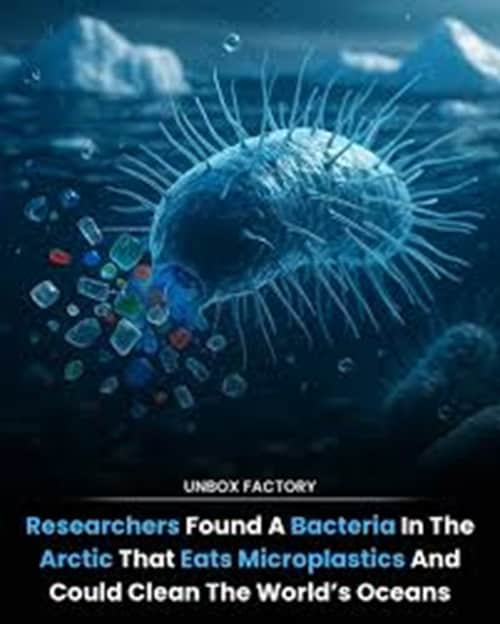
Plastic pollution has reached even the most remote regions of the planet, and researchers are now uncovering surprising biological responses in these fragile ecosystems. A team of scientists from Novgorod State University, Lomonosov Moscow State University, and the P. P. Shirshov Institute of Oceanology has discovered that the Arctic seas harbor bacteria capable of feeding on plastic waste. Among the species identified is a previously unknown organism now recognized for its ability to participate in natural plastic degradation. This new insight may play an important role in developing future solutions for reducing marine pollution in the Arctic.
The researchers focused on the Barents Sea, one of the regions most affected by drifting waste carried from the North Atlantic and introduced by growing shipping and fishing activities. As plastic debris accumulates, it creates a new ecosystem known as the plastisphere, where diverse microorganisms settle on its surface. Until recently, the biological activity within these plastispheres remained poorly understood. The new findings show that several Arctic microorganisms not only colonize plastic but can break it down and use it as their sole energy source. Plastic-eating bacteria
Plastic waste poses a severe ecological challenge in Arctic waters. Scientists estimate that the surface of the Barents Sea may contain as many as 650,000 macroplastic particles per square kilometer. Because of the region’s cold temperatures and limited sunlight, natural decomposition is extremely slow, making the discovery of plastic-eating bacteria especially valuable. These organisms could eventually support biotechnological approaches to plastic recycling, including biocomposting and controlled biodegradation systems.
To investigate this potential, the research team collected samples during field expeditions from 2021 to 2023. They gathered plastic debris from tidal zones in the Zelenetskaya and Podpakhta bays, as well as the Kola Bay. These samples included widely used plastic types such as polyethylene terephthalate (PET), polyethylene, polypropylene, and polystyrene. Once the plastics were retrieved, scientists carefully washed off the microbial communities living on their surfaces.
The next stage involved evaluating whether these microorganisms could truly act as plastic-eating bacteria. The scientists placed the collected bacteria on a mineral-rich medium intentionally designed without any organic nutrients. The only available food source was finely processed plastic provided in powder, fiber, or emulsion form. If a bacterial colony began growing in these conditions, it indicated that it could use plastic as its primary source of carbon and energy. Plastic-eating bacteria
To confirm this behavior, researchers looked for several indicators. One was measurable weight loss in the plastic samples after an extended cultivation period. Another was visible bioerosion—small areas where the plastic surface showed pitting or roughness due to bacterial activity. A third was the absence of bacterial growth in environments without plastic, confirming that the plastic-eating behavior was genuine and not incidental.
To understand how the bacteria altered plastic at a molecular level, the researchers used Fourier transform infrared spectroscopy (FTIR). This method provides detailed information about chemical bonds within the plastic. By comparing the spectral fingerprints of untouched plastic with those exposed to bacteria for at least 40 days, scientists identified clear structural changes. These results showed that some samples had experienced chemical bond damage consistent with microbial degradation. Such structural shifts offer strong evidence that certain Arctic bacteria can break down complex plastic polymers.
Once the team verified biodegradation activity, they turned to identifying exactly which microorganisms were involved. They decoded a section of the 16S rRNA gene from each strain, a widely used method for determining microbial taxonomy. In total, nine unique cultures were isolated. Five came from PET, two from polyethylene, and one each from polypropylene and polystyrene. Of these nine cultures, seven successfully demonstrated the ability to function as plastic-eating bacteria, confirming that they could survive and grow using plastic as their only food source.
Several of the identified organisms belonged to genera already known to inhabit Arctic plastispheres, including Rhodococcus, Pseudomonas, Pseudoalteromonas, and Rhodopirellula. These bacteria are recognized worldwide for their metabolic flexibility and ability to survive in extreme environments. However, the team also discovered a newcomer: Persicitalea sp. This newly identified species represents the first observation of its kind on plastic in the Arctic seas, expanding the scientific understanding of microbial diversity in polar ecosystems.
Despite the promising findings, scientists emphasize that research into natural plastic biodegradation is still in its early stages. Understanding how plastic-eating bacteria behave in controlled environments is only one part of a much larger effort. Real-world biodegradation in cold marine conditions is slow, and the effects of widespread microbial breakdown require further study. The next phase of research will involve evaluating how these organisms can be integrated into practical technological systems, potentially supporting new strategies for managing plastic waste.
The discovery contributes to a growing body of evidence that nature may hold key solutions to the plastic crisis. As plastic waste continues spreading into the Arctic, identifying and understanding organisms capable of degrading it becomes increasingly important. These plastic-eating bacteria could inspire innovative approaches to recycling and environmental restoration, especially in regions where traditional waste management is difficult or impossible.
This research highlights the resilience and adaptability of microbial life even in harsh polar environments. It also offers hope that with further study, these naturally occurring organisms may contribute to global efforts to reduce plastic pollution and safeguard sensitive marine ecosystems.
More…