Sulzer and Vitol’s WPU Advance Chemical Recycling in Rotterdam
Chemical Recycling Rotterdam: Sulzer Technology Selected for Vitol’s WPU Plastics Facility
Vitol’s plastics recycling business WPU has selected Sulzer to support a new chemical recycling facility in Rotterdam, a project designed to process up to 80,000 tonnes of mixed plastic waste per year and convert it into reusable raw material. Recent industry reports describe the agreement as a significant step for large-scale plastic waste processing in the Netherlands.
The facility will be located next to Vitol’s VPR refinery in the Port of Rotterdam. Its role is to handle end-of-life plastic streams that are difficult to recycle mechanically, using pyrolysis to convert mixed plastic waste into vapors that can then be cooled and condensed into liquid feedstock.
Why the Rotterdam project matters
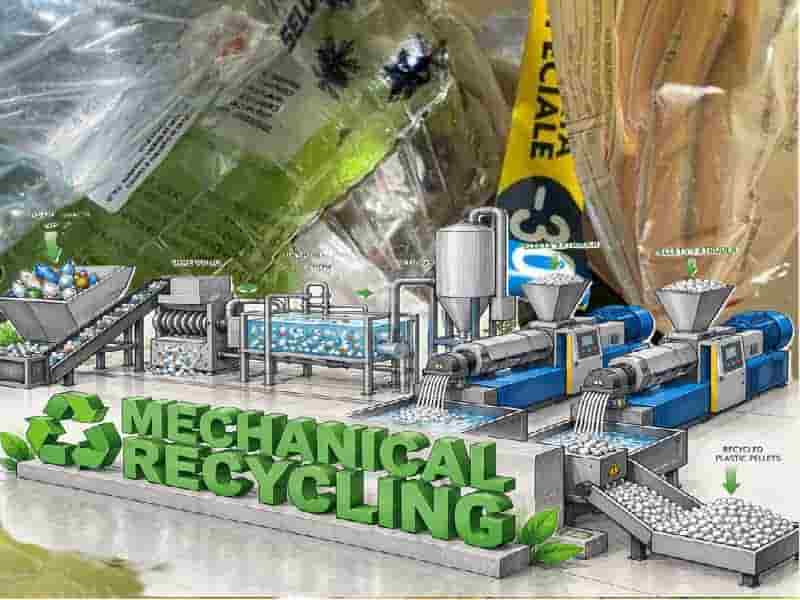
Plastic waste remains one of the most difficult materials challenges for the packaging, petrochemical and recycling sectors. Mechanical recycling is essential, but it cannot always treat contaminated, mixed or degraded plastic streams. Chemical recycling is being developed to address part of that gap by breaking down plastic waste into materials that can re-enter industrial value chains.
WPU’s planned Rotterdam facility is notable because of its scale. Vitol has said the plant will have capacity for 80,000 tonnes per year of post-consumer end-of-life plastic, increasing WPU’s total recycling capacity to 100,000 tonnes per year. The Port of Rotterdam has also described the project as expected to be among Europe’s largest chemical recycling plants for end-of-life plastics.
Sulzer’s role in the chemical recycling process
Sulzer will provide its PyroCon technology and engineering services for the new plant. In the process described by the companies, WPU’s technology converts waste plastic into gas through pyrolysis, while Sulzer’s PyroCon system rapidly cools and condenses the vapors into a liquid feedstock.
That liquid feedstock can then be used as an input for producing new plastic materials. This is important because chemical recycling facilities must deliver consistent output even when incoming plastic waste varies in composition, contamination level and operating conditions.
Sulzer will also support project execution through engineering services and a skid-mounted modular solution. Basic engineering was completed in the first quarter of 2026, with first skid deliveries scheduled for the first quarter of 2027. chemical recycling Rotterdam
Turning difficult plastic waste into circular feedstock
The central promise of the Rotterdam facility is its ability to process mixed plastic waste that may not be suitable for conventional recycling routes. By converting this material into pyrolysis-derived feedstock, the project aims to support the production of new plastics from recycled carbon rather than relying only on fossil-derived inputs.
This does not make chemical recycling a complete solution to the plastic waste problem. Collection quality, sorting systems, emissions controls, product certification and downstream acceptance all remain critical. However, the Rotterdam project shows how large industrial players are positioning pyrolysis as a complementary technology for plastic streams that are otherwise hard to recover.
Why the Port of Rotterdam is strategically relevant
The Port of Rotterdam is one of Europe’s most important industrial and logistics hubs. Locating the WPU facility next to Vitol’s VPR refinery could give the project access to existing infrastructure, industrial utilities and downstream feedstock routes. That co-location may help reduce operational complexity compared with a stand-alone recycling site.
Vitol announced earlier in 2026 that WPU planned to build the facility alongside its refinery and that the new plant would expand WPU’s recycling capacity to 100,000 tonnes per year.
What comes next
The immediate next phase is project execution. According to recent reporting and Sulzer’s announcement, basic engineering was completed in Q1 2026 and the first skid deliveries are scheduled for Q1 2027.
For the recycling and plastics sectors, the key questions will be whether the plant can operate reliably at scale, consistently handle variable waste streams and produce feedstock that meets the specifications required by plastics producers.
Bottom line
The Sulzer-WPU agreement strengthens the industrial roadmap for chemical recycling in Rotterdam. If delivered as planned, the facility would add major capacity for processing mixed end-of-life plastics and could become an important source of circular feedstock for the plastics value chain.
The project should be viewed neither as a replacement for waste reduction and mechanical recycling nor as a guaranteed solution to all plastic waste. Its importance lies in targeting difficult plastic streams and testing whether pyrolysis-based recycling can scale reliably within an established industrial hub.
More…