Plastic bottle graphite -Scientists Turn Plastic Bottles Into Battery-Grade Graphite
Plastic bottle graphite
Scientists Turn Plastic Bottles Into Battery-Grade Graphite for EV Batteries
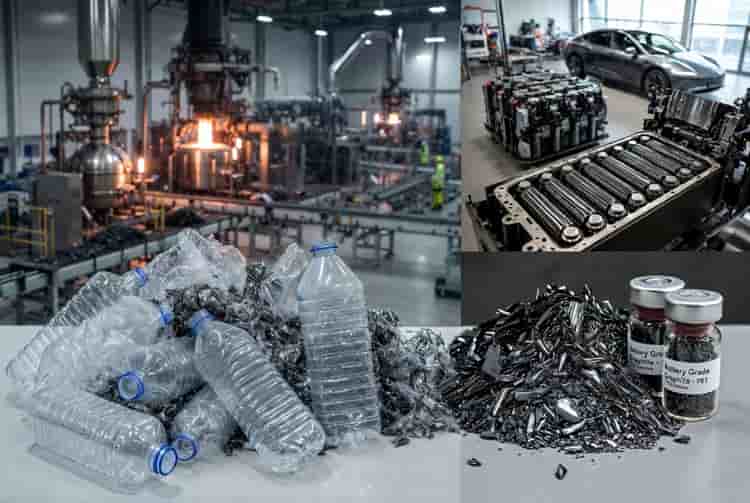
A discarded plastic bottle may not look like part of the clean energy transition. But new research from Penn State suggests that PET plastic, the material commonly used in disposable drink bottles, could be transformed into highly ordered graphite for lithium-ion batteries.
The work matters because graphite is not a minor battery ingredient. It is the main material used in the anode, the part of a lithium-ion battery that stores and releases charge during use. Electric vehicles, smartphones, laptops and grid-scale storage systems all depend on this material.
Penn State’s research team reports that waste PET plastic can be converted into synthetic graphite with a crystal structure that, in key measurements, exceeded commercial natural graphite samples. That does not mean plastic bottles are ready to replace mined graphite tomorrow. The study is still at the materials-research stage. But it does point to a possible new route for turning a common waste stream into a higher-value battery material. plastic bottle graphite
Why graphite is a strategic battery material
Graphite often receives less attention than lithium, cobalt or nickel, but it is essential to most lithium-ion batteries. In conventional cells, lithium ions move into and out of graphite layers during charging and discharging. The better ordered those carbon layers are, the more suitable the material may be for high-quality anode applications.
That is why battery-grade graphite is strategically important. Demand is expected to grow as electric vehicles, consumer electronics and stationary energy storage systems expand. At the same time, critical mineral supply chains are under pressure as governments try to secure materials needed for clean technology, digital infrastructure and renewable energy systems.
This is where the Penn State work becomes interesting. Instead of treating PET bottles as low-value waste, the researchers tested whether their carbon content could be reorganized into a useful graphitic structure.
How PET plastic becomes graphite
The process starts with shredded PET plastic. Researchers combined it with small amounts of graphene oxide, then heated the mixture through a controlled thermal process. During that treatment, carbon atoms from the plastic reorganized into stacked graphitic layers.
The important detail is that the method does not rely on metal catalysts such as iron, nickel or cobalt. Conventional routes to synthetic graphite can use metal catalysts, but those metals may leave impurities that require additional purification. Penn State’s approach uses graphene-based additives instead, which help guide graphitization without adding metallic contaminants.
The research team found that adding 2.5% graphene oxide by weight produced the best graphite quality. At that concentration, the material formed large, well-ordered crystallites, meaning microscopic regions where carbon layers are closely aligned.
What makes the result notable
The strongest part of the finding is not simply that plastic waste became carbon. Many carbon-rich materials can be charred. The key point is that the resulting material showed a high degree of structural order.
According to Penn State, the PET-derived graphite produced under the best conditions had crystallite properties that exceeded those associated with commercial natural graphite samples. Tech Xplore’s report of the paper notes that the research was peer-reviewed and published in Diamond and Related Materials.
That distinction is important for readers and search engines alike: this is not a claim that every bottle can immediately become an EV battery part. It is a specific laboratory result showing that PET plastic, with the right graphenic additive and thermal treatment, can form highly ordered synthetic graphite.
Why graphene oxide matters
Graphene oxide appears to act as more than a simple additive. Oxygen-containing functional groups along the edges of graphene oxide sheets help start and promote lateral crystal growth. In simpler terms, the graphene oxide helps guide loose carbon atoms into a more organized structure as the plastic breaks down under heat.
This template-like effect is what separates the process from ordinary plastic charring. Without guidance, carbon from decomposed plastic would be far less ordered. With the right amount of graphene oxide, the researchers were able to encourage the formation of stacked graphite layers.
A possible circular-economy route for batteries
The environmental appeal is clear. PET is one of the most widely used plastics, especially in bottles and food packaging. Much of it is discarded, downcycled or sent to landfill even when consumers place it in recycling bins.
If the process can eventually scale, it could create a circular route in which plastic waste becomes feedstock for battery materials. That would address two problems at once: plastic waste management and the rising demand for graphite anodes.
However, several questions remain. The process still needs further validation for large-scale production, energy use, cost, consistency and real battery performance. A material can look promising in structural analysis but still need extensive electrochemical testing before it can be considered commercially viable.
What this could mean for electric vehicles
For electric vehicles, the promise is not just cleaner recycling. It is supply diversification. Battery makers need stable access to anode-grade graphite, and supply chains for critical minerals are becoming a strategic concern for governments and manufacturers.
A PET-to-graphite pathway would not eliminate mining or conventional synthetic graphite production in the near term. But it could eventually add another source of battery carbon, especially if integrated with existing plastic collection and recycling systems.
The most realistic near-term takeaway is this: waste plastic may become more than a disposal problem. With the right chemistry, some of it could become a resource for advanced energy materials.
The bottom line
Penn State’s research shows that PET plastic bottles can be converted into highly ordered synthetic graphite using a graphene oxide-assisted process. The best result came from a 2.5% graphene oxide formulation, producing graphite with structural properties that compared favorably with commercial natural graphite.
The breakthrough is still early-stage, but it is scientifically meaningful. It suggests a future where plastic bottle graphite could support lithium-ion battery production while giving discarded PET a more valuable second life.
More…