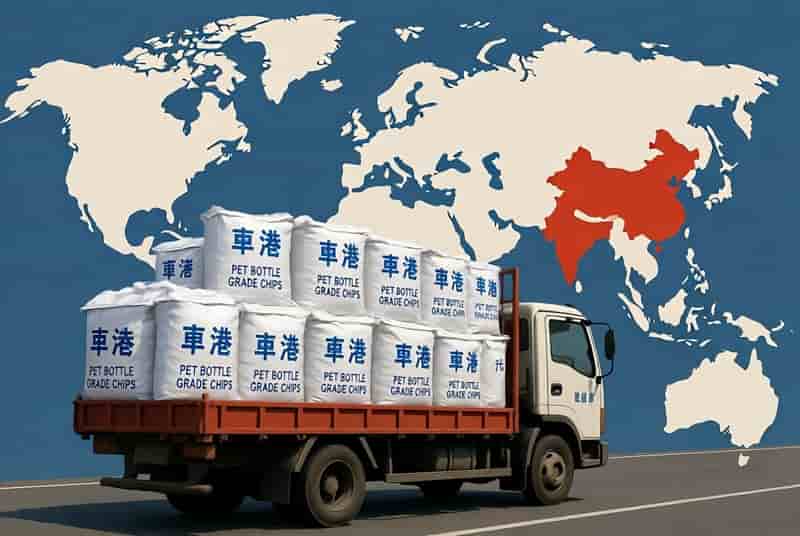
India Extends Anti-Dumping Duty on Chinese PET Resin for Five Years – Polymer Price Trends
India anti-dumping duty PET resin China – Full price table (15/06/2026 →22/06/2026)
| ITEM | 15/06/2026 | 22/06/2026 | +/− |
|---|---|---|---|
| Bottle grade PET chips domestic market | 7,850 yuan/ton | 7,550 yuan/ton | -350 |
| Chinese bottle-grade PET chips FOB export price | 1,135 $/ton | 1,020 $/ton | -115 |
| LDPE CFR Est China | 1,175 $/ton | 1,040 $/ton | -35 |
| PET Semidull — Fiber chips | 7,100 yuan/ton | 6,970 yuan/ton | -130 |
| PET Bright — Fiber chips | 7,200 yuan/ton | 7,070 yuan/ton | -130 |
| Pure Terephthalic Acid PTA domestic market | 6,315 yuan/ton | 6,075 yuan/ton | -240 |
| Pure Terephthalic Acid PTA FOB China | 800 $/ton | 790 $/ton | -10 |
| Monoethyleneglycol (MEG) South China | 4,549 yuan/ton | 4,419 yuan/ton | -130 |
| Monoethyleneglycol (MEG) CFR China | 575 $/ton | 550 $/ton | -25 |
| Paraxylene PX FOB Taiwan market | 1,123 $/ton | 1,026 $/ton | -97 |
| Paraxylene PX FOB South-Korea market | 1,126 $/ton | 1,029 $/ton | -97 |
| Paraxylene PX FOB EU market | 1,200 $/ton | 1,030 $/ton | -170 |
| Polyester filament POY 150D/48F domestic market | 8,450 yuan/ton | 8,250 yuan/ton | -200 |
| Recycled Polyester filament POY 150/48F domestic market | 7,300 yuan/ton | 7,300 yuan/ton | – |
| Polyester filament DTY 150D/48F domestic market | 9,500 yuan/ton | 9,300 yuan/ton | -200 |
| Polyester filament FDY 68D/24F | 9,450 yuan/ton | 9,300 yuan/ton | -150 |
| Polyester filament FDY 150D/96F domestic market | 8.750 yuan/ton | 8,600 yuan/ton | -150 |
| Polyester staple fiber 1.4D 38mm domestic market | 7,500 yuan/ton | 7,490 yuan/ton | -10 |
| Caprolactam (CPL) domestic market | 11,500 yuan/ton | 11,200 yuan/ton | -300 |
| Caprolactam (CPL) CFR China | 1,500 $/ton | 1,510 $/ton | +10 |
| Nylon 6 chips overseas market |
Northeast Asia (FOB China / Taiwan)$1.45 – $1.84 Southeast Asia (CIF ASEAN)$1.66 – $2.15 Middle East (CFR UAE / Gulf)$1.60 – $2.05 Western Europe (FD Germany / Italy)$2.41 – $2.53 North America (FOB US Gulf)$2.51 – $2.54 |
Nord America — 2.540 USD/MT Europa — 2.530 USD/ MT Nord‑Est Asia — 1.840 USD/ MT Sud‑Est Asia — 2.150 USD/ MT Medio Oriente — 2.050 USD/ MT |
– |
| Nylon 6 chips conventional spinning domestic market | 11,850 yuan/ton | 11,500 yuan/ton | -350 |
| Nylon 6 chips high speed spinning domestic market | 12,350 yuan/ton | 12,050 yuan/ton | -300 |
| Nylon 6.6 chips domestic market | 19,000 yuan/ton | 18,100 yuan/ton | -900 |
| Nylon6 Filament POY 86D/24F domestic market | 13,600 yuan/ton | 13,600 yuan/ton | – |
| Nylon6 Filament DTY 70D/24F domestic market | 16,000 yuan/ton | 16,000 yuan/ton | – |
| Nylon6 Filament FDY 70D/24F | 13,800 yuan/ton | 13,800 yuan/ton | – |
| Spandex 20D domestic market | 31,700 yuan/ton | 31,700 yuan/ton | – |
| Spandex 30D domestic market | 31,200 yuan/ton | 31,200 yuan/ton | – |
| Spandex 40D domestic market | 28,500 yuan/ton | 28,500 yuan/ton | – |
| Adipic Acid China domestic market | 8,850 yuan/ton | 8.000 yuan/ton | -850 |
| Adipic Acid Europe market | 2,050 $/ton | 1,970 $/ton | -80 |
| Benzene domestic market East China | 7,300 yuan/ton | 7,100 yuan/ton | -200 |
| Benzene CFR China | 980 $/ton | 965 $/ton | -15 |
| Ethylene South East market | 935 $/ton | 900 $/ton | -15 |
| Ethylene NWE market CIF | 996 $/ton | 837 $/ton | -159 |
| Acrylonitrile (ACN) domestic market | 10,600 yuan/ton | 11,000 yuan/ton | +400 |
| Acrylonitrile ACN Southeast Asia | 1,635 $/ton | 1,580 $/ton | -55 |
| Acrylic staple fiber (ASF) CFR China | 16,055 yuan/ton | 16,055 yuan/ton | – |
| VSF viscose staple fiber | 14,100 yuan/ton | 14,200 yuan/ton | +100 |
| PP Powder domestic market | 9,690 yuan/ton | 8,900 yuan/ton | -790 |
| Naphtha overseas market | 706 $/ton | 692 $/ton | -14 |
| Phenol domestic market (Jinan Dezheng / Yanshan Petrochemical, Shandong) | 8,050 yuan/ton | 7.687 yuan/ton | -363 |
| Recycled PET | 4,200 yuan/ton | 4,200 yuan/ton | – |
India anti-dumping duty PET resin China
India Extends Anti-Dumping Duty on Chinese PET Resin as Domestic Producers Seek Market Stability
India has renewed anti-dumping protection on bottle-grade virgin polyethylene terephthalate resin imported from China, extending a duty of $200.66 per tonne for another five years. The decision strengthens a trade-remedy framework first introduced in 2021 and signals that New Delhi remains focused on shielding domestic polymer producers from low-priced imports.
The measure applies to bottle-grade virgin PET resin with an intrinsic viscosity of 0.72 decilitres per gram or higher. This material is widely used in beverage bottles, food packaging, consumer goods packaging and other rigid plastic applications.
Recycled PET resin is excluded from the scope of the measure.
What India Has Decided
The Ministry of Finance has continued the anti-dumping duty on imports of Chinese-origin PET resin following a sunset review by the Directorate General of Trade Remedies.
The renewed duty is set at $200.66 per tonne and will remain in place for five years unless it is amended, replaced or withdrawn earlier.
The measure covers relevant PET resin imports under HS codes 3907 61 10, 3907 61 90, 3907 69 30 and 3907 69 90. The duty is notified in US dollars but payable in Indian rupees, based on the applicable exchange rate at the time of filing the bill of entry.
This structure is important for importers because it links the final duty payment to customs documentation and foreign-exchange movements.
Why the Duty Was Extended
The key reason behind the extension is DGTR’s finding that dumping and injury risks had not disappeared.
In its sunset review, the authority found that Chinese PET resin continued to enter India at prices that undercut domestic producers. It also observed that import volumes from China had continued to rise despite the existing anti-dumping duty.
That matters because a sunset review is not simply a backward-looking exercise. It asks whether removing the duty would likely lead to renewed or continued dumping and further injury to the domestic industry.
DGTR concluded that the risk remained significant.
For India’s domestic PET resin manufacturers, the concern is not only the current level of imports, but also the possibility that Chinese producers could redirect larger volumes into India if trade protection were removed.
A Market Shaped by Packaging Demand
PET resin is a strategic material for India’s packaging economy.
It is used across bottled water, carbonated drinks, edible oils, processed foods, household products and personal-care packaging. As consumption grows, demand for bottle-grade PET resin remains closely linked to urbanisation, retail expansion and the rise of packaged consumer goods.
For domestic producers, this growth should create room for higher capacity utilisation and investment. However, low-priced imports can limit their ability to raise prices in line with costs, particularly when buyers have access to cheaper overseas material.
The renewed duty is therefore expected to support pricing discipline in the Indian market. India anti-dumping duty PET resin China
Impact on Domestic PET Resin Producers
The extension is positive for Indian PET resin manufacturers.
By reducing the price advantage of Chinese imports, the duty gives local producers more room to defend margins, improve capacity utilisation and protect market share. It also supports the investment case for domestic polymer capacity, especially at a time when India wants to deepen local manufacturing across chemicals, plastics and packaging materials.
The main beneficiaries are likely to be producers exposed to bottle-grade PET demand from beverage, food packaging and fast-moving consumer goods customers.
The duty does not eliminate competition. Imports from other sources remain possible, and domestic producers still need to compete on quality, reliability, delivery and price. But it reduces the risk of unfairly low-priced Chinese material setting the market floor.
Impact on Packaging Converters and Buyers
The measure may be less comfortable for downstream users.
Packaging converters, bottle manufacturers and consumer goods companies will closely watch domestic PET resin prices in the coming months. If local prices rise, converters may face higher raw material costs, especially in price-sensitive packaging segments.
However, the impact will depend on several factors: domestic supply availability, crude-linked feedstock costs, demand from beverage and food packaging, import alternatives, and the pricing strategies of Indian producers.
For large buyers, procurement diversification will remain important. Companies may seek a balance between domestic sourcing, long-term supply contracts and selective imports from countries not covered by the duty.
Why Circumvention Controls Matter
The renewed measure is designed to prevent simple rerouting of Chinese-origin PET resin through third countries.
The duty applies not only to material shipped directly from China, but also to Chinese-origin PET resin exported through other countries. This is a critical detail because trade remedies can lose effectiveness if exporters simply redirect goods through alternative shipping routes.
By covering origin as well as export route, India is trying to preserve the practical impact of the duty and reduce the risk of trade diversion.
For importers, this means origin documentation, supplier verification and customs compliance will be essential.
India’s Wider Trade Policy Signal
The decision fits into a broader pattern in India’s trade policy.
India has increasingly used anti-dumping, countervailing and safeguard tools to protect domestic industries where authorities find evidence of unfair trade practices. In chemicals and polymers, these measures are often used to balance the needs of upstream producers with those of downstream manufacturers.
The PET resin case is especially relevant because it sits at the intersection of industrial policy, packaging demand and China-linked supply pressure.
For policymakers, the challenge is to protect domestic manufacturing without creating excessive cost pressure for packaging users. For producers, the challenge is to use this window to improve competitiveness rather than rely only on tariff protection.
What Market Participants Should Watch Next
The immediate market impact will depend on how quickly domestic suppliers adjust pricing and how buyers respond.
Key indicators to watch include import volumes from China, alternative sourcing from other Asian producers, domestic PET resin prices, converter margins and demand from beverage and food packaging sectors.
If Indian demand remains steady and imports from China slow, domestic producers could see stronger pricing power. If converters face higher costs, some may try to renegotiate supply contracts or explore other regional suppliers.
The next phase will therefore be shaped by both trade policy and real market behaviour.
Outlook
India’s five-year extension of anti-dumping duty on Chinese PET resin gives domestic producers a stronger shield against low-priced imports.
The decision follows DGTR’s finding that dumping, import pressure and price undercutting remained relevant despite the existing duty regime. For Indian PET resin makers, the extension should support margins, market share and investment confidence.
For downstream packaging companies, the priority will be cost management and supply flexibility.
Overall, the measure reinforces India’s intent to defend domestic petrochemical production while keeping a close watch on import behaviour, market pricing and the long-term resilience of its packaging supply chain.
More…