EREMA Group Revenue Falls, but Recycling Specialist Stays Profitable
EREMA Group revenue
EREMA Group Stays Profitable as Revenue Falls 28%
The EREMA Group remained profitable in its 2025/26 financial year even as difficult conditions in the plastics recycling market pushed revenue sharply lower.
The Austrian recycling technology specialist generated revenue of €235 million during the financial year that ended in March 2026. That represents a year-on-year decline of 28%, according to results reported on August 7. The company did not publish its exact profit or operating margin.
The result presents a mixed picture. Customers are delaying investments, demand for recycled plastics remains weak and European manufacturers continue to face comparatively high energy and production costs. Nevertheless, EREMA’s cost controls and family-owned structure helped the group finish the year with a positive result.
EREMA Group’s 2025/26 results at a glance
- Revenue: €235 million
- Year-on-year revenue change: down 28%
- Financial result: profitable, but no earnings figure disclosed
- Financial year-end: March 2026
- Systems and components sold since 1983: approximately 9,200
- Estimated annual recycling capacity enabled worldwide: more than 26 million tonnes
- Strongest current growth momentum: Asia and the Americas
- Main sales market: Europe
These figures were reported by recent industry publications, including Plastech and Packaging Journal, on August 7, 2026.
Why did EREMA Group revenue decline?
The downturn cannot be attributed to a single issue. It reflects several interconnected pressures affecting plastics recyclers, equipment manufacturers and their customers.
Demand for recyclates has remained subdued, particularly where newly manufactured, or virgin, plastic is available at low prices. When the price difference becomes too wide, recycled material can struggle to compete unless customers must meet regulatory requirements or have made firm sustainability commitments.
High energy costs are another obstacle. Recycling, extrusion, washing and material preparation all require energy, so elevated electricity and production costs can affect both recyclers and the companies that manufacture their equipment.
International competition is also becoming more intense. EREMA CEO Manfred Hackl has argued that Europe’s cost base is putting industrial companies in the region at a growing disadvantage in global markets.
The immediate consequence is greater caution among recycling businesses. When customers are uncertain about demand, margins or regulation, investments in new production lines and recycling systems are more likely to be postponed.
EREMA CFO Horst Wolfsgruber confirmed that delayed customer investments had affected the group directly.
Profitability offers an important counterpoint
A 28% revenue contraction is substantial, particularly after an already difficult period for the sector. EREMA nevertheless reported a profit for 2025/26.
The company attributes this resilience partly to strict cost management. Its stable, family-owned structure also allows it to take a longer-term approach instead of responding exclusively to short-term market pressure. EREMA Group revenue
Earnings before interest and taxes, net income and the group’s profit margin were not disclosed. It is therefore not possible to assess the size of the profit or make a complete comparison with previous years.
The revenue trend, however, is clear. EREMA reported €330 million in revenue for 2024/25, when sales were already approximately 13% lower than in the preceding year. Those earlier figures are available in the company’s official 2024/25 results.
The latest €235 million total shows that the slowdown continued into 2025/26. Differences caused by rounding or reporting scope may explain why applying the stated 28% decline directly to the previously published €330 million does not produce precisely €235 million.
Europe remains central, but growth is shifting
Europe is still EREMA’s most important sales market, although regional demand is currently weaker. Asia and the Americas are providing more of the group’s growth momentum.
This geographical balance matters because recycling investment does not move at the same speed in every market. Energy prices, access to financing, local waste volumes, environmental rules and the cost of virgin resin can all influence whether a recycling project is commercially viable.
EREMA already has an extensive international presence. Its installed systems and components collectively provide capacity to recycle more than 26 million tonnes of plastic waste annually, according to the company.
The group says it has sold approximately 9,200 systems and components since its establishment in 1983. These numbers describe installed capacity rather than the amount of material actually recycled each year; real output depends on how customers operate their facilities.
Research and Austrian production remain priorities
Despite the decline in EREMA Group revenue, management is maintaining investment in research and development and remains committed to production in Austria.
Continuing R&D during a downturn can help a machinery manufacturer prepare for the next investment cycle. Recycling companies increasingly need equipment capable of handling contaminated or variable waste streams while producing material of sufficiently consistent quality for demanding applications.
Better filtration, energy efficiency, process control and decontamination can also determine whether recycled material is technically and commercially suitable for new products.
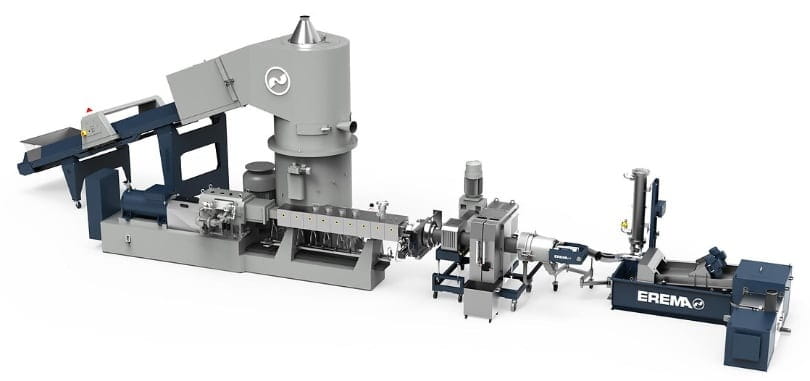
EREMA covers multiple stages of mechanical plastics recycling through its group companies. Its current portfolio includes technologies for recycling, washing, filtration, material processing and related services.
Why EREMA expects the market to recover
The near-term outlook remains difficult, but the group sees a stronger long-term case for recycling technology.
Global plastics consumption continues to create demand for material recovery and more effective waste management. At the same time, manufacturers are seeking ways to introduce higher proportions of recycled content into products.
Recycled plastic is also becoming a more strategically important secondary raw material in several international markets. If collection systems, product design and recycling capacity develop together, investment in modern processing equipment should follow.
This does not guarantee an immediate rebound. Recycling projects still depend on financing, predictable regulation, energy costs and stable demand for their output. The timing of a recovery may therefore differ considerably between Europe, Asia and the Americas.
Outlook
EREMA enters the 2026/27 financial year with lower revenue but a positive result, an established global installed base and continued investment in technology.
The company’s profitability indicates that cost discipline has provided some protection against the market downturn. Its next challenge will be converting long-term interest in circular production into new machinery orders while customers remain cautious about capital spending.
For the wider industry, EREMA’s results underline a central contradiction: the long-term need for plastics recycling capacity is growing, but the short-term economics of operating and expanding that capacity remain under pressure.
EREMA drives 5 powerful advances in high-quality plastics recycling worldwide growth
More…