Revolutionary Graphene Packaging Film Slashes Emissions and EPR Fees
Graphene Packaging Film Breakthrough Promises Lower Carbon Emissions and Slashed EPR Fees
A major technological milestone has emerged from the UK flexible packaging industry. Duo Packaging, a 37-year-old manufacturer based in Manchester, England, has launched 2DPE—a next-generation flexible polyethylene packaging film fortified with graphene nanomaterials. Developed over more than a year of research in direct collaboration with the University of Manchester’s Graphene Engineering Innovation Centre (GEIC), the novel film targets one of the most persistent operational hurdles facing modern fulfillment networks: how to significantly downgrade plastic film thickness without sacrificing structural integrity or bag durability. Graphene Packaging Film
The innovation arrives as brands face intense pressure from upcoming regulatory compliance targets, including the European Union’s Packaging and Packaging Waste Regulation (PPWR) and escalating Extended Producer Responsibility (EPR) fee structures across international markets. By introducing atomic-scale carbon structures directly into polyethylene matrices, converter specialists have demonstrated that nanomaterials can be scaled from high-level physics research onto high-speed automated packaging lines. Graphene Packaging Film
The Physics Behind 2DPE: Leveraging Nobel Prize Discoveries
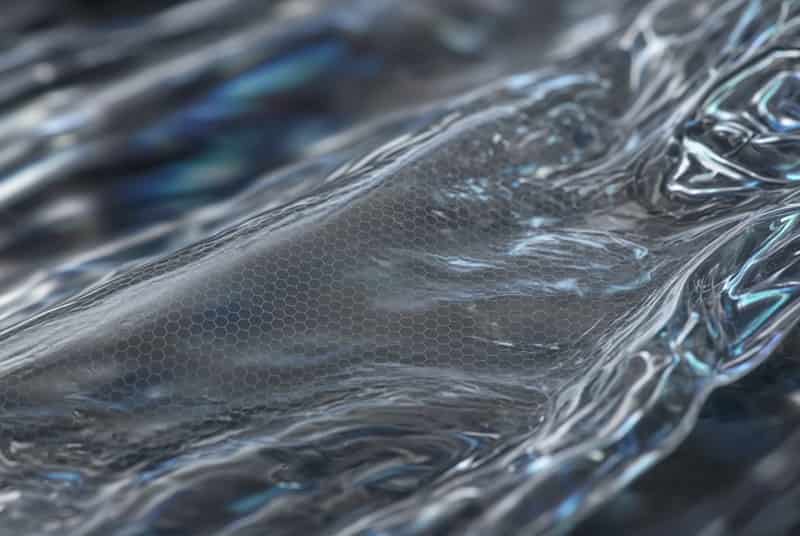
The performance foundation of 2DPE stems from graphene, a carbon allotrope famously isolated in 2004 by Sir Andre Geim and Professor Konstantin Novoselov at the University of Manchester. Their work, which earned them the 2010 Nobel Prize in Physics, proved that a single layer of carbon atoms arranged in a two-dimensional hexagonal honeycomb lattice could exist independently.
Despite being only one atom thick, graphene boasts unmatched mechanical strength, minimal weight, high flexibility, and exceptional thermal conductivity. While graphene has found early commercial footholds in electronics, aerospace engineering, and battery development, its application in everyday flexible poly packaging marks a fresh turn toward practical circular economy solutions.
Engineered Strength and Operational Savings
Incorporating graphene into standard flexible polythene matrices solves a long-standing trade-off in plastic manufacturing. Typically, incorporating higher ratios of post-consumer recycled (PCR) resin into polythene weakens the molecular structure, forcing converters to make bags thicker to prevent tearing. Graphene counteracts this degradation, allowing manufacturers to increase recycled content without weakening the final product. Graphene Packaging Film
Industrial evaluations conducted alongside GEIC highlight four distinct engineering advantages:
-
Up to 35 Percent Increase in Tensile Strength: The added carbon lattice reinforces puncture and tear resistance, letting fulfillers downgrade film gauge safely.
-
High Recycled Resin Integration: The structural reinforcement permits film formulations to incorporate between 45 percent and 60 percent recycled content without performance degradation.
-
Reduced Sealing Temperatures: Graphene’s high thermal conductivity allows automatic bagging machines to seal packaging at lower temperatures—specifically up to 15 degrees Celsius lower in live plant settings—yielding lower energy consumption across packaging lines. Graphene Packaging Film
-
Compatibility with Existing LDPE Recycling: Packages engineered with 2DPE can re-enter standard low-density polyethylene (LDPE) recycling streams without requiring special separation procedures.
Proven Logistics Deployment: The QVC Case Study
The practical financial and environmental benefits of 2DPE have been verified in real-world conditions at QVC UK’s main distribution site in Liverpool, England. The retailer replaced traditional auto-bagging film with Duo Packaging’s graphene-enhanced alternative to evaluate its viability in daily operations. Graphene Packaging Film
By switching to a thinner 28-micron 2DPE film with 60 percent recycled plastic content, QVC maintained line throughput while achieving clear cost and environmental gains:
-
Plastic Reduction: Eliminates roughly 50 metric tons of virgin plastic consumption annually based on baseline operating volume.
-
Emissions Slashes: Cuts an estimated 147,966 metric tons of CO2 equivalent emissions over time, calculated using official UK government greenhouse gas conversion metrics.
-
Direct Fee Savings: Yields an estimated £21,150 annual savings in packaging Extended Producer Responsibility (EPR) obligations due to a 5 percent overall weight reduction per unit shipped.
Navigating Modern Market and Policy Dynamics
The timing of this launch coincides with broader shifts across global supply chain management. Around the world, retail operations and logistics managers are re-evaluating packaging specifications as government policies shift from voluntary recycled content targets to strict monetary penalties for excess packaging weight and virgin plastic use. Graphene Packaging Film
Additionally, current industry discussions in the UK highlight ongoing debates regarding packaging policy frameworks, where industry figures emphasize that legislation must continue rewarding innovative resource-reduction methods. Advanced materials science offers a clear path forward, enabling companies to meet stringent regulatory limits while simultaneously reducing freight weight and total overhead.
The Expanding Horizon for Advanced Nanomaterials
Following its successful rollout in automated e-commerce packaging, Duo Packaging is exploring additional applications for 2DPE across its broader product portfolio, including mailing bags, industrial shrouds, and heavy-duty flexible wraps.
As global logistics managers seek to eliminate waste without sacrificing operational speed, nano-engineered materials like graphene demonstrate that scientific discoveries can transform standard industrial packaging into highly efficient, low-emission assets. Graphene Packaging Film
HydroGraph Certifies Midland for Graphene Polymer Applications
More…