Battery Recycling : Revolutionary Battery Recycling Breakthroughs Transform India’s Auto Industry: A Powerful, Positive Shift Toward Sustainable, Profitable, and Resilient Green Manufacturing Success 13-10-2025
Battery Recycling: A Strategic Opportunity for Automakers to Meet Green Targets
As India’s electric mobility revolution accelerates, Battery Recycling is emerging as the next frontier in sustainability. For automakers, it’s not only about producing cleaner vehicles but ensuring that every battery completes a circular journey — from production to reuse. With electric commercial vehicles reshaping logistics and consumer mobility, the new measure of success is no longer just uptime or earnings but reliability, sustainability, and long-term material security.
The New Reality for Automakers
Electric vehicles have solved one part of the emissions equation — eliminating tailpipe pollution. Yet, the growing number of lithium-ion batteries reaching the end of their lifecycle presents a challenge and an opportunity. What happens after a battery’s performance declines determines whether the industry truly achieves net-zero ambitions. Here’s where Battery Recycling offers a critical advantage.
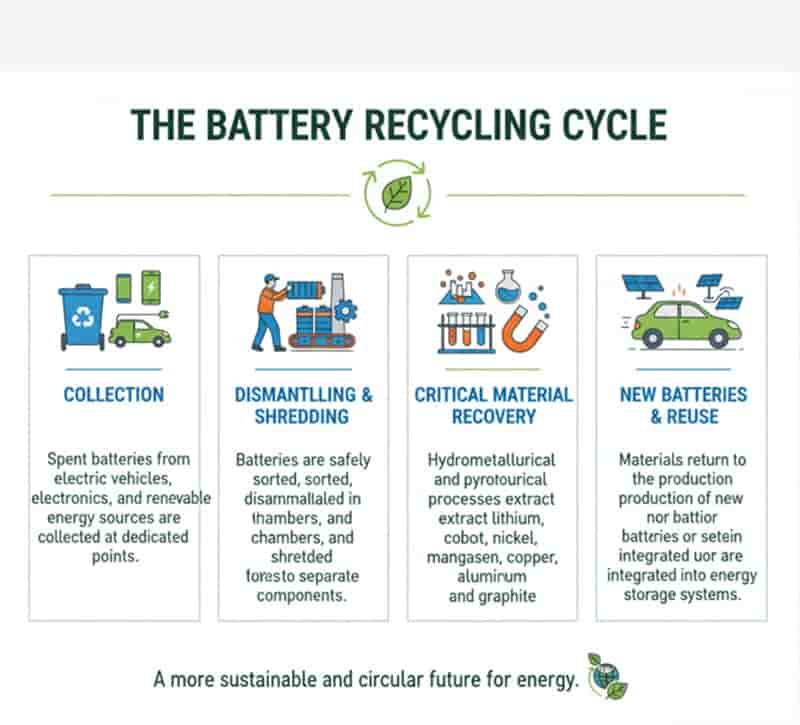
By recovering valuable metals such as lithium, cobalt, nickel, and manganese, automakers can reduce their dependence on imported resources, lower production costs, and significantly cut carbon emissions. Unlike traditional mining, recycling consumes far less water and energy, producing less than half the greenhouse gas emissions. This shift turns end-of-life batteries into a renewable source of essential raw materials — a strategic move for any manufacturer aiming for resilience and sustainability. Battery Recycling
Building a Circular Value Chain
India’s automotive sector stands at the intersection of policy momentum, technological innovation, and environmental urgency. The path forward lies in creating a circular value chain — where every used battery feeds into the creation of new cells, minimizing waste and maximizing resource efficiency.
Recycling helps automakers secure a stable supply of critical materials while supporting India’s broader mission for energy independence. By closing the loop, the industry not only mitigates supply chain risks but also strengthens its competitive edge in the global electric vehicle market.
Economic and Environmental Payoff
The economics of Battery Recycling are rapidly improving. Lithium-ion batteries account for nearly 40% of an electric vehicle’s total cost. By recovering high-purity materials like lithium carbonate, cobalt sulfate, and nickel sulfate from spent batteries, companies can directly reuse these in new manufacturing cycles — dramatically reducing costs.
Modern recycling facilities across India now use advanced hydrometallurgical processes that achieve high recovery rates and material purity. These innovations prove that circularity can be both profitable and sustainable. As recycling capacity grows to handle thousands of tonnes of e-waste annually, India is demonstrating that economic efficiency and environmental stewardship can coexist.
Policy Support Driving the Transition
Government policy has been a major catalyst in shaping the recycling ecosystem. The Battery Waste Management Rules (2022) established a clear roadmap under Extended Producer Responsibility (EPR), mandating that automakers recycle at least 90% of end-of-life batteries by 2026 and reuse 20% of recovered materials by 2030.
This policy ensures accountability across the value chain, from manufacturers to recyclers. It also aligns with the National Critical Minerals Mission, which aims to recover 40,000 tonnes of key minerals annually. Together, these initiatives make Battery Recycling not just a compliance requirement but a strategic lever for sustainability and self-reliance. Battery Recycling
Collaboration Across the Industry
Major automakers such as Tata Motors, Bajaj Auto, Hero MotoCorp, and Ather Energy are already partnering with government-recognized recyclers to ensure responsible battery management. These partnerships integrate recycling into the product lifecycle, ensuring traceability from collection to material recovery.
Such collaborations are redefining sustainability in India’s automotive industry. Recovered materials are being reintegrated into manufacturing processes, reducing the need for virgin extraction and cutting emissions throughout the supply chain. The result is a more circular and transparent ecosystem that supports both industry growth and environmental goals.
Technological Innovation Leading the Way
Innovation is the foundation of modern recycling. New technologies are enabling faster, cleaner, and more scalable recovery methods that make recycled materials as reliable as those sourced from mining. Processes such as hydrometallurgical extraction, direct regeneration, and thermal treatment have evolved to ensure near-virgin purity and minimal waste generation.
Automakers that integrate these technologies into their operations not only meet regulatory benchmarks but also future-proof their supply chains. Investing in these capabilities today ensures that as the EV market grows, material availability and cost efficiency remain stable. Battery Recycling
A Strategic Lever for ESG and Competitiveness
Environmental, Social, and Governance (ESG) metrics are now central to investment decisions. For global investors and regulators alike, the ability of automakers to implement effective Battery Recycling practices demonstrates genuine commitment to sustainability. Beyond compliance, it enhances brand reputation, investor confidence, and long-term competitiveness.
Recycling also contributes directly to corporate carbon reduction targets. By offsetting emissions from mining and refining, companies strengthen their sustainability profiles while gaining measurable economic advantages. This alignment between profit and purpose defines the next generation of green automotive strategies.
Preparing for the Future of Electric Mobility
India’s EV ecosystem is expanding rapidly, and with it comes a surge in used batteries. By 2030, the nation is expected to generate tens of thousands of tonnes of end-of-life lithium-ion batteries annually. Without robust recycling systems, this could become an environmental burden. With proper recycling, however, it becomes a powerful resource stream.
Automakers that act early to embed recycling into their core operations will gain significant strategic advantages. They’ll ensure access to critical materials, achieve regulatory compliance effortlessly, and position themselves as sustainability leaders in both domestic and global markets.
Integrating Data, AI, and Traceability
The next frontier in Battery Recycling involves digitalization. Advanced tracking systems and AI-powered analytics can trace batteries throughout their lifecycle — from manufacturing to collection, recycling, and reuse. These tools improve accountability, reduce waste leakage, and help regulators and manufacturers make data-driven decisions.
AI can also optimize sorting and recovery processes, ensuring higher yield and quality in recycled materials. Such smart infrastructure aligns perfectly with India’s digital transformation goals and its commitment to circular innovation.
The Bigger Picture: Sustainability as Strategy
Battery Recycling is not merely an environmental initiative — it’s a strategic business decision that shapes the future of the automotive industry. It transforms potential waste into a renewable asset, turning sustainability from an obligation into a competitive advantage.
As EV adoption scales and global pressure for sustainability intensifies, recycling becomes a defining factor in corporate success. The automakers that embrace it will be the ones that thrive in the era of resource scarcity and environmental accountability.
Conclusion: Powering a Circular Automotive Future
The shift toward Battery Recycling represents one of the most important industrial transitions of this decade. It bridges environmental responsibility, economic value, and energy security in a single system. For automakers, this is a unique opportunity to lead by example — turning used batteries into the foundation for a greener, more resilient future.
In the race toward carbon neutrality, recycling is no longer optional. It is the strategic backbone of India’s electric mobility revolution — a force that transforms sustainability into long-term growth, independence, and innovation.
More…